
Fermentation Basics — 06
While you wait, the lead roles quietly change over
A six-month calendar, and how to decide when it is ready
About 10 min read
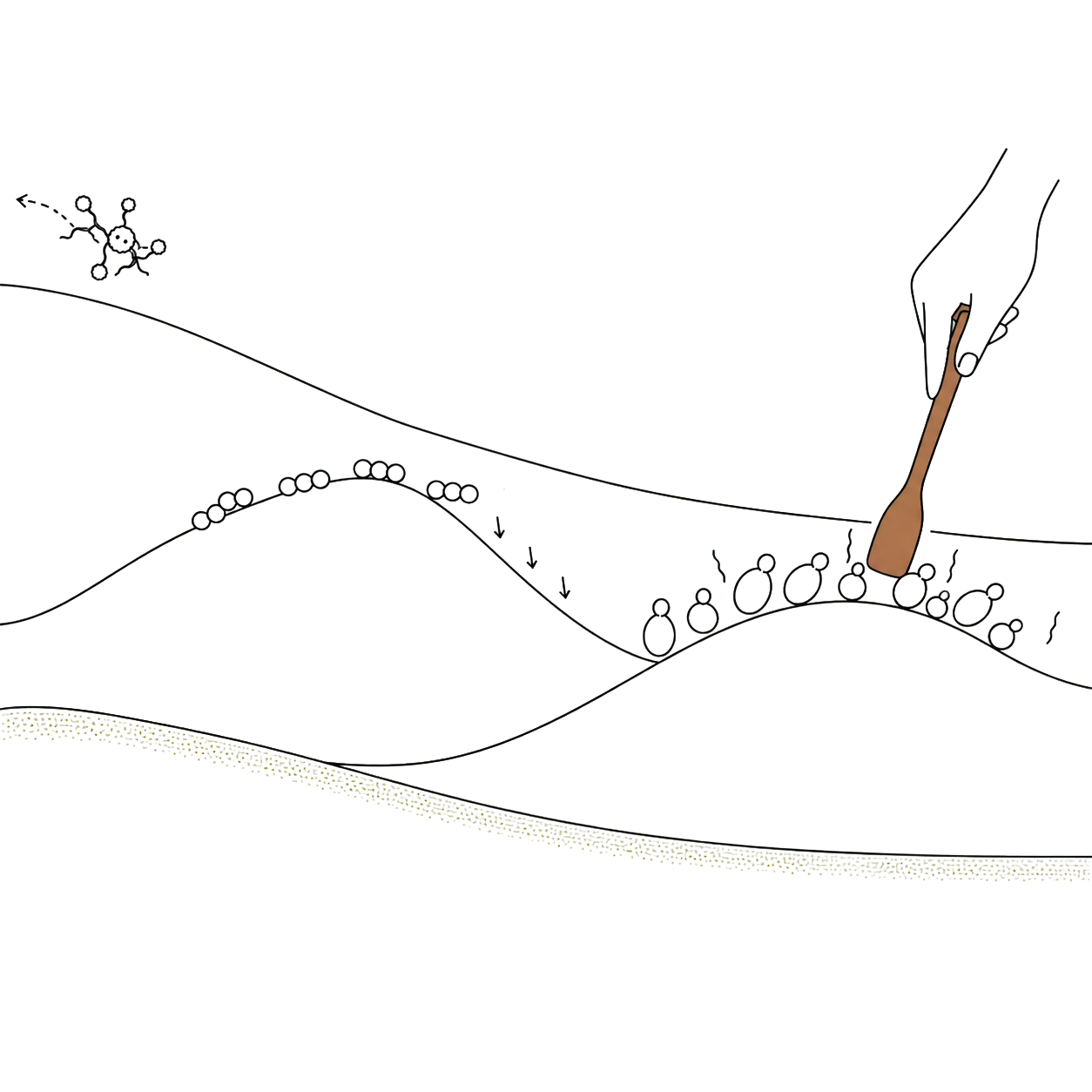
The week after you prepare it, you want to open the lid. Has anything changed? You open it, and the color has barely moved, and the smell is still boiled beans and salt. Take a taste and it is simply salty.
In the first month it looks as though nothing is happening. That is normal
What is going on at this stage is invisible cutting work. The enzymes the koji mold left behind on its way out are quietly making soybean protein and rice starch smaller. The amino acids and sugars cut free have not yet reached quantities the tongue can register. As for whoever makes the smell of miso, they have not even turned up yet.
So it looking as though nothing is happening is exactly according to plan. If anything, the thing to watch out for is opening the lid again and again out of anxiety. Every time you open it, oxygen gets to the surface, and you are thinning with your own hands one of the four walls raised in Chapter 4 — the shortage of air. All you have to do at this stage is leave it alone.
Months 2-4: lactic acid bacteria turn the place sour, and the yeasts arrive
As the enzymes cut on, sugars and amino acids build up in the miso. What starts moving first here is not the yeasts. Salt-tolerant lactic acid bacteria come first. You often see explanations written as "after the koji mold, the yeasts, and after that the lactic acid bacteria", but that is slightly off. The primary brewing literature agrees that lactic acid bacteria come first.
There are three reasons. First, miso just after preparing is at pH 5.7-6.0, which is close to the range salt-tolerant lactic acid bacteria prefer. Second, lactic acid bacteria multiply faster. Third, in brewery preparation, lactic acid bacteria are added at ten times the level of the yeasts, deliberately giving them the head start. Home-made miso adds neither, but the first two work the same way.
As the lactic acid bacteria produce lactic acid, the miso tilts slowly towards acidity, falling to around pH 5.0 at the finish. Only once this acidic environment is in place can salt-tolerant yeasts get to work. The yeasts are in charge of alcohol, and of that sweet, toasty aroma. Waiting six months is not because the umami is lacking but because the one in charge of aroma has not yet arrived.
Nobody is directing this order. Here is the interesting part: the environment the previous occupant changed becomes the entry condition for the next. The lactic acid bacteria stop multiplying because of the acid they themselves produced, and hand their seat to the yeasts. That said, this sequence is not absolute; under some conditions the yeasts suppress the lactic acid bacteria. That tangled relationship is a story for Chapter 4 of "Down the Fermentation Rabbit Hole".
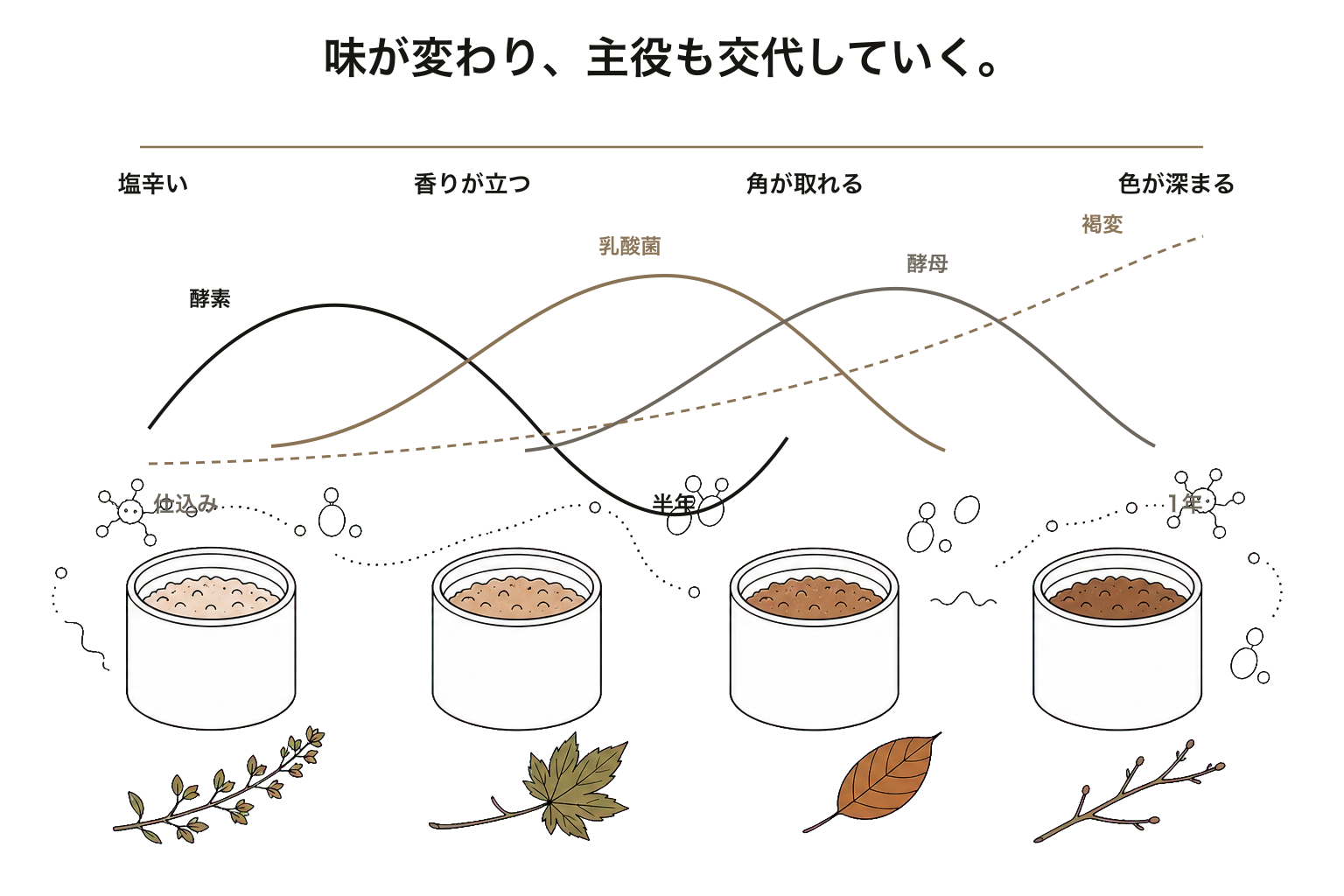
The labels in this illustration are in Japanese.
The months are only a guide. In a trial run under factory temperature control (28-32°C), lactic acid production had settled down in about 30-40 days. The peak of yeast growth was around the same time, and even within the same trial some strains peaked at 20-30 days and others at 40-50. Quite a spread. A room-temperature kitchen is slower than this, and preparing in winter slower still. The markings on the calendar stretch and shrink with temperature.
Tamari, a white film, deepening color: things that can appear without concern
Around this time, a few changes appear at the surface. First, a dark liquid rises. This is miso-damari, the moisture and the umami components seeping out as breakdown proceeds inside. It is not separation, and not a failure. You can mix it back in, or scoop it off and use it as a seasoning. If anything, a surface covered in liquid is shut off from the air, and this is one of the reasons for putting a weight on top.
White grains sometimes appear on the sides of the container or in the miso itself. These are crystals of the amino acid tyrosine. They are often mistaken for mold, but they are harmless. If the gritty texture bothers you, remove them; it is no more than that.
A white film may also form on the surface. This is film-forming yeast, an air-loving, salt-tolerant yeast. It is characteristically flat-spreading and wrinkled. It is said not to be harmful to the body, but it does damage the aroma, so skim that part thinly off. Something white that rises in a circle from a single point and becomes three-dimensional, like down, is mold. Tell them apart by shape, not color. The axis for that judgment is set out in Chapter 4.
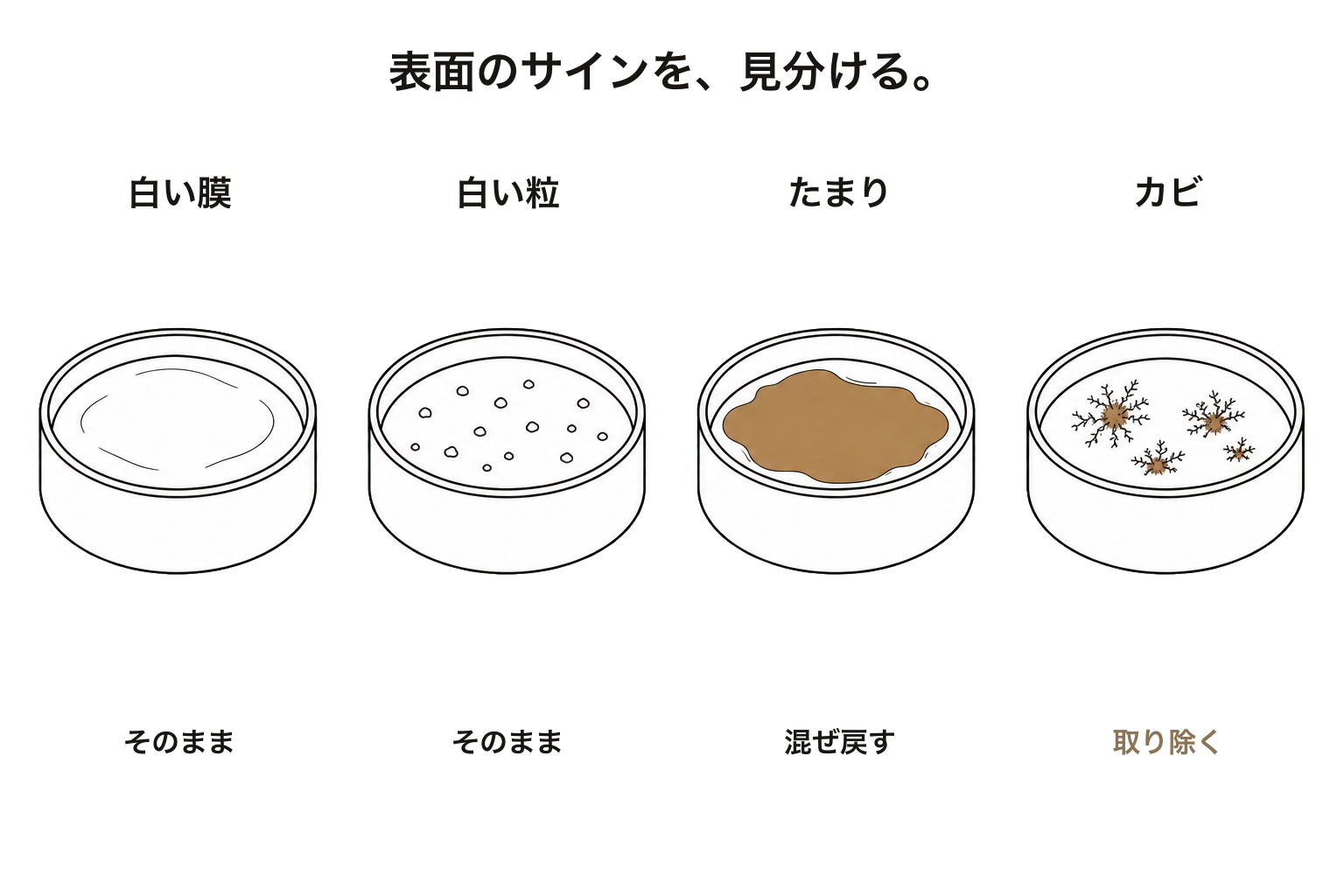
The labels in this illustration are in Japanese.
A word about tenchi-gaeshi, the top-bottom turning. The turning done in breweries has three aims: to even out the fermentation in a large tank, to let oxygen in and help the yeasts multiply, and to release the heat produced by fermentation. All three are problems that arise because the tanks hold several tonnes, and they hardly occur with a few kilograms at home. That is why Saitama Prefecture's guidance for home use has no turning step. You may do it, and you may not. It is not a task you have to do.
Being ready is not a state of the miso; it is something you decide
As it happens, there is no such thing as a completion date. Even for miso prepared in a brewery, the days spent maturing change with the koji-buai, the preparation of the soybeans, and the size and material of the fermentation tank. The short ones take about a month, the long ones years. Heating is stopped once the target color is reached — that is, it is people who decide where to stop. Fermentation does not stop by itself if left alone. Six months is a guide, not a deadline.
For tasting, three axes will keep you from getting lost. Has the edge of the salt rounded off? How long does the aftertaste stay? Does the aroma rise the moment you open the lid? Checking these three about once a month is plenty.
There is one slightly surprising thing. People often say that the longer you leave it the better it gets, but for aroma at least this only holds up to a point. HEMF, the component key to the sweet, toasty smell of miso, peaked at around 45 days of maturation in a test brewing held at 30°C, and decreased after that. Lowering the temperature to 25°C, or raising the salt to 15% (of the weight of the finished miso), pushes the peak back to around 75 days of maturation. Here too, the markings stretch and shrink with temperature and salt.
Free amino acids, the source of umami, move differently. For salty miso it has been reported that the longer the maturation and the deeper the color, the more free amino acids there are. What increases with long keeping is color, depth of body, toastiness — and umami. But the peak of aroma comes earlier than that. When you decide it is ready, these two will not point to the same day for you.
Once you like it, move it to the fridge. This is not an operation that stops fermentation but one that slows it down. In a test measuring the progress of coloring in rice miso over three months, it was about 1.3 times at 4°C, 2.2 times at 20°C and about 17 times at 37°C. Lower the temperature and progress becomes much gentler, but it does not become zero. Return it to room temperature and it starts moving again.
Everything here applies just as well to shio-koji and amazake
Koji is not an ingredient reserved for miso. Shio-koji uses the protein-cutting enzymes directly as a seasoning. Amazake has only the starch-cutting enzymes do the work, and is finished by holding it for about half a day at 55-60°C, the temperature the enzymes are good at. There is no changing of the microbial guard here. Shoyu-koji works the same way.
What differs is only what you have cut, and how many walls you raise. Miso stacks four — salt, acid, low oxygen and time — so it can stand at room temperature for six months. Amazake raises almost no walls, and in exchange it is finished within hours. A different number of walls means a different keeping time and a different way of storing it. Having made one batch of miso, you should be able to work this out for yourself by now.
This was preparation, not a record
What these six chapters have done is preparation. Knowing in advance what will happen inside, so that when you open the lid you can read what is in front of you. That was this page's job.
Joining six months of temperature and observations into a single line, and seeing when it will be ready — that is not work for a browser. A single point measured on its own means little; it only becomes a clue once it is a line. From there on it is the app's department.
One last thing. Your miso differs from last year's not because fermentation is uncertain, and not because the microbes are capricious. It is not that it cannot be known; it is that it is not yet visible. The means of seeing are waiting for you in "Down the Fermentation Rabbit Hole".