
Fermentation Basics — 05
You decide only four things, and the work ends before the lid goes on
Reading the steps as interventions rather than as actions
About 9 min read
A sheet of instructions for making miso is usually a numbered list of actions. Soak, cook, mash, mix, pack. Each finishes in a single line, with no word about why.
When the reason is not written down, you cannot judge whether a step can be skipped. Nor can you tell what would happen if you swapped the order. And the worry that it must need special equipment or a special place usually starts here too.
So let us reread the steps not as actions but as interventions. There are, in fact, only four things a person can touch. Once you can see which of them each step is setting, you can say in your own words why the order is what it is, and which steps cannot be skipped.
You can touch only four things: temperature, salt, water and time
In making miso, these four are what a person holds. Everything else belongs to the microbes and the enzymes.
Temperature works in two ways at once, because it sets both how fast microbes multiply and how fast enzymes cut. Higher is not better, though: raise it too far and the enzymes lose their shape and do not return. Salt decides who gets to stay. Rather than a dial for flavor, it is in practice a variable we have decided not to move. The presets this site gives have fixed ratios.
Water is the size of the space in which the reactions run. The more there is, the more readily the breakdown proceeds, but for the same amount of salt, the salt is that much more diluted. In reduced-salt miso trials, raising the water from 46% to 48% alone was reported to have turned a batch too sour (Miyagi Prefectural Industrial Technology Institute). And time is not simply waiting; it is the very amount by which the reactions have run.
| Variable | What you decide | What changes when you move it |
|---|---|---|
| Temperature | where you keep it, and cooling before mixing | how fast it goes. Raise it too far and the enzymes are destroyed and do not come back |
| Salt | weight % of the finished weight (the ratio is fixed) | who can survive. The thickness of the defense |
| Water | the amount of seed water, how far the soybeans are cooked | firmness and how readily it proceeds. More water dilutes the effect of the salt |
| Time | when you start eating it, where you keep it | how far breakdown and browning go |
The salt percentage is a weight percentage of the weight of the finished miso. A standard home formulation is roughly 10-14%, and salty rice miso falls at 11-13%.
Three ingredients, and the tools you already have in the kitchen
Three ingredients: soybeans, rice koji and salt. For tools, a pot, a bowl, some way of mashing and a container with a lid are enough. No dedicated equipment is needed. As for a weight, public guidance for home use puts it at around 20% of the total ingredients, and says it can be left out for small amounts (Saitama Prefecture). Quantities can be worked out from the fixed-ratio presets (calculator page; no account needed).
For hygiene: wash your hands, wipe the container with boiling water or alcohol, and let it dry. That is far enough. It does not need to be sterile. As we saw in Chapter 4, the defenses are stacked several deep. That said, disinfection is not all-powerful. Boiling water and alcohol work on mold spores and yeasts, but not on heat-resistant spores (killing spores takes the equivalent of 120°C for four minutes). Disinfection is the measure against mold; against spores, salt and water content are the defense. Separating the roles takes a great deal of the guesswork out.
Read the steps as interventions, not as actions
Preparing a batch divides into seven steps. For each one, we add which variable that action is setting. The detailed handling, with photographs, is on the instructions page, so here we look only at the reasons.
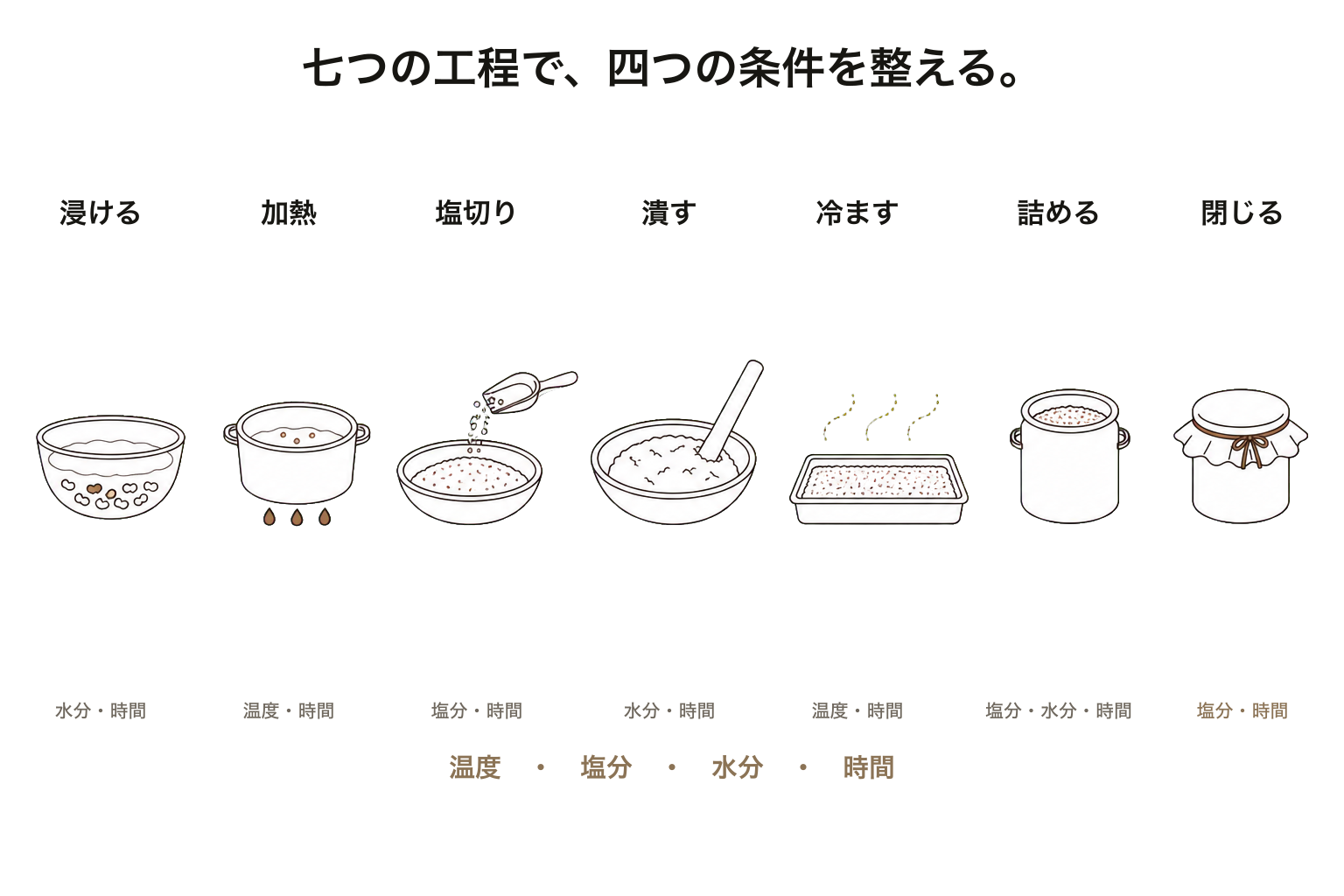
The labels in this illustration are in Japanese.
- 01
Soaking — water
You are putting water back into the dried soybeans, right to the center. At room temperature, 12-16 hours is the guide. But how fast they take up water varies a good deal with water temperature. A test measuring the time to reach near saturation found about 14 hours in water at 30°C, about 24 hours at 20°C and about 42 hours at 10°C. With cold winter water, one night may not be enough. If the water has not reached the center, no amount of cooking afterwards will get rid of the hard core.
- 02
Heating — water and time
This softens them enough to mash and at the same time unfolds the folded soybean protein. The unfolded chains are easier for the enzyme scissors to get into. Solids are lost differently depending on whether you boil or steam: about 5% with steaming, around 10% passing into the cooking liquid with boiling.
- 03
Mixing the koji and salt first — salt
This step is called shiokiri. About nine tenths of the salt you need is mixed into the koji beforehand. It is partly so as not to give the koji any time before it meets the salt, and partly so that no low-salt pockets are left once the batch is packed.
- 04
Mashing — time
This is an operation to increase the area over which enzymes and ingredients touch. The larger the pieces, the longer it takes to cut through to the center. The mashing itself is easier while they are still hot.
- 05
Cooling to body temperature — temperature
This is what keeps you from destroying, on the spot, the enzymes that are meant to work for the next six months. The guide is body temperature (about 35°C), and 40°C at the latest. Of every step in preparing a batch, this is the classic example of a mistake that cannot be redone.
- 06
Pressing the air out and packing — the wall of low oxygen
You roll it into balls, throw them into the container and press them down so there are no gaps. This physically reduces the space available to microbes that like air. A weight on top is an extension of the same idea.
- 07
Closing it and waiting — time
From here on, how far it goes before you eat it is a person's decision. The more often you open it, the less the pressing-out of air means.
Let us write a little more about the fifth. The familiar explanation that you cool it because heat kills the koji mold is, in fact, slightly off. Given the salt and water conditions, the koji mold cannot multiply inside prepared miso in any case. What is being protected is not the life of the microbe but the shape of the tools it left behind.
Enzymes are tools made of protein, so once heat destroys their shape it does not come back. The danger is roughly from 55°C upward. And it is not a matter of "it breaks at this temperature" but of how long it spent there. For a starch-degrading enzyme embedded in a food matrix, activity falls to a tenth in about four to five hours at 55°C, about an hour at 60°C and about five minutes at 70°C. The step of cooling to body temperature can be understood as a decision that leaves ample margin below 55°C.
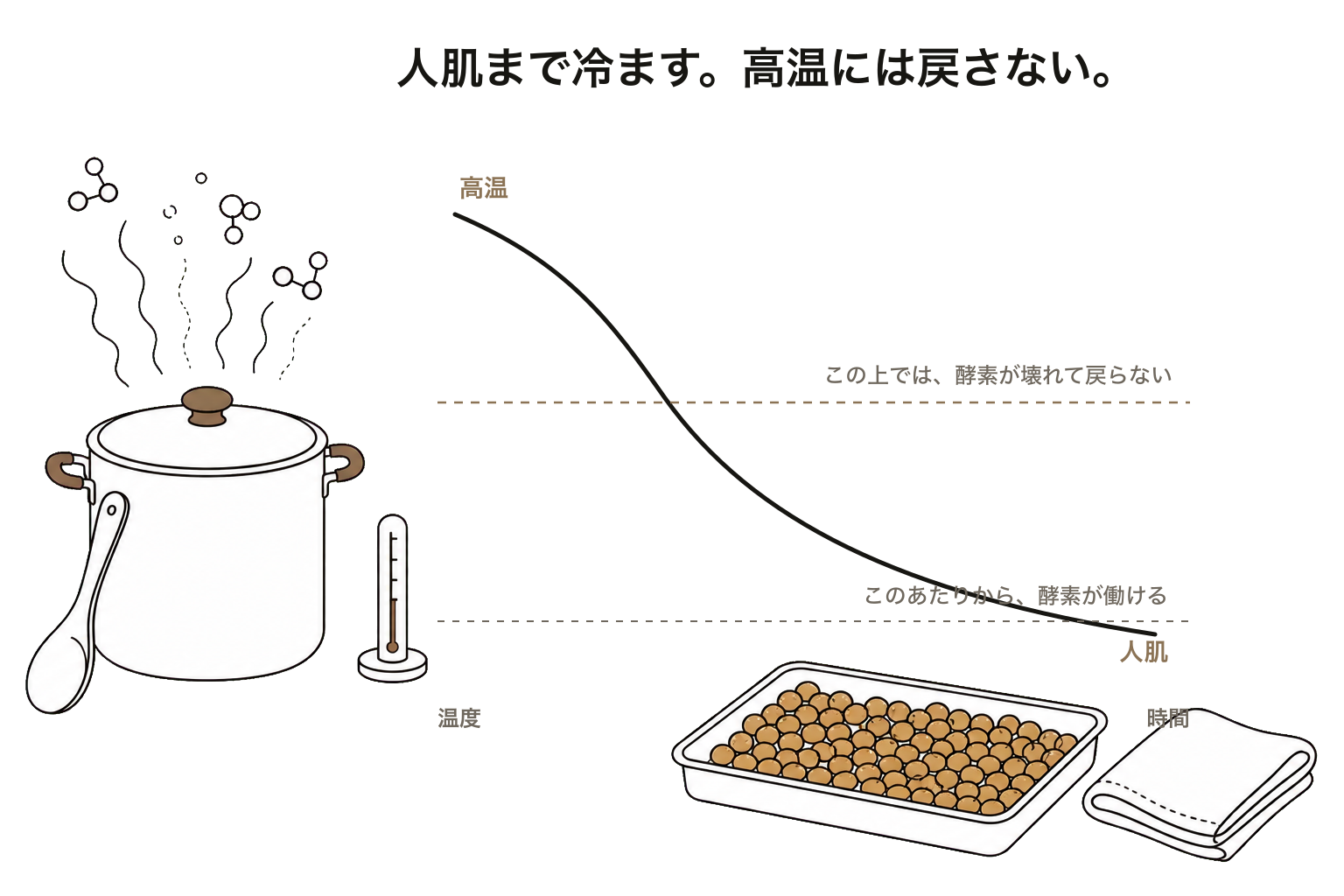
The labels in this illustration are in Japanese.
The last piece of design is deciding where to keep it
The last variable, decided just before the lid goes on, is where to keep it. The temperature of that place all but decides the color and the progress six months later.
Figures from a storage trial make an easy example. Reduced-salt miso at 9% salt was divided up after completion and kept at different temperatures. In the 20°C group the lightness value fell from 15.0 to 7.4 over four months, a clear deepening of color. At 15°C it was 11.9 and at 5°C 14.1, barely moving at all (Miyagi Prefectural Industrial Technology Institute).
Since this was a low-salt miso kept in its finished state, the figures do not transfer directly to home-made miso maturing. Even so, the direction — that the temperature where you keep it governs how it proceeds — does not change. An under-floor cupboard and a heated living room will give you different things from the same formulation. Put it in the fridge and progress comes close to stopping.
Keep it at room temperature out of direct sunlight, for six months to a year. Human involvement ends here. What is left to do is looking, not touching. That your hands are tied is not a shortcoming; it is the structure of this way of making things, which concentrates the design before you prepare the batch.
Write three things on the label: the date, the formulation and the place
Finally, one piece of work for the sake of the next batch. On the paper you stick to the container, write three things.
- the date you prepared it
- the amounts of soybeans, koji and salt (adding the salt % of the finished weight makes the next comparison easier)
- where you put it
And next time you prepare a batch, change one thing only. More koji, a different place, a longer wait before you start eating. Change two or more at once and, when the result changes, you will not know which one did it.
The same miso never comes twice. But "cannot be reproduced" and "cannot be controlled" are different things. As long as you know which of the four you moved, you can genuinely move the direction. Note that a tool for drawing six months of temperature and observations into a single line is not on this page. That is the app's department.
With the lid closed, this chapter's work is done. Over the following six months, the lead roles inside the container quietly change over.