
Fermentation Basics — 01
Fermentation is leaving the remaking to microbes
The first question — what is fermentation, really?
About 9 min read

Look around your kitchen and you will find any number of things that came out of fermentation. Miso, soy sauce, vinegar, mirin, yogurt, cheese, bread, beer. They are all this close at hand, and yet, if someone asks "what is fermentation?", the answer suddenly becomes hard to give.
And when you first think about making miso yourself, what usually comes to mind is the worry. Will it really not go bad, sitting in the kitchen for six months? What is the difference between going bad and fermenting? And looking after something for half a year — that hardly sounds like something you could keep up.
This chapter answers those three in order. To give away the conclusion first: fermentation is a technique for leaving the remaking to microbes, the line between it and spoilage is set by conditions you can measure, and the part where you move your hands takes one day out of the six months.
Fermentation is handing ingredients to microbes and having them turned into something else
Fermentation is handing food over to microbes you cannot see, and having it remade into something else. Let us put that one sentence down first.
Here is the interesting part. Seen from the microbes' side, this is simply a meal. They break down soybeans and rice, take in what they need, and put out what they could not use. What comes out becomes sourness for us, and aroma, and alcohol. Fermentation is a meal for the microbes, and seasoning for people.
So fermentation is not spoiling but remaking. Substances that were not in the original ingredients appear afterwards, newly made. Boiled soybeans on their own have not a trace of the smell of miso.
Miso, soy sauce, vinegar, sake, pickles, bread, cheese, yogurt, beer, wine. The ingredients, the countries and the methods are all different, but the frame of what is happening is the same. Microbes break the ingredients down, and people eat the result. We will not explain them one by one in this chapter. Just take home that they all stand on the same frame.
Let us untangle one thing that often gets said. The international definition of fermented foods (ISAPP, 2021) is "foods made through desired microbial growth and enzymatic conversions of food components", and living microbes remaining in the food is not part of the condition. There are almost no living microbes in bread, or in pasteurized soy sauce. They are fermented foods all the same. The worth of fermentation lies not in microbes surviving, but in the ingredients having been remade.
Miso is made from soybeans, koji, salt and time
Before the theory, let us hand over what actually gets mixed with what. As it happens, the ingredient list for miso is surprisingly short.
Soybeans are the source of umami: soybean protein is cut apart and becomes umami. Koji is the tool for breaking things down — rice with koji mold grown on it, and what is inside are tools, that is, enzymes. Salt is the filter that sorts; it decides who is let through and who is shut out. And time is simply the amount by which the reactions have run.
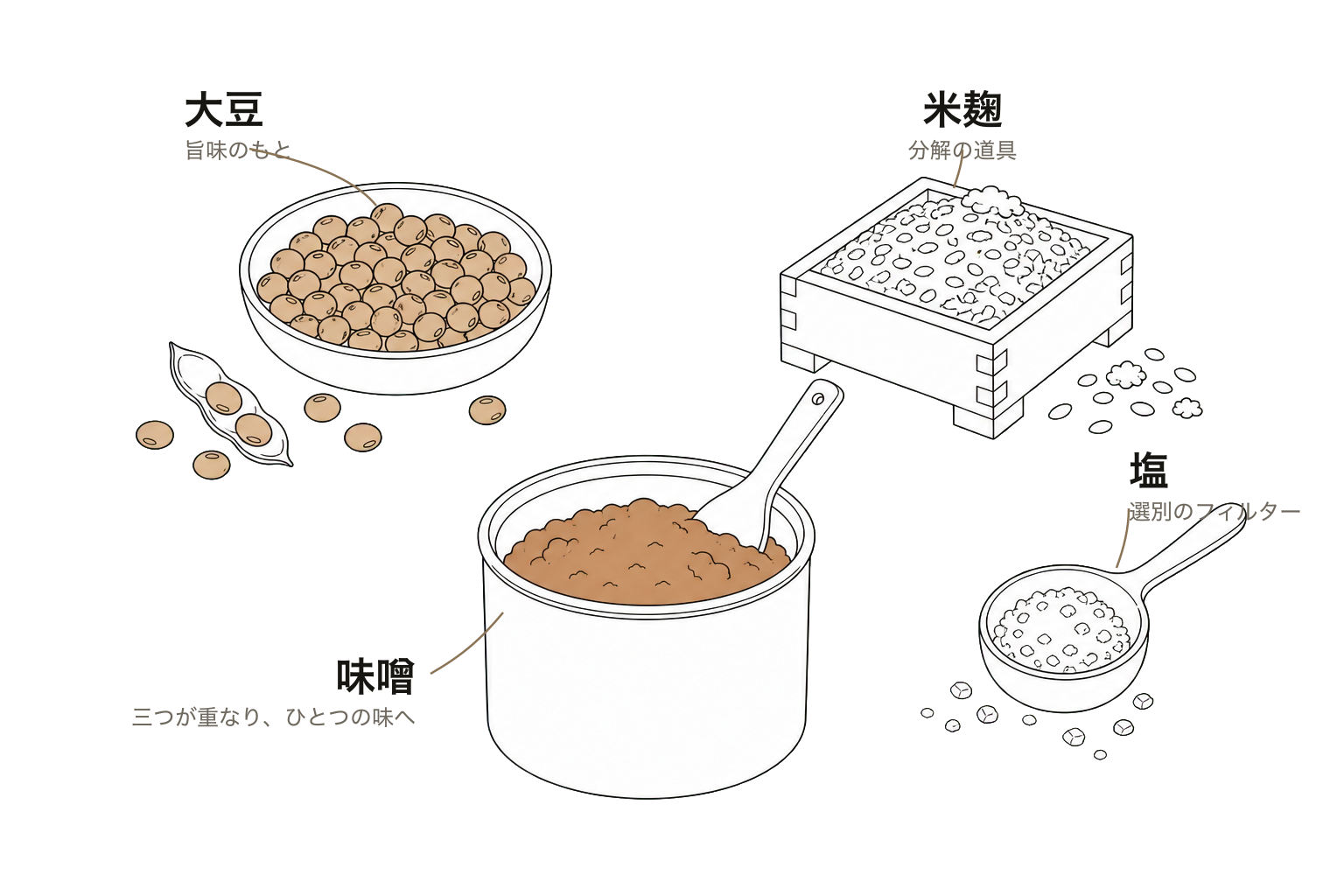
The labels in this illustration are in Japanese.
The three in the figure, plus the invisible fourth of time — soybeans, koji, salt and time — make the skeleton of the six chapters you are about to read. Why koji is a tool is Chapter 2; how soybeans turn into umami is Chapter 3; what salt is shutting out is Chapter 4; and what happens during the time is Chapter 6.
We will not put quantities here. The ratio between soybeans, koji and salt is fixed, so once you say how much you want to make, it can be worked out. The quantities for basic miso can be produced on the calculator page. No account is needed.
What separates spoilage from fermentation is which microbes win
If Bacillus subtilis grows on steamed soybeans you get natto, and we call that fermentation. Leave boiled beans standing, let the same Bacillus subtilis grow, and if it turns stringy and smells of ammonia, this time we call it spoilage. The microbe, and the reactions taking place, are in fact the same kind of thing.
The ones doing the naming are us. Of the workings of microbes, we call the ones useful to human life fermentation, and the harmful ones spoilage. This is not a folk saying; it is written plainly in the Journal of the Brewing Society of Japan.
There is just one thing to be careful about as we take a step on from here. That the names are settled by human convenience, and that safety is settled by human convenience, are entirely different statements.
Which microbes can survive is decided by how salty it is, how acidic it is, how much water the microbes can use, and the temperature. These work quite apart from how anyone feels. There is a real example. Salted squid (shiokara) was originally a preserved food made at 10% salt or more, but as salt reduction went on, food poisoning from Vibrio parahaemolyticus occurred in shiokara that had come down to 1.8-2.4% salt. Vibrio parahaemolyticus grows best at 2-3% salt and cannot grow at 10% or more. What was setting the line was not human intention, but the salt.
Having come this far, we can also set aside the saying that fermentation is one step short of spoilage. Miso that has been well prepared is not balanced on a knife edge. Miso that was at pH 5.7-6.0 when prepared drops to around 5 as it matures, and the water available to microbes decreases as well. Neither spoilage bacteria nor food-poisoning bacteria can multiply there. It is not the middle of a tightrope walk; it is where the walk arrives. How it gets to that state is what we will go through, one by one, in Chapter 4.
You move your hands for one day only
"It takes six months" sounds as though you will be tending it for six months. That is not how it goes.
The evening before, you put dried soybeans in water to soak. Soybeans take 12-16 hours to take up water, so this finishes while you are asleep. The next day you cook the beans, mash them, mix in salt and koji, pack it into a container and put the lid on. That is the end of it. In half a day to a day, all of your work is done.
The remaining six months are not a period of doing nothing. They are a period of having work done for you. Keep it at room temperature out of direct sunlight; at home, six months to a year is the usual guide. How fast it goes is strongly swayed by temperature — factories drop it below 15°C to stop maturation altogether. So deciding where to put it turns out to be your last job.
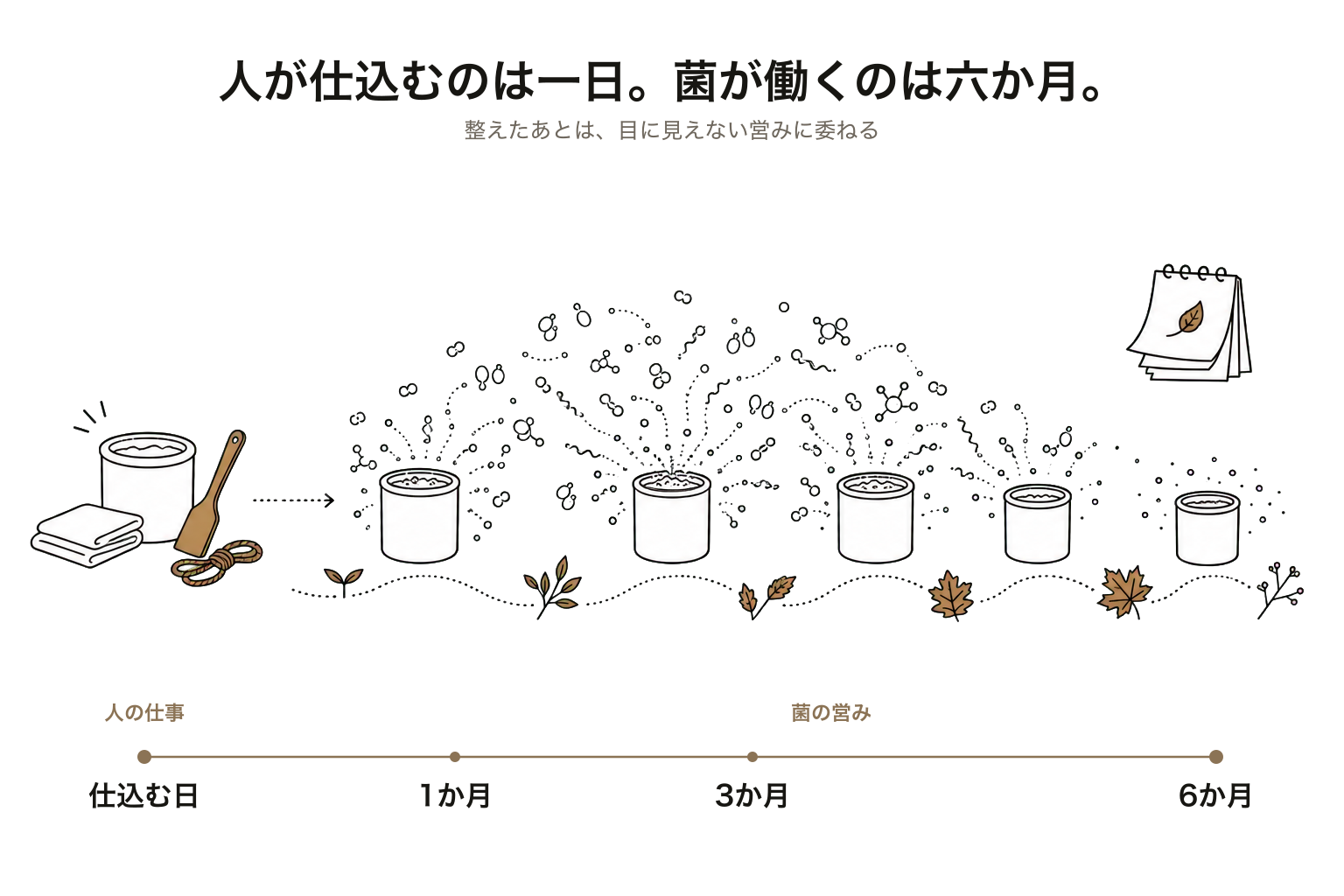
The labels in this illustration are in Japanese.
These six chapters take you as far as making one batch of miso
When you finish these six chapters, what you are left with is not "I can talk about fermentation" but "I can make a batch of miso". Here, set out in advance, is what each chapter takes care of.
- Chapter 1 (this one) — what fermentation is, and how it differs from spoilage.
- Chapter 2 — who is doing the work. What koji really is, and what stays behind after you prepare the batch.
- Chapter 3 — why it comes out tasting good. Where the umami and the sweetness come from.
- Chapter 4 — why it does not go bad. Why it can sit at room temperature for six months.
- Chapter 5 — what you yourself do. Reading the steps from the reasons rather than the actions.
- Chapter 6 — what is going on inside while you wait. How to decide when it is ready.
Let us also say in advance what these six chapters will not cover. We do not write about health effects or nutritional value on this page. There is research on fermented foods and health, but our policy is not to assert more than can be said about ordinary foods. The history of miso, and the differences between regional misos, are kept in the reading series and the glossary.
Now, let us go and meet the first of them: the white fuzz covering the grains of rice.