
Fermentation Basics — 02
The workers are not the microbes but the enzymes they left behind
Aspergillus oryzae, and what it leaves behind
About 10 min read
Open a bag of rice koji and inside is rice that looks dusted with white powder. Break it apart with your fingers and you can see that the grains are joined to one another by a thin fluff. This is koji.
On the back of the bag it says "koji mold", and explains that it is, in fact, a mold. Most people stop right here. Is it really all right to mix a mold into something you are going to eat for the next six months?
From here we will zoom right in on koji. At the end of that we arrive at the least intuitive thing about miso: the moment you prepare the batch, the koji mold leaves the stage. And fermentation carries on for six months regardless.
Koji is the only fermentation you can see with your eyes
Of all the microbes involved in miso, the only one whose form is directly visible is the koji mold. Lactic acid bacteria are about 1 micrometer, and even yeasts only 3-10 micrometers, far too small for the naked eye. Without a microscope you would not even know they were there.
The white fuzz of koji is not the microbe itself. It is a dense mass of branching hyphae. A single hypha is around 5 micrometers thick, about a twentieth of a human hair. Only when countless numbers of them bundle together does it look white.
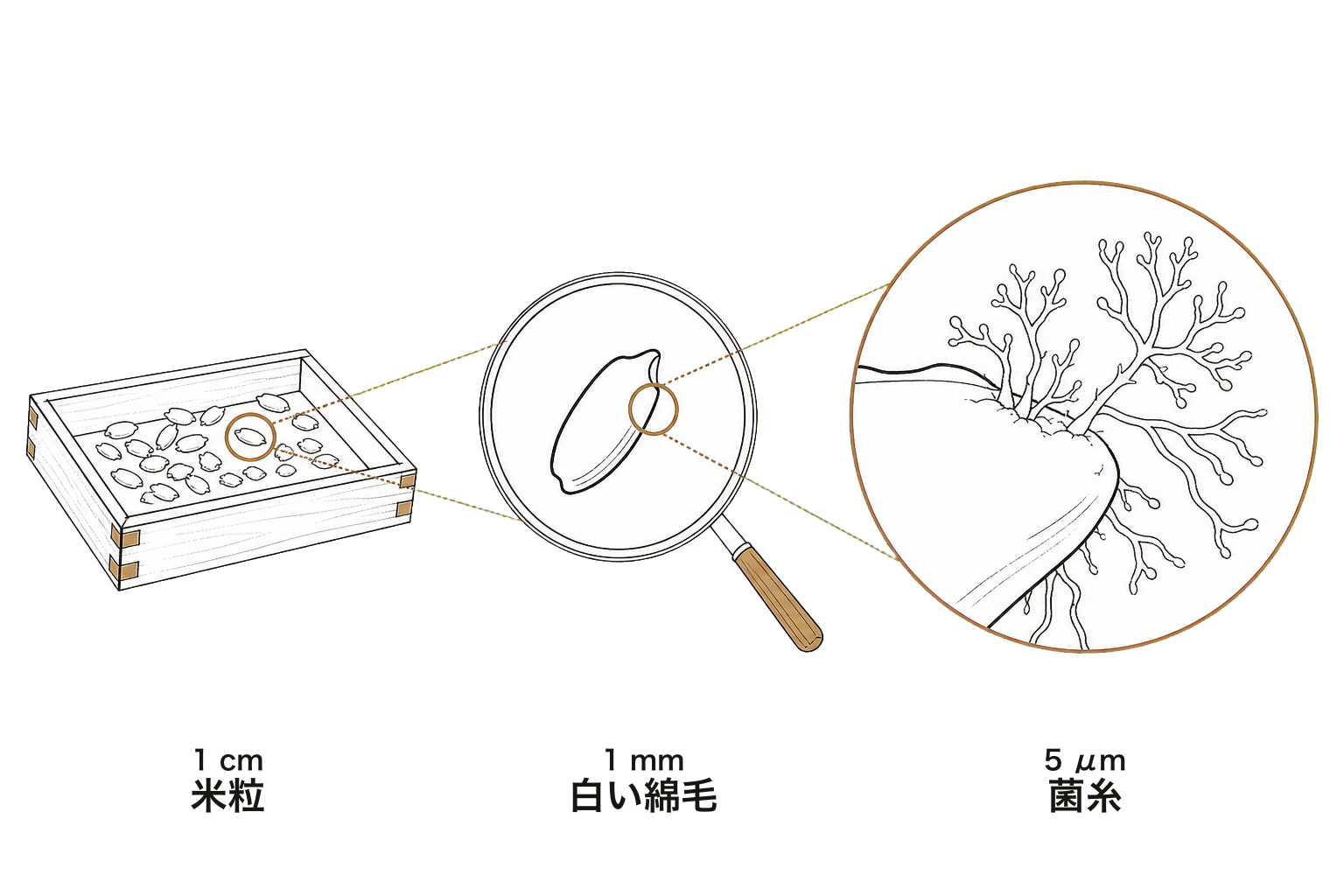
The labels in this illustration are in Japanese.
The hyphae extend at their tips, creeping across the surface of the rice grain and burrowing inside as well. Koji is the one place where the visible side and the invisible side are directly connected. This mold is called Aspergillus oryzae.
This is a lineage that people have made unable to produce toxin
Bracing yourself at the word "mold" is a perfectly correct reaction. Right next door to Aspergillus oryzae is a species that produces a mold toxin called aflatoxin. The two match at roughly 99.5% in their protein-coding regions, close enough that some have proposed they are ecotypes of the same species. The relationship between wolves and dogs may be a useful picture.
So why does Aspergillus oryzae not produce the toxin? Not because it lacks the genes. It has them, but the blueprint is torn in several places. A study of 196 domestic yellow koji strains found that about 45% had lost most of the toxin gene cluster to a chromosomal break, and the broken ends were structured so that they cannot be put back. In the remaining 53% or so where the blueprint survives, the gene that gives the order barely functions, and even if it did, its partner protein is broken. Broken twice and three times over is closer to the truth.
This is not a safety that nature guaranteed. It is thought to be the result of people selecting non-toxic individuals over a very long time. Domestication, in effect. In Japan that selection has been carried out since the Muromachi period by tane-koji makers, known as moyashi-ya. As a business selling microbes themselves it is among the oldest anywhere in the world, and there are now about six such firms in Japan. Miso breweries and sake breweries alike make their koji from starter koji bought there.
Microbes do not bite their food. They put scissors outside and have it cut for them
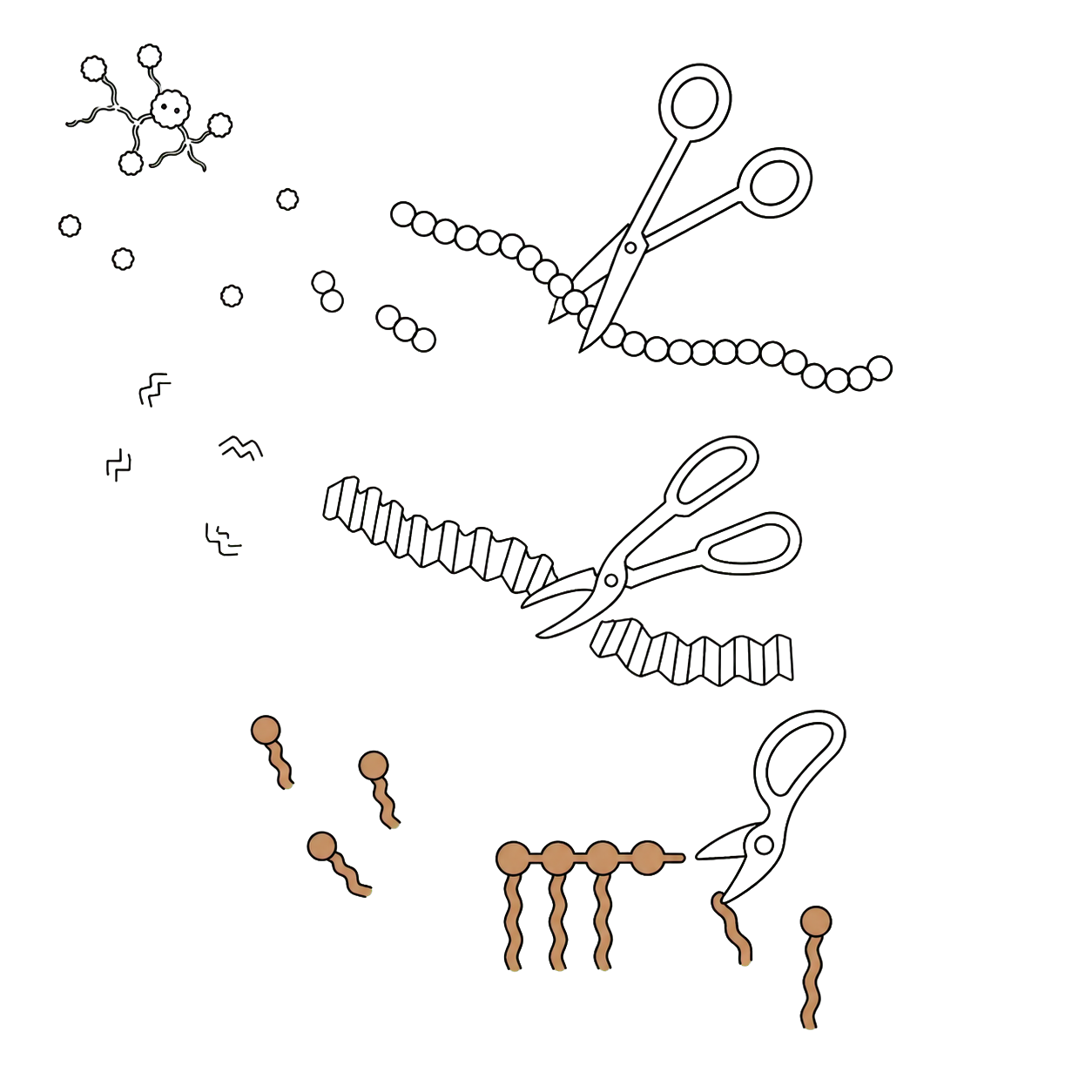
Aspergillus oryzae has no mouth. Instead it releases enzymes outside its own body. The enzymes cut the ingredients up finely on the outside, and it absorbs only what has become small enough. This is called extracellular digestion.
Enzymes are often likened to scissors. Since they really do cut molecules, the metaphor is one of the less misleading ones. But each pair of scissors has a fixed partner it can cut. This is their substrate specificity. Proteases cut only protein, amylases only starch, lipases only fat.
What makes Aspergillus oryzae special is that it sends out many kinds of these scissors, and in great quantity. Its genome, sequenced in 2005, has 12,074 genes and is larger than its close relatives, and what had increased were mainly the genes for degrading enzymes it secretes outside. The genes for protein-cutting enzymes alone number over a hundred. Here is the interesting part: the very format of growing it on steamed rice matters too. Some of the enzymes responsible for saccharification are produced at only about a twentieth the level in liquid culture compared with steamed rice.
Koji, in other words, is an ingredient loaded with enzymes. Making koji is not raising a microbe; it is stockpiling scissors.
The moment you prepare the batch, the koji mold leaves. Fermentation carries on anyway
When you prepare the batch, the world of the koji changes completely. Salt comes in, and the oxygen goes as it is pressed into the container. Aspergillus oryzae is a mold that needs oxygen, so it cannot multiply inside miso at around 12% salt.
What actually happens is a little more dramatic than leaving. After the batch is made, the hyphae begin to dissolve themselves. A study following soy sauce moromi reported that both the number and the length of hyphae had clearly decreased by day seven. Even after Aspergillus oryzae disappears, the breakdown of the ingredients continues. What carries it on are the enzymes left behind in the koji.
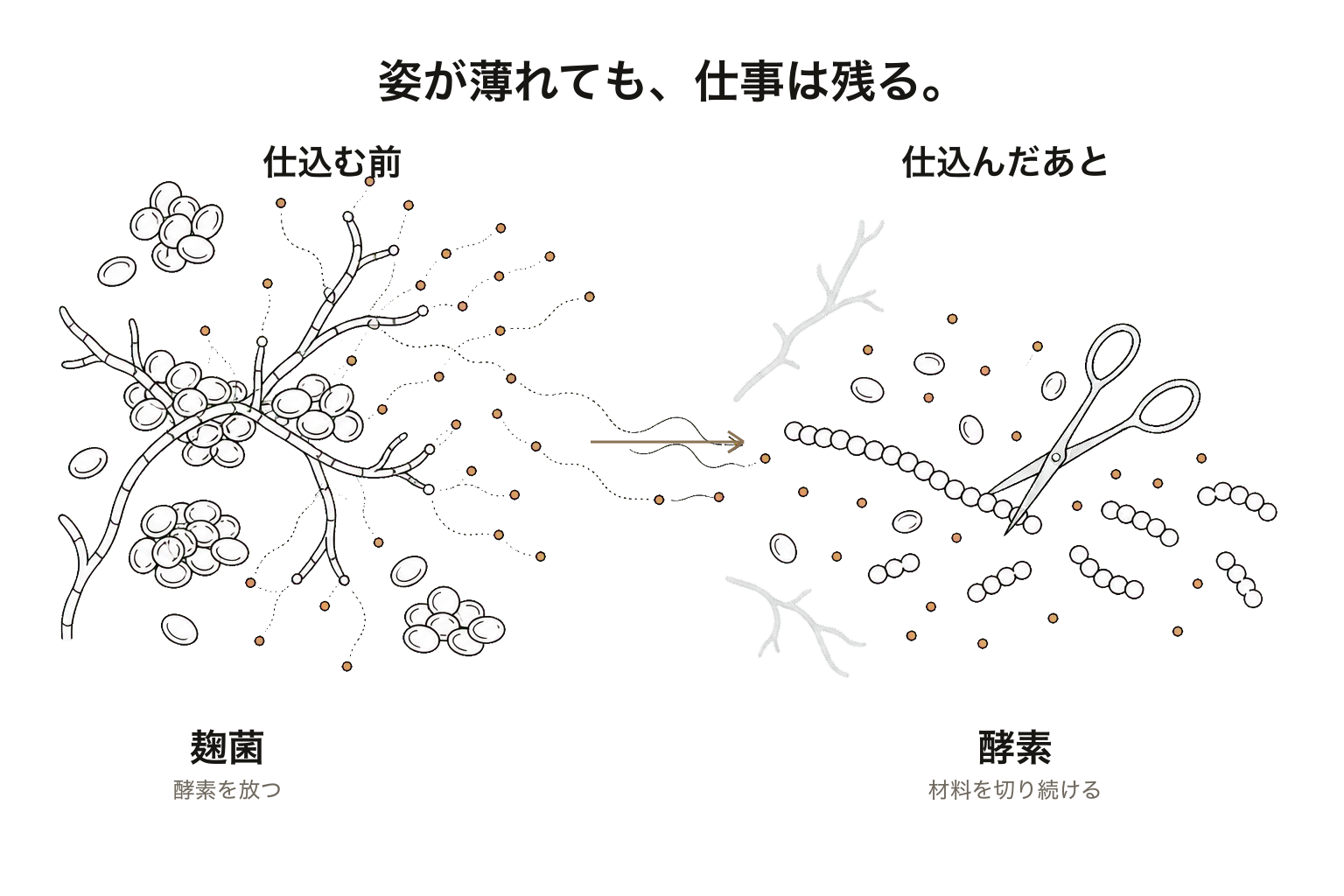
The labels in this illustration are in Japanese.
And the flavor keeps changing. Enzymes are not living things but molecular tools made of protein. What is more, most of them are not destroyed inside miso. In a test held at 30°C and 13% salt for 60 days, six of the nine enzymes measured kept high activity: about 95% for three protein-cutting proteases, 97% for glucoamylase, and even 84% for alpha-amylase.
There is an exception, though. In the same test, only the three leucine aminopeptidases fell to 33-57% over 60 days. These are the enzymes that take amino acids off the end of a peptide one at a time, producing directly the free amino acids that become the source of umami. The original paper too regards the effect of this decline on flavor as large. Of the tools stockpiled, the ones tied most directly to umami are the first to dwindle away.
Everything so far has been about enzymes. But that does not mean the inside of the miso becomes sterile. Salt-tolerant lactic acid bacteria and yeasts survive and go on producing lactic acid, alcohol and esters. After Aspergillus oryzae withdraws, the baton for breakdown passes to the enzymes, and the baton for building aroma passes to the lactic acid bacteria and the yeasts.
So please do not mix it while it is still hot
Every set of instructions says to cool the mashed soybeans to body temperature before combining them with the koji. The reason given is usually that the koji mold dies if it is hot. The first half is true — Aspergillus oryzae cannot grow above 44°C. It is a common explanation, but as a reason it is slightly off the mark, because the koji mold cannot live in the salt in any case.
What you are protecting is the enzymes. Enzymes are proteins, folded into a fixed shape. Because that shape exists, the partner molecule fits snugly into it. Warm them and the molecules move more, so the cutting speeds up. But warm them too much and the folds come undone, and they never return. This is called inactivation.
What matters is not "at what temperature does it break" but "how long was it held at what temperature". For alpha-amylase from Aspergillus oryzae, the time taken for activity to fall to a tenth was measured in buffer at about 25 minutes at 55°C, about 9 minutes at 60°C, about 4 minutes at 65°C and about 2 minutes at 70°C. A rise of just 15 degrees cuts the time it lasts to roughly a tenth. Inside miso or soybeans it is thought to last longer than this, but even so, touching 60°C for a minute and sitting at 60°C for an hour are entirely different things. In a test digesting 13% salt shio-koji for 96 hours, alpha-amylase activity was well retained at 45°C and almost gone at 55°C.
So the danger zone begins at roughly 55°C. The instruction to cool to body temperature reads as a practice that leaves plenty of margin below that. Cooling is only a matter of waiting, but overheating cannot be taken back. Of every step in preparing a batch, this is the only one where a mistake cannot be undone. Which also means that once you have watched out for this, you can take the rest calmly.
The reason there is so little for you to do over the six months is that most of the work finishes before the lid goes on. What a person does is to get tools that will work for six months into the container without breaking them. So what do those tools cut, and what becomes flavor? Neither the umami nor the sweetness is added from outside.