
How Far Fermentation Reaches — 03
The history of miso is newer than you think, and vaguer than you think
Telling the kinds of evidence behind a date apart
About 10 min read
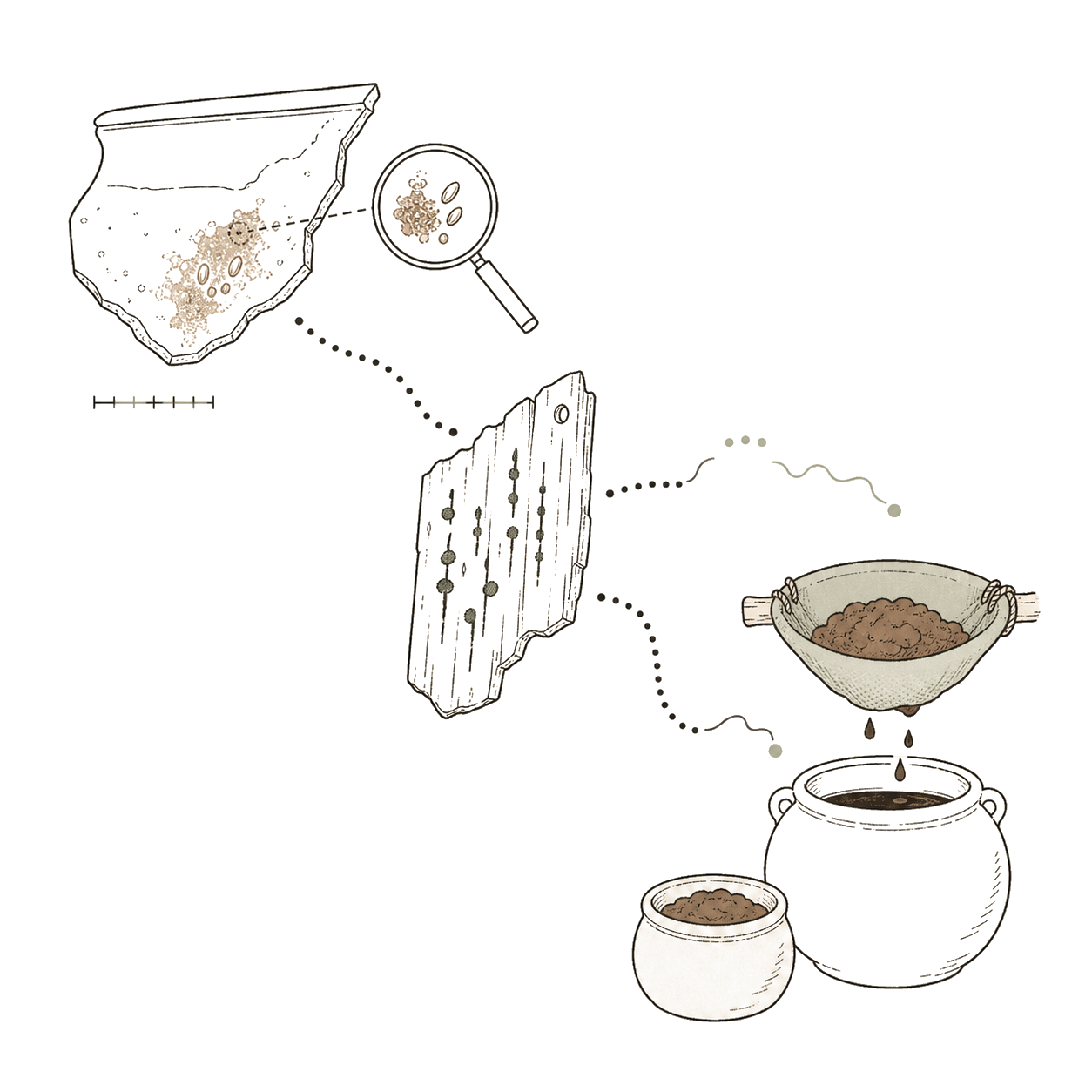
Bags of miso and brewery introductions often carry a number of years. "1,300 years of history." "Four thousand years of China." Seeing them, you feel a certain weight.
Trace them to their sources, though, and the ground is rather soft. A law whose text has been lost, a classic whose date of compilation moves by centuries, a pedigree written up in the Meiji era. None of it is a lie, but the degree of certainty is not the same.
This chapter is not a chronology but an account of how to tell dates apart. Get into the habit of first asking "what is this date based on?" and the lineage of miso comes into view far more quickly.
Dates come in kinds of evidence
The evidence behind dates in fermentation falls into three broad kinds: chemical analysis of residues in excavated vessels, use-wear and residues on tools, and records written in words. Even under the same word "oldest", the three differ in meaning and in precision.
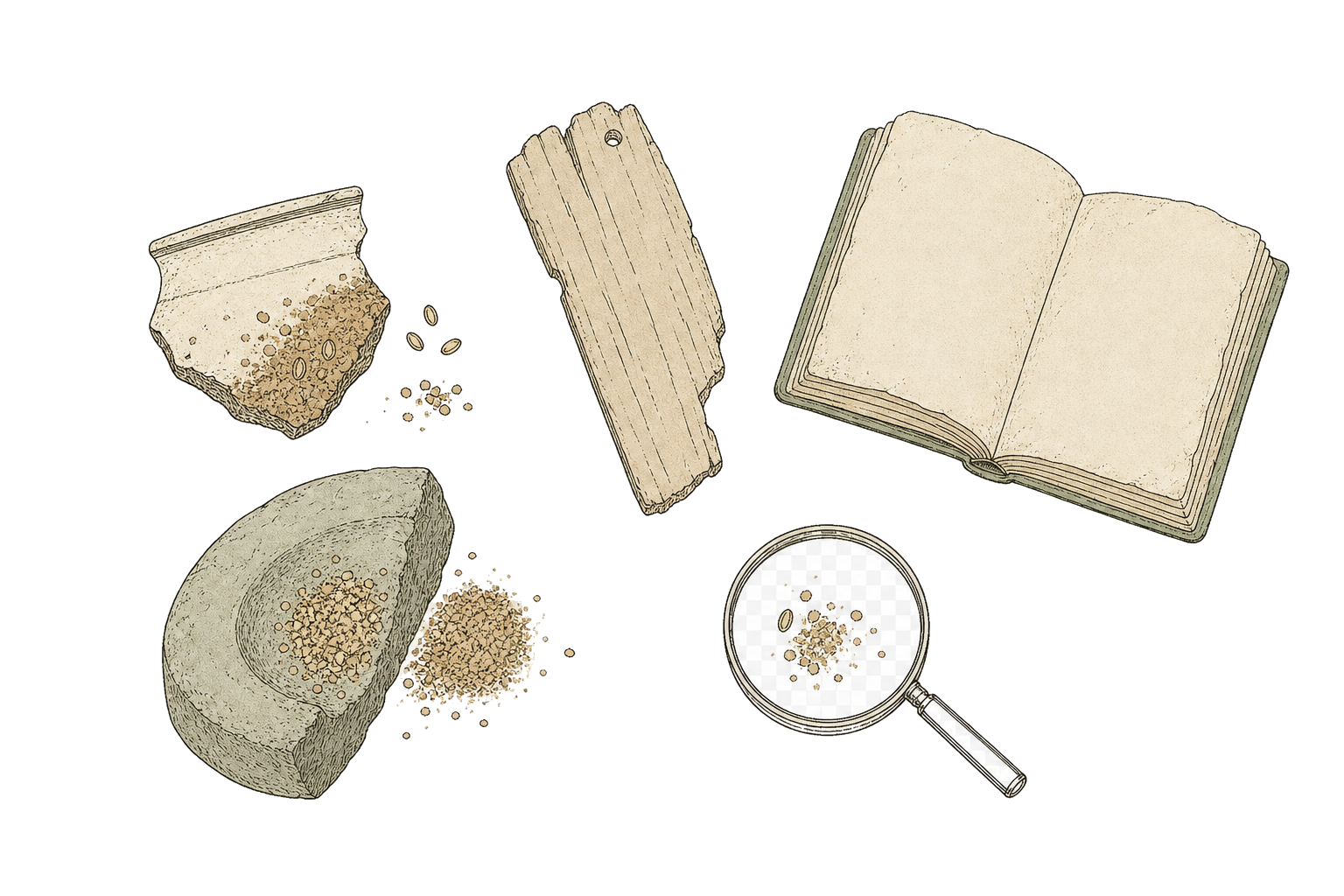
The labels in this illustration are in Japanese.
Chemical analysis shows in molecular form what was in a vessel. It is strong evidence, but the account leans toward the components that survive well. Use-wear and residues show how a tool was used: the process is visible, but what was produced can only be inferred. Written records are the most concrete, but the year something was written is not the year the practice began.
That is the biggest pitfall. The date of a practice and the date of a record are different things. The Hymn to Ninkasi, which sings of Sumerian beer brewing, survives on a clay tablet from around 1800 BCE, but beer did not begin in that year. Records generally appear well after something has settled into a society. "The date of a site" and "the date of an object" are different too: even where the date of a stratum has been measured, it does not follow that the residue itself was dated.
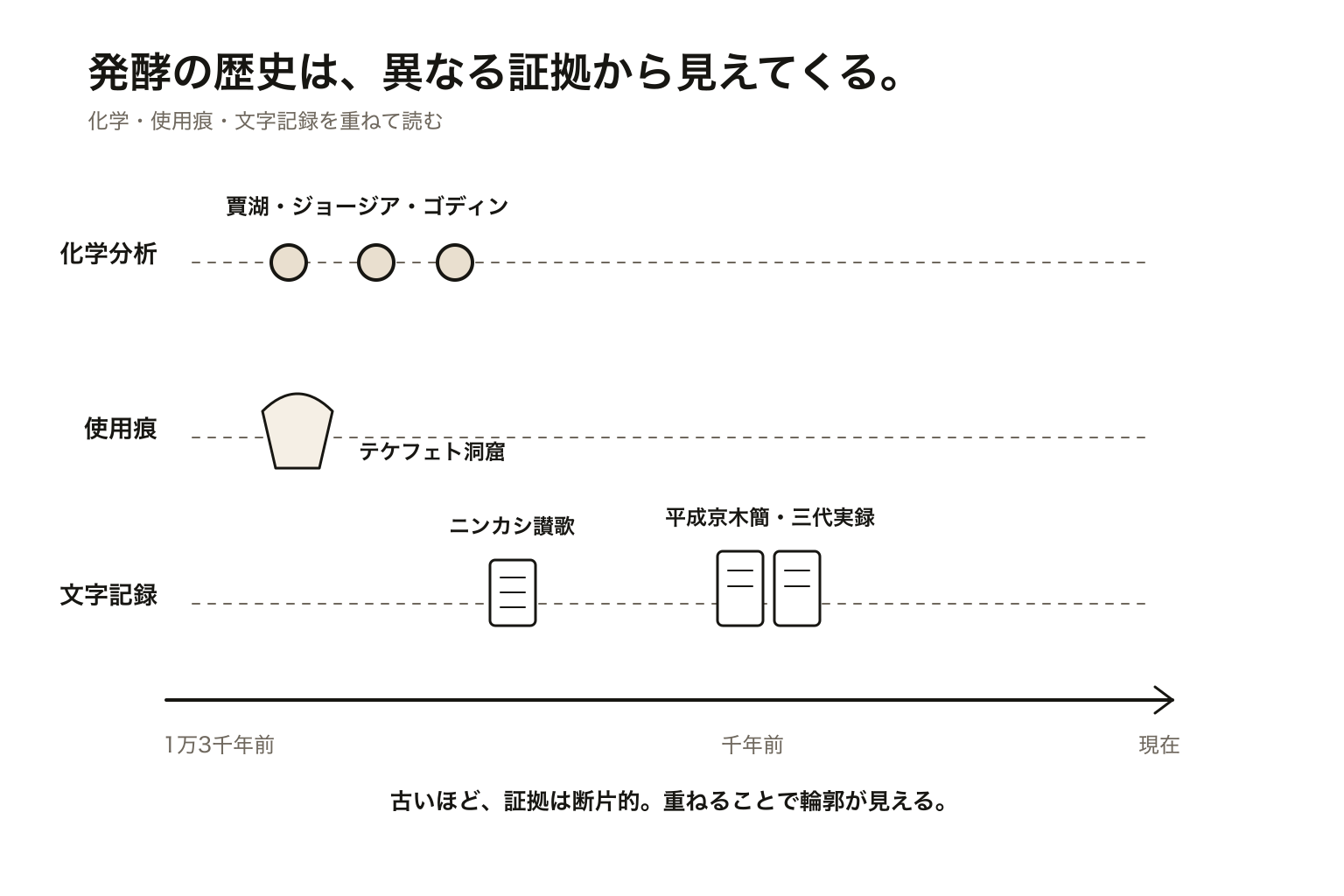
The labels in this illustration are in Japanese.
How far has the oldest fermentation in the world been verified?
The oldest trace of fermentation reported so far comes from stone mortars found in Raqefet Cave on Mount Carmel in Israel. In the 2018 report by Liu and colleagues, starch granules of germinated wheat and barley were found in three mortars, bearing the particular damage left by heating and enzymatic breakdown.
What was found, however, is damage to starch granules, not alcohol itself. Neither ethanol nor its breakdown products were detected. The research team themselves describe the drink as "low in alcohol, closer to a thin gruel". Whether it was deliberate brewing is also not settled.
| Site (present-day country) | Date | What the date rests on |
|---|---|---|
| Raqefet Cave (Israel) | About 13,000 years ago | Use-wear on stone mortars and damage to malted starch granules. Alcohol not detected |
| Jiahu (China) | 7000-6600 BCE | Tartaric acid and beeswax components absorbed into pottery. A mixed drink of rice, honey and fruit |
| Gadachrili Gora and others (Georgia) | 6000-5800 BCE | Tartaric acid in pottery. The oldest biochemical evidence for wine |
| Godin Tepe (Iran) | 3500-3100 BCE | Calcium oxalate on the inside of a jar. Chemical evidence for barley beer |
"About 13,000 years ago" is a rounding of the date range of the site stratum (13,700-11,700 cal BP), not a value measured on the residue itself. The place names are worth keeping apart as well: Godin Tepe is in Iran and Raqefet in Israel, and neither is on the Mesopotamian plain.
The number "eight thousand years" fits not Mesopotamian beer but Georgian wine. The often-heard "beer in Mesopotamia eight thousand years ago" is probably that date mixed up with the date of Jiahu in China. The oldest chemically confirmed beer in the Near East is at Godin Tepe in the Zagros mountains of Iran, 3500-3100 BCE.
In writing, Mesopotamian beer is attested far earlier. Even so, the oldest case in which beer has been directly identified from residue analysis on the Iraqi side is Khani Masi, 1415-1290 BCE. Nowhere is the difference between "it is written" and "it has been excavated" clearer than here.
Jiang began as meat and fish
Trace the ancestry of miso back and you arrive at the Chinese jiang (hishio in Japanese). The earliest jiang, however, was not made of soybeans. The Shuowen Jiezi of the Later Han glosses jiang as hai — that is, a salted preserve of meat. What the Rites of Zhou deals with is likewise a preserve of animal matter; a commentary says the meat was dried, mixed with koji and salt, and steeped in liquor.
Soybean-and-koji jiang took the leading role much later. The Simin Yueling of the Later Han records a jiang called modu being prepared from crushed beans in the first month, and fish jiang, meat jiang and clear jiang being made from the sixth to the seventh month. Bean jiang was still one among many. By the Qimin Yaoshu of the Northern Wei (first half of the sixth century), jiang means bean jiang, and its method is set out in the same framework we use now: preparing the ingredients, making koji, preparing the batch, maturing.
Two mix-ups turn up often here. One writes the Qimin Yaoshu up as "an agricultural treatise of about four thousand years ago", when it is in fact about fifteen hundred years old. The other cites the Rites of Zhou for "jiang goes back three thousand years". The Rites of Zhou takes the form of a record of Western Zhou offices, but the scholarly consensus places the composition of the text itself in the Warring States period, so five to seven hundred years are being skipped over.
The Japanese misho survives on eighth-century wooden tablets and ledgers
The line most often quoted in the history of Japanese miso is that "misho appears in the Taiho Code of 701". But the text of the Taiho Code itself does not survive. What can be read today is the Yoro Code, compiled in 718 and enforced in 757, whose article on the Imperial Table Office establishes "two masters of jiang" — officials making assorted jiang, fermented beans and misho. It is likely that the Taiho Code had a provision to the same effect, but there is no way to confirm it.
For objects that can be dated, there are plenty. A wooden tablet excavated at the Heijo Palace site records a jiang prepared on the sixth day of the fourth month of Tenpyo 3, from six koku four to of soybeans, six koku four to of salt, six to four sho of kamutachi (taken to correspond to koji) and one to two sho of liquor: that is, a record from 731. Tax ledgers from Oki Province in 733 and from Izu Province in 739 also list massho by the jar. That jiang and massho existed in eighth-century Japan can be stated from excavated objects and ledgers, not from inference.
The two characters now written for miso appear a little later. In the Nihon Sandai Jitsuroku, under the year 886, a list of supplies to monks includes "two go of miso" and "one go of jiang" alongside white rice and salt. What is interesting here is that miso and jiang stand as separate items in the same list. The second of those two characters exists in China as well; the Guangyun lists it in a compound describing the sound of a bell. What was made in Japan was not the character but the practice of writing the native word miso with those two characters.
So where does the word miso come from? The best-known account has it as a shift from misho, "that which has not yet become jiang", but a derivation from koma-bishio (Korean jiang) and a reading of the first element of massho as "powder" stand alongside it, and the matter is not settled.
Soy sauce is the junior of miso
The relationship of miso and soy sauce is easy to get backwards. It is not that soy sauce came first and its prototype became miso. In fact it is the reverse. A solid to semi-solid jiang came first, and the liquid form became independent later.
The fifteenth-century cookery text Shijo-ryu Hochosho (with a colophon of 1489) mentions tare-miso: miso is mixed with water and simmered down, put in a bag and hung up, and the liquid that drips is collected. Miso first, liquid after. The shift toward preparing a batch in order to take the liquid from the outset belongs to the sixteenth century.
The word deserves to be treated in stages as well. The sound "shoyu" appears in diaries of the first half of the sixteenth century, written with various characters. A firm example in which the two-character spelling now used carries that reading is the Ekirin-bon Setsuyoshu, with a colophon of 1597. When you read "the first attestation of shoyu is 1597", it refers to this final stage.
Then there is the famous account that "in 1254 the Zen monk Kakushin brought the method back from the Jingshan temple in China". Kakushin's journey to Song China and his return are historical fact, but no contemporary record in either Japan or China says that he transmitted a fermented food. According to the study by Lee M., the documentary starting point of this account is a historical note in the 1908 articles of association of the Yuasa soy sauce trade association in Kishu. There, Kakushin's return is given as 1228, twenty-six years off the historical return in 1254.
That a pedigree should be tidied up after the fact is not particularly unusual. What is worth watching is when it comes to be quoted with the same weight as a historical source. Between 1254 and the sixteenth century lies a gap of three hundred years.
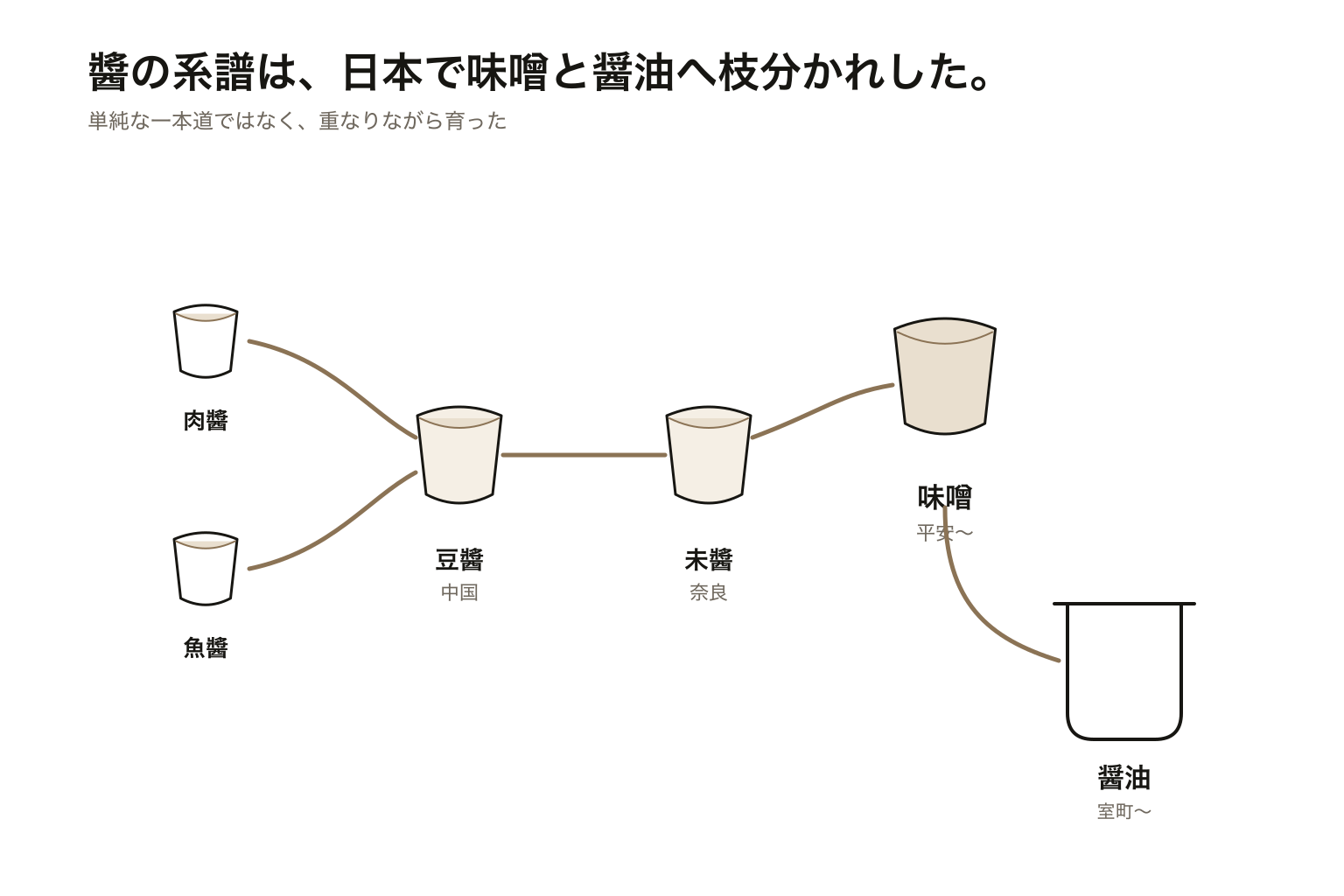
The labels in this illustration are in Japanese.
How miso became an everyday food
Nor was miso miso soup from the start. In the Heian period miso was not a seasoning but a luxury, licked as it was or spread on food. It served as a gift to the highly ranked and as a supply to sutra copyists.
What changed it was a tool. In the Kamakura period the grinding bowl spread, and ground miso — miso with its remaining grains crushed — became soluble in water, at which point miso soup became possible. The meal form of one soup and one dish is said to have settled around then as well. It is a case not of a new food being born but of a new tool changing how something was eaten.
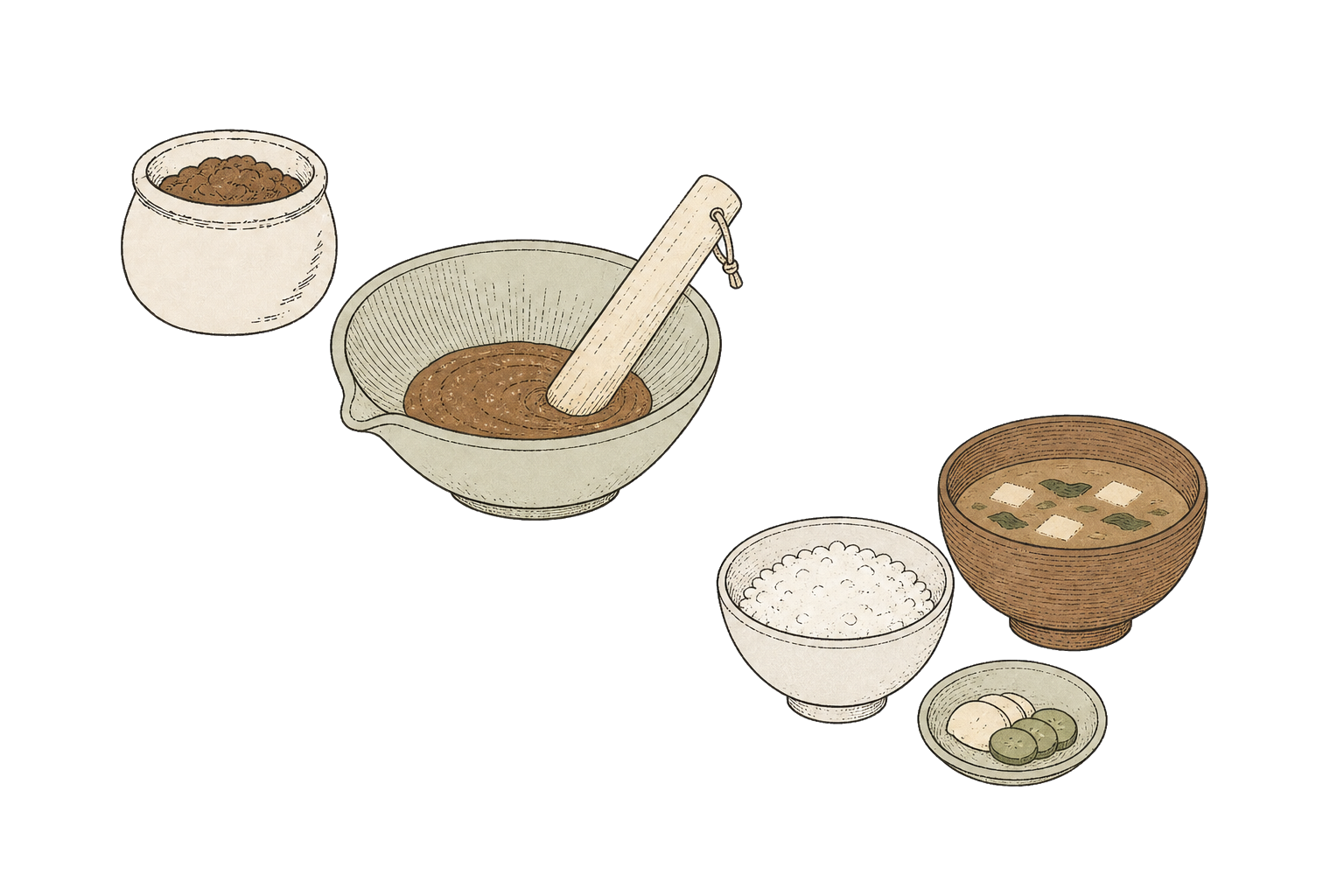
The labels in this illustration are in Japanese.
Soybean production increased in the Muromachi period, and farmers began preparing miso in their own homes. In the Warring States period it became a field ration, and in Edo local production could not keep up with demand, so miso was carried in from Mikawa and Sendai.
Calling boastfulness temae-miso, "my own miso", is a relic of the days when every household prepared its own. When the phrase itself was born, however, is not clear.
And understanding the mechanism is very recent indeed
Microbes have not appeared once in the story so far. Naturally enough: nobody had seen them.
The first person to observe microbes was Antonie van Leeuwenhoek, who reported "little animals" (animalcules) to the Royal Society in a letter of 1676. He did not, however, go so far as to say that they were what fermentation is. He only saw them.
The person who showed that fermentation is the activity of living microbes was Louis Pasteur, with his paper on lactic fermentation in 1857 and on alcoholic fermentation in 1858. His refutation of spontaneous generation, often run together with these, was a separate piece of work: the swan-neck flask experiments date from 1861-62. Saying "Pasteur discovered microbes" compresses the work of two people into one.
So we used this for several thousand years without knowing the mechanism. Filing it away as "how clever people were in the old days", though, hides what was actually happening. What was at work was less wisdom than selection: keeping what worked and discarding what did not.
In koji making, that meant first tomodane, keeping part of a koji that had turned out well to use for the next batch, and eventually tane-koji makers selling spores. By the Muromachi period koji had become an independent trade, and in 1444 a dispute over the right to make it broke into armed conflict in Kyoto (the Bunan koji riot).
Go on selecting and the thing being selected changes too. The koji mold used for miso today was not taken straight out of the natural world. It is a microbe that is the result of people choosing, raising and distributing it. Quite how far it is a product of human hands is a chapter in itself.