
How Far Fermentation Reaches — 02
The fermented foods of the world fall into four types
Koji type, lactic type, yeast type, bacterial type
About 9 min read
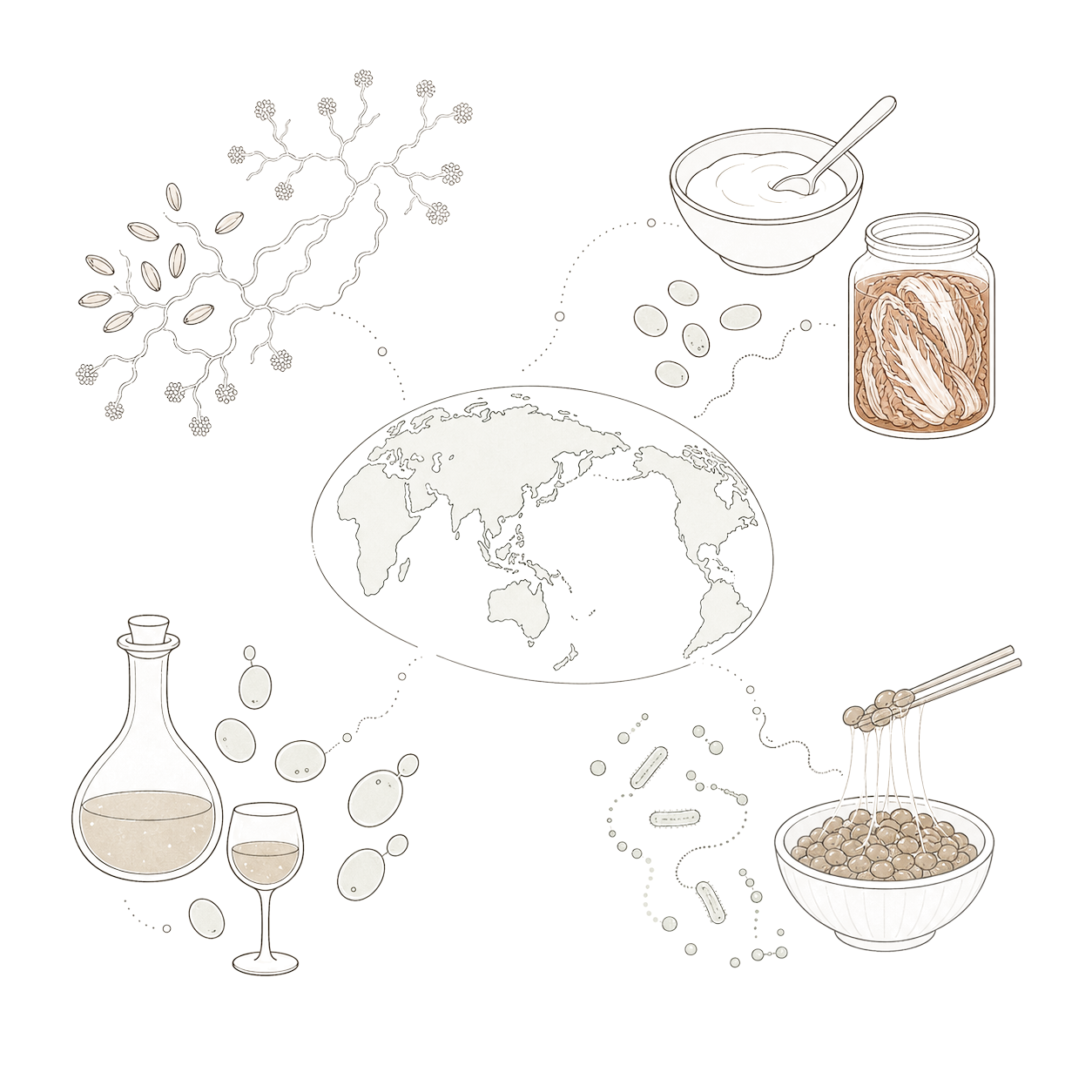
Open a book on fermented foods and you will usually find a list by country. Miso and natto from Japan, kimchi from Korea, sauerkraut from Germany, tempeh from Indonesia. Looking at the photographs is enjoyable, but you often finish still not knowing "so what does this share with miso?"
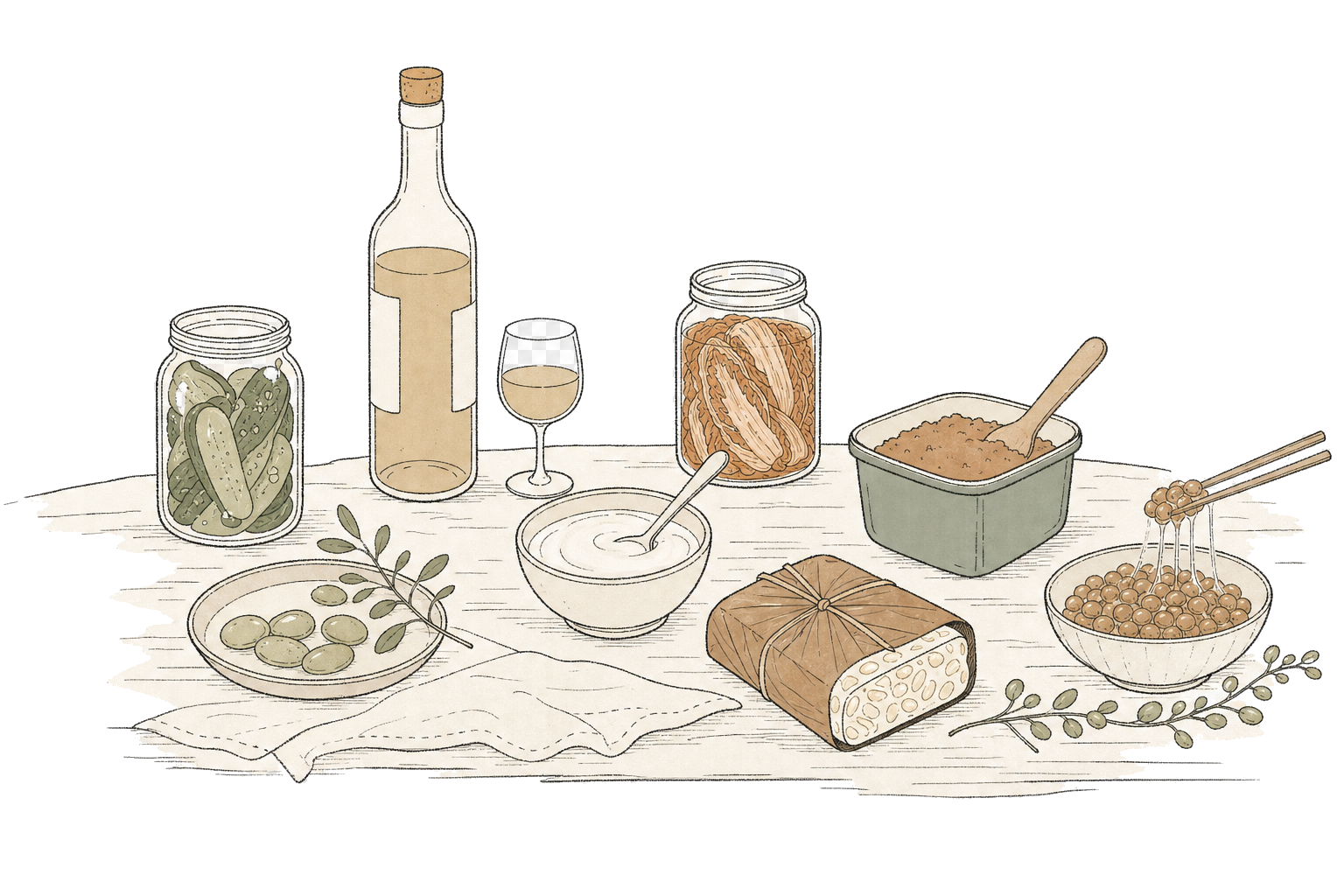
The labels in this illustration are in Japanese.
Lining them up by country does not show you much
National borders mean nothing to a microbe. What a microbe sees is whether there is sugar, how much salt is at work, whether there is oxygen, and what the temperature is. That is all. Shift the axis of sorting from geography to "who is playing the lead" and the view changes a great deal.
Four questions are enough to find the lead. What is being broken down? Who produces the enzymes (a mold, a bacterium, a yeast, the ingredient itself, or something added from outside)? What is shutting out the unwanted microbes (salt, acid, or alcohol)? And what aroma do the leftover metabolites become? Those four put every fermented food in the same table.
Rearranged, foods that are geographically far apart land in the same column, and neighbors split into different ones. Japanese miso and Korean doenjang look alike and are used alike, but their answer to the second question differs. Japanese natto and West African dawadawa are as far apart as anything on the table, and yet their four answers are almost identical.
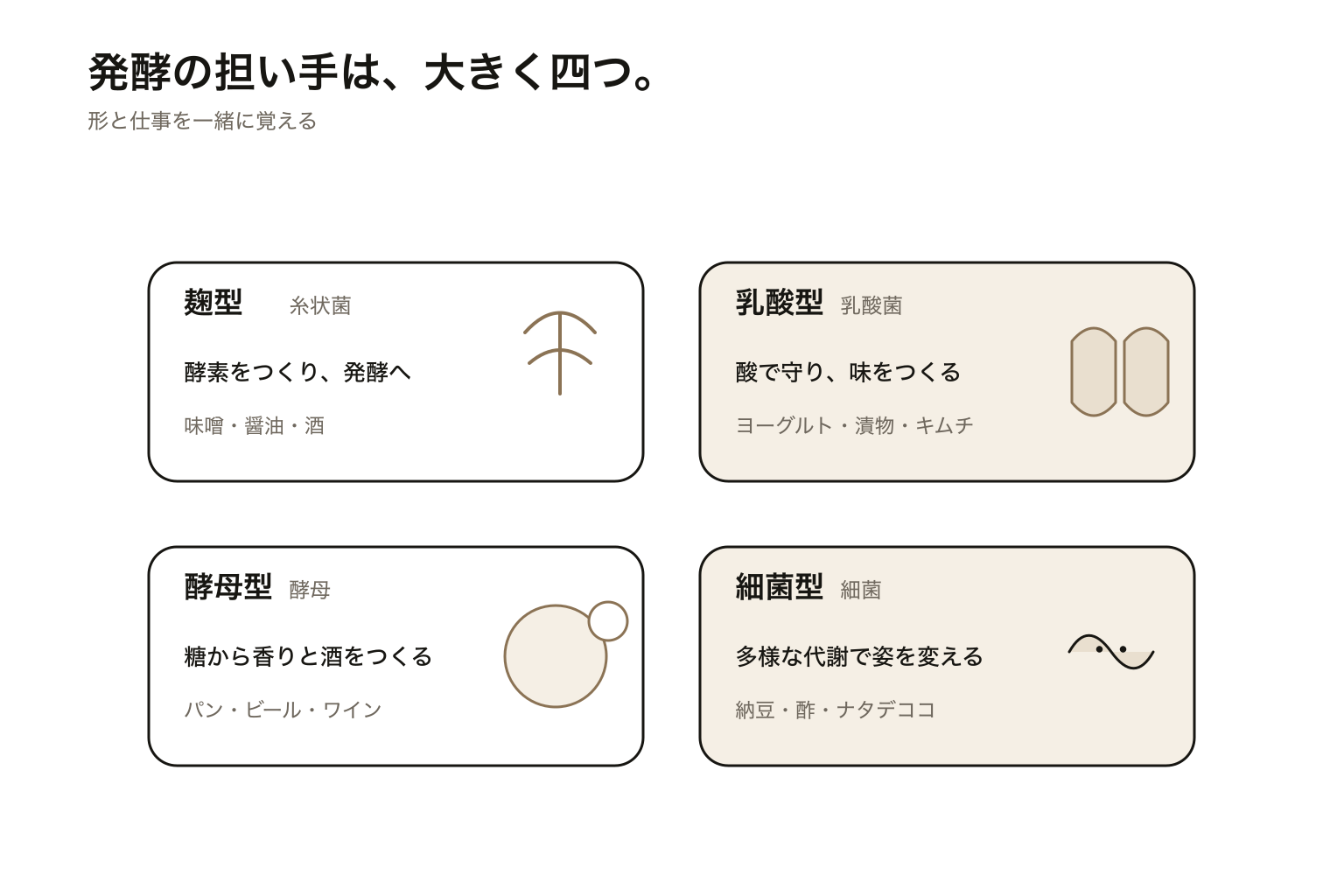
The labels in this illustration are in Japanese.
Type 1: the koji type — having a mold make the tools
What marks out the koji type is that it comes in two stages. First a filamentous fungus (a mold) is grown on the material and made to produce nothing but degrading enzymes. Those enzymes cut the ingredients, and the sugars and amino acids that emerge are handed to the next microbe. Breaking down and fermenting are handled separately.
Miso, soy sauce, sake, mirin, amazake. Some Chinese douchi belongs here too. The koji mold (Aspergillus oryzae) stockpiles enzymes during seikiku, and after the batch is prepared only the enzymes work — exactly the structure we saw in Chapter 1 of Basics.
Korean doenjang is introduced as "Korean miso", but the entrance to the first stage is in fact different. Traditional doenjang is not inoculated with koji. Boiled soybeans are formed into blocks called meju, which are hung up while the surrounding microbes settle on them. Early on, Bacillus and Mucor dominate the surface, and as it proceeds Aspergillus becomes the main mold.
Tempeh also uses a filamentous fungus, but it is after something different. The tempeh fungus (Rhizopus microsporus var. oligosporus) extends its hyphae at around 30°C for 24-48 hours, binding the soybeans into a white slab. Rather than handing enzymes on to another step, the hyphae themselves become building material. The fermentation time is shorter by an order of magnitude because there is no need to stockpile enzymes.
Within the koji type, sake is a little unusual. The reaction in which the enzymes of the koji cut starch into sugar and the reaction in which yeast turns that sugar into alcohol proceed at the same time in the same vessel (multiple parallel fermentation). Because the steps are not separated, sugar never builds up, and a high alcohol concentration can be reached.
Type 2: the lactic type — taking the ground with acid
In the lactic type, lactic acid bacteria turn sugar into lactic acid and lower the pH. The lowered pH is itself what shuts out other microbes. The acid that appeared in Chapter 4 of Basics as the second of the four walls is the lead here. Kimchi, sauerkraut, nukazuke, yogurt, sourdough, funazushi. The materials and the regions are scattered, but the skeleton is the same.
Sauerkraut is the textbook example of this type. Add about 2% salt by weight of shredded cabbage and the salt-tolerant Leuconostoc mesenteroides starts things off. Next comes Lactobacillus brevis, and finally the most acid-tolerant, Lb. plantarum, dominates and sets the final acidity. How sour it gets is decided by temperature: at 18°C it takes about 20 days to reach a total acidity of 1.7-2.3%, and at 32°C it arrives at the same place in 8-10 days.
This is the interesting part: nobody gives the order. Each microbe that arrives changes the environment, makes it inhospitable to itself, and hands the seat to the next. The same thing happens as the changeover we described for miso in Chapter 6 of Basics.
Kimchi follows the same succession under different conditions. The salt is about 3%, and around 10°C is preferred over anything above 20°C. Readiness is judged at 0.4-0.8% lactic acid and pH 4.2-4.5; any more sour than that and it stops being acceptable.
Miso has lactic acid bacteria too. They are not the lead, though. What can work is limited to a few lactic acid bacteria that tolerate high salt, and the pH does not fall as far as in kimchi. In miso, salt takes the lead and acid plays a supporting part.
Type 3: the yeast type — turning sugar into alcohol
In the yeast type, yeasts eat sugar and give out alcohol and carbon dioxide. Wine, beer, bread. Wine has sugar in the grapes from the start, so it can be handed straight to the yeast.
Beer cannot do that. Barley starch is too large for yeast, so it has to be cut into sugar first. In beer, that job is done by the enzymes of the germinated barley itself — malt. The idea of saccharifying before handing over to yeast is the same as the koji type; the only difference is whether a mold or the grain itself does the saccharifying.
Bread uses a different exit from the same reaction. In drink you take the alcohol; in bread you take the carbon dioxide. The gas the yeast gives out is caught in the gluten film and the dough rises, while the alcohol mostly flies off in the oven.
Kombucha is a compound of the yeast type and the acetic type. The white mass on the surface, known as the SCOBY, is not a mushroom. It is a cellulose film made by acetic acid bacteria, inhabited by yeasts and acetic acid bacteria. The yeasts split sucrose into simple sugars, and the acetic acid bacteria turn those sugars, and the ethanol the yeasts give out, into acid.
So kombucha always passes through alcohol. It is not zero; it is made and then consumed on the spot. In an experiment leaving it 14 days in an open vessel and then 10 days sealed, the ethanol that accumulated with the proper kombucha community was about 1.0 g/L (roughly 0.13 vol%). With an artificially simplified combination of microbes, it rose by up to 4.3 g/L (roughly 0.54 vol%) while sealed. The fuller the cast of residents, the more the alcohol produced seems to be used up on the spot.
As for health effects, little has been confirmed compared with how much is claimed. A 2024 systematic review found only four human trials across the six years from 2018 to 2023. Participants numbered between 11 and 42, and one trial that began with 12 had 7 left in the analysis. The periods ranged from a single measurement after a meal to at most four weeks, and the results did not agree. It is not that it "does not work"; it is that nothing can yet be said.
Type 4: the bacterial type — Bacillus, and fish sauce as an exception
In the bacterial type, bacteria play the lead. The representative is natto, where Bacillus subtilis settles matters quickly without salt. What decisively separates it from the other types is the direction of the pH: where the lactic type swings acidic, natto swings alkaline.
The same type is found in many places: Korean cheonggukjang (2-3 days at around 40°C), kinema in Nepal and northeast India, thua nao in Thailand, dawadawa in West Africa. The resemblance is no coincidence; closely related microbes are doing the same thing on similar substrates.
Fish sauce half falls outside this classification. Nam pla, shottsuru, the garum of ancient Rome. What does most of the cutting here is not an enzyme released by a microbe but the digestive enzymes the fish itself already had (autolysis). It has one foot outside the frame of "fermentation is microbes breaking things down".
That said, it is not as though high salt leaves the inside all but sterile. Bacteria that live even at 15% salt are frequently isolated from commercial mackerel shiokara, and most of them are presumed to be Tetragenococcus halophilus — the same species that carries the maturation of miso and soy sauce.
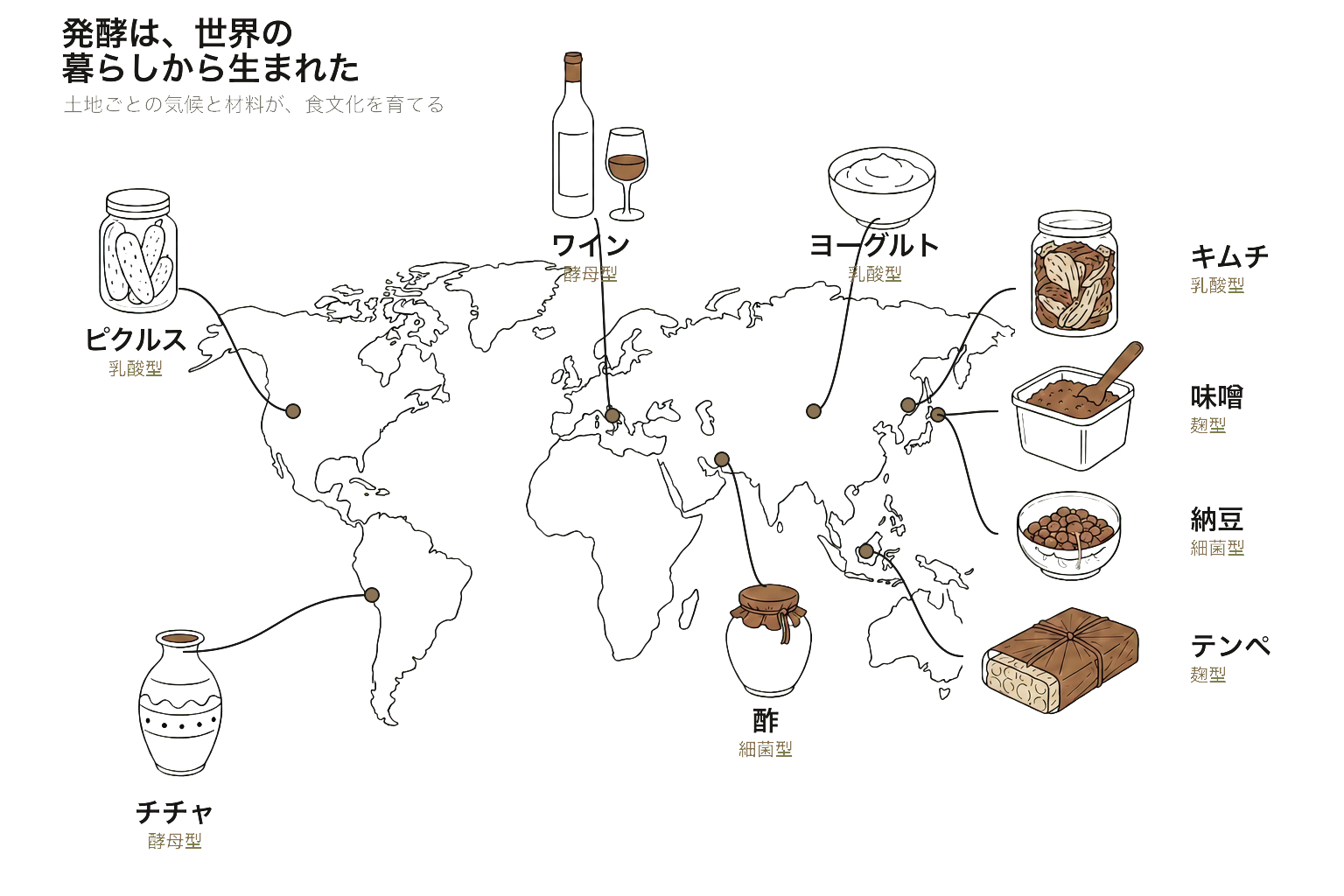
The labels in this illustration are in Japanese.
Where "the principle is the same" holds, and where it does not
Laid out like this, you can see how far the phrase "the principle is the same" is true. Two things can be called the same. Large molecules are cut small to make the raw materials of taste and aroma. And the environment is deliberately skewed so that unwanted microbes cannot multiply.
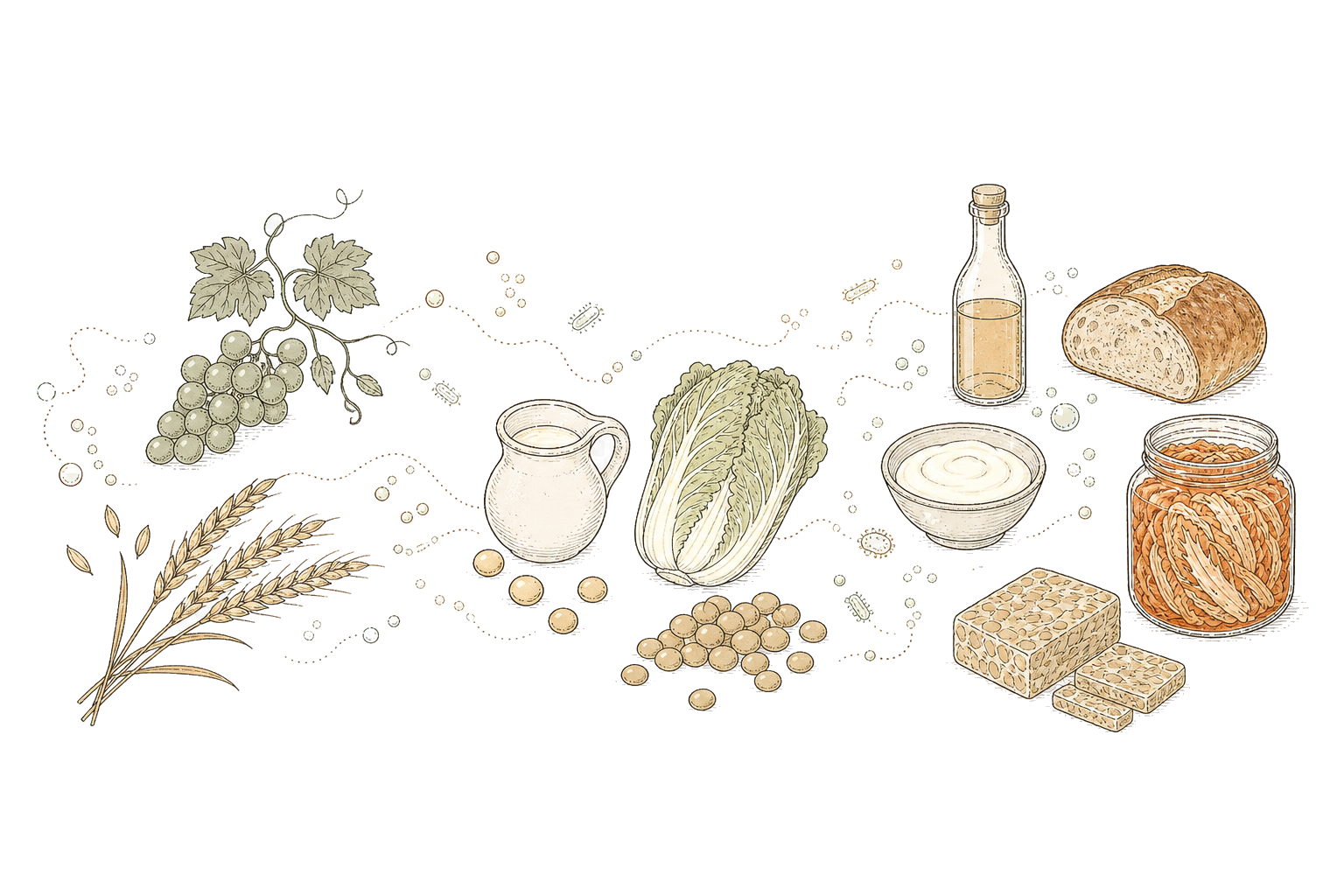
The labels in this illustration are in Japanese.
What cannot be called the same is everything after that. Who produces the degrading enzymes differs (a mold, a bacterium, a yeast, the ingredient itself, or rennet added from outside). The direction in which oxygen is needed differs too. Lactic acid bacteria prefer no oxygen, acetic acid bacteria cannot work without it, yeasts manage either way, and molds require it. So if you file fermentation away as "shutting out the air", kombucha becomes impossible to explain.
And the difference that matters most in practice is the means of shutting others out. What protects miso is salt, and the water activity it has pushed down (the proportion of water in a food that microbes can use). The water activity of miso is higher in some types and lower in others, but broadly it sits in the 0.7s. Most food-poisoning organisms need somewhere damper than that; Clostridium botulinum, for instance, can neither grow nor produce toxin below 0.94. Kimchi and sauerkraut, on the other hand, are protected mainly by acid, alcoholic drinks by alcohol, and tempeh by heating and acidification.
Salt and water activity do not shut everything out, either. Staphylococcus aureus grows even at 16-18% salt, and under the right conditions produces the toxin enterotoxin even at 10% salt. Keeping your hands and tools clean when preparing a batch is worth doing because of organisms like this.
Acidifying the soaking water for tempeh with vinegar or the like is not an operation for flavor either. It is a safety step to hold back the bacterium that produces the powerful toxin bongkrekic acid (Burkholderia gladioli pv. cocovenenans). Skip it as if it were a step for taste and something that was protecting you comes away.
The four types are not boxes to memorize. They are an order of questions to ask when you meet a fermented food for the first time. What is being cut? Who is cutting it? What is shutting others out? What do the leftover metabolites become? Ask in that order and you can more or less read the structure of a food whose name you do not even know. Anyone who has once prepared a batch of miso already holds those four in their hand.