
How Far Fermentation Reaches — 01
The misos of Japan differ because the numbers people choose differ
Rice, barley and bean; sweet and salty; and the measure called koji-buai
About 9 min read
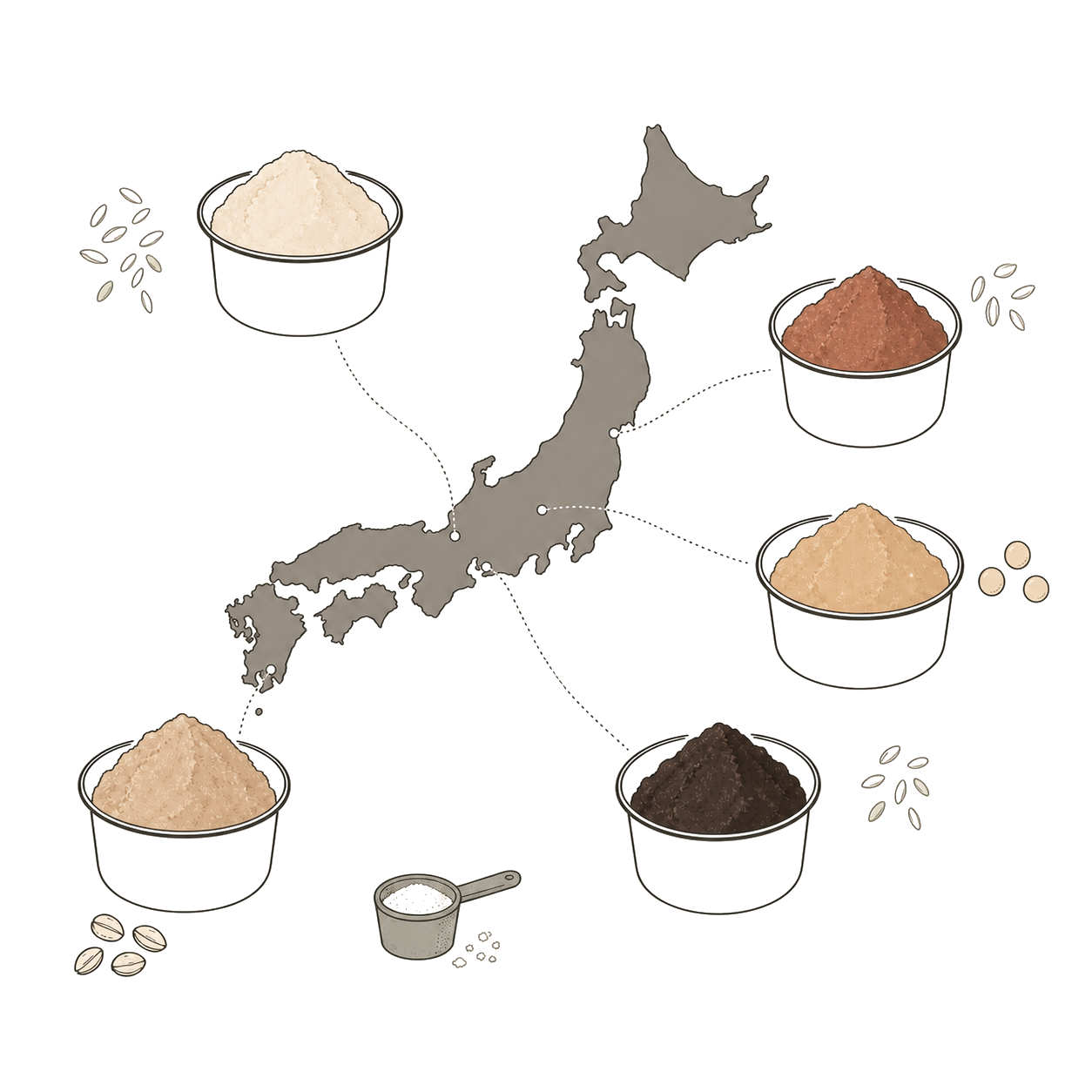
There are two measuring sticks for sorting miso
Stand at the miso shelf and read the names aloud. Shinshu, Sendai, Saikyo, Hatcho, Kyushu barley, awase. Place names, ingredient names and descriptions of taste are all mixed together, and it is not obvious which of them belong to the same conversation.
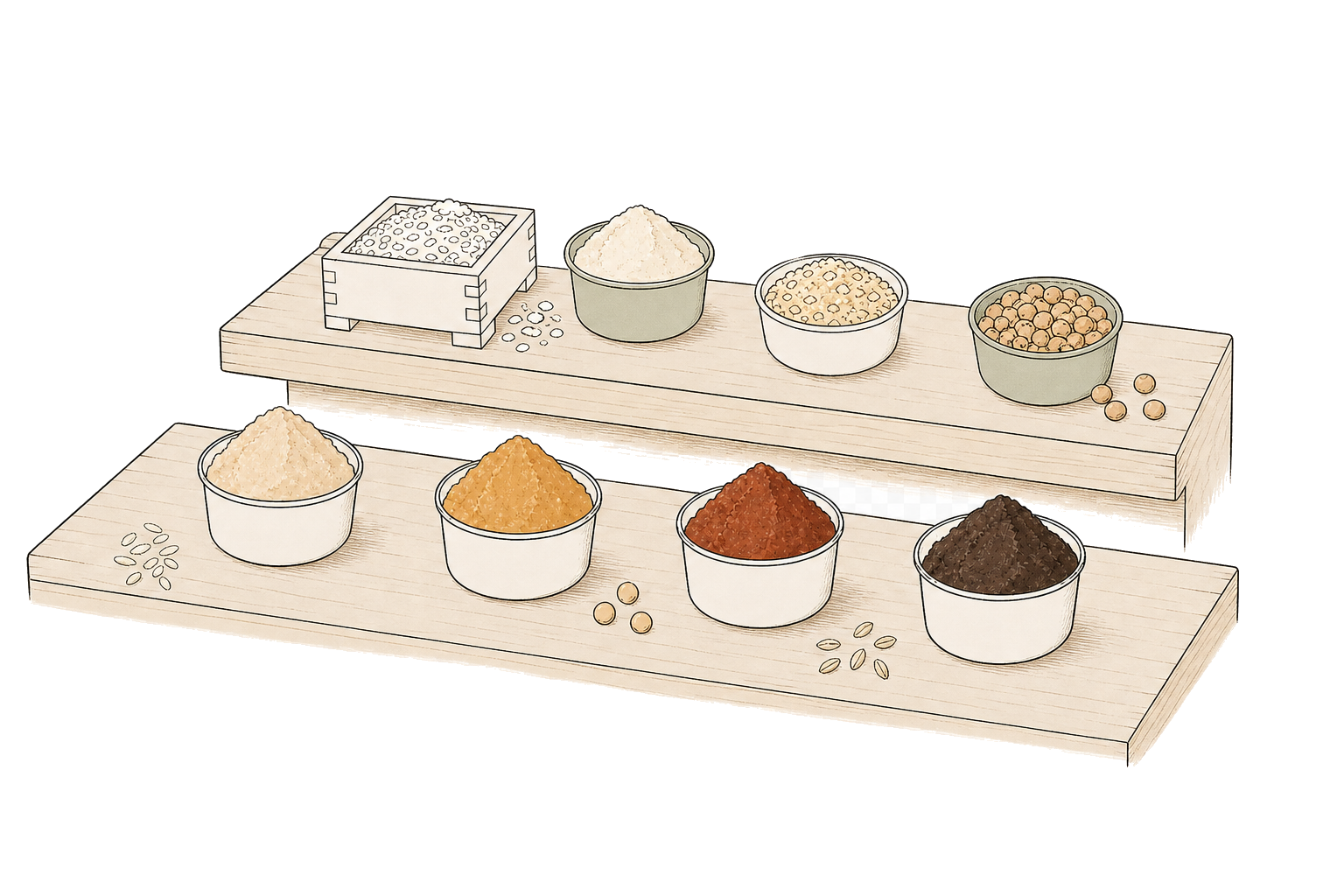
The labels in this illustration are in Japanese.
There is a proper reason for the confusion: miso is sorted by at least two measuring sticks. And the two are independent of each other, so fixing one does not fix the other. A great many people take "the opposite of red miso is white miso" and "the opposite of rice miso is bean miso" to be the same measuring stick.
The first is what the koji is made from. The Food Labeling Standards, and JAS 0022 "Miso" enacted in March 2022, divide miso into four: rice miso, barley miso, bean miso and blended miso. What is worth holding on to is that this is not a classification by main ingredient. Rice miso and barley miso are both made by combining koji with steamed soybeans. Only the koji is barley; the soybeans are in both.
Bean miso is the sole exception. For bean miso, salt is mixed into "bean koji", made by growing the koji mold on the steamed soybeans themselves. Since no grain koji is used, the ingredients are only soybeans, salt and water. In other words, the four categories classify "which koji is combined with the soybeans".
The second measuring stick is taste and color: sweet miso, mildly salty miso, salty miso, and white, pale or red. These do not appear in the legal classification. The Federation of Japan Miso Manufacturers Cooperatives explains that classification by color was not taken into the labeling system because it is something you can see for yourself.
Multiply the two together and a brand is more or less uniquely placed. Shinshu miso is rice, salty, pale. Sendai miso is rice, salty, red. Saikyo miso is rice, sweet, white. Hatcho miso is bean, salty, red. If you can name those three things, you have almost placed the miso in front of you.
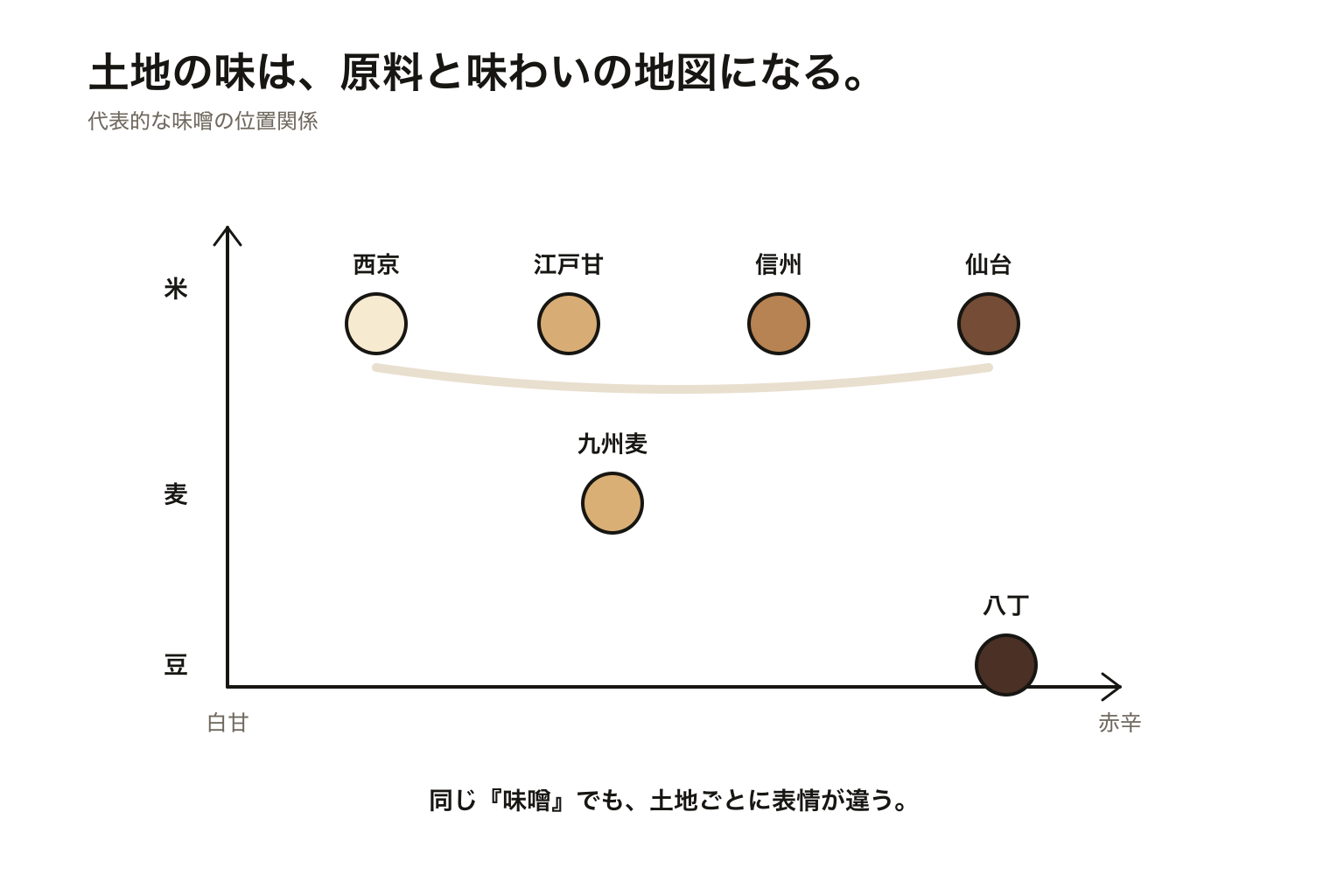
The labels in this illustration are in Japanese.
Incidentally, the statement that "there is no JAS standard for miso" was correct up to 2021. JAS 0022 is a standard for production methods rather than composition: the koji fungus must be Aspergillus oryzae, the koji must be loose koji or bean koji, and so on. Behind its enactment lies growing exports and the need to distinguish miso from similar fermented pastes abroad.
A word on quantity, just once. In the 2025 figures from the Federation (on a shipped-volume basis), rice miso came to 306,336 tonnes, blended miso 31,341, bean miso 15,572 and barley miso 12,368, for a total of 365,617 tonnes. Rice miso accounts for 83.8%. You often see it said that "rice miso is about 80%", but that is the figure from around 2010 (79.9% in 2010); it is about four points higher now.
Koji-buai is counted in bu, not in percent
People tend to assume that what separates sweet miso from salty miso is the amount of salt. That is half right, but it does not account for everything, because there are misos classed as mildly sweet at 11-13% salt. There is another number that people decide.
That is the koji-buai. It is defined as "weight of rice divided by weight of soybeans, times 10". The unit is not the percent but the bu. At 10 bu the soybeans and rice weigh the same; at 20 bu the rice is twice the soybeans. For barley miso the numerator is barley.
There is one more place to stumble. The numerator is not the weight of the finished koji but the weight of the dry milled rice before it is made into koji. The denominator is likewise the dry soybeans before soaking. Both are counted as dry weights. Calculate with the rice after it has become koji and the figure comes out high by the water it absorbed.
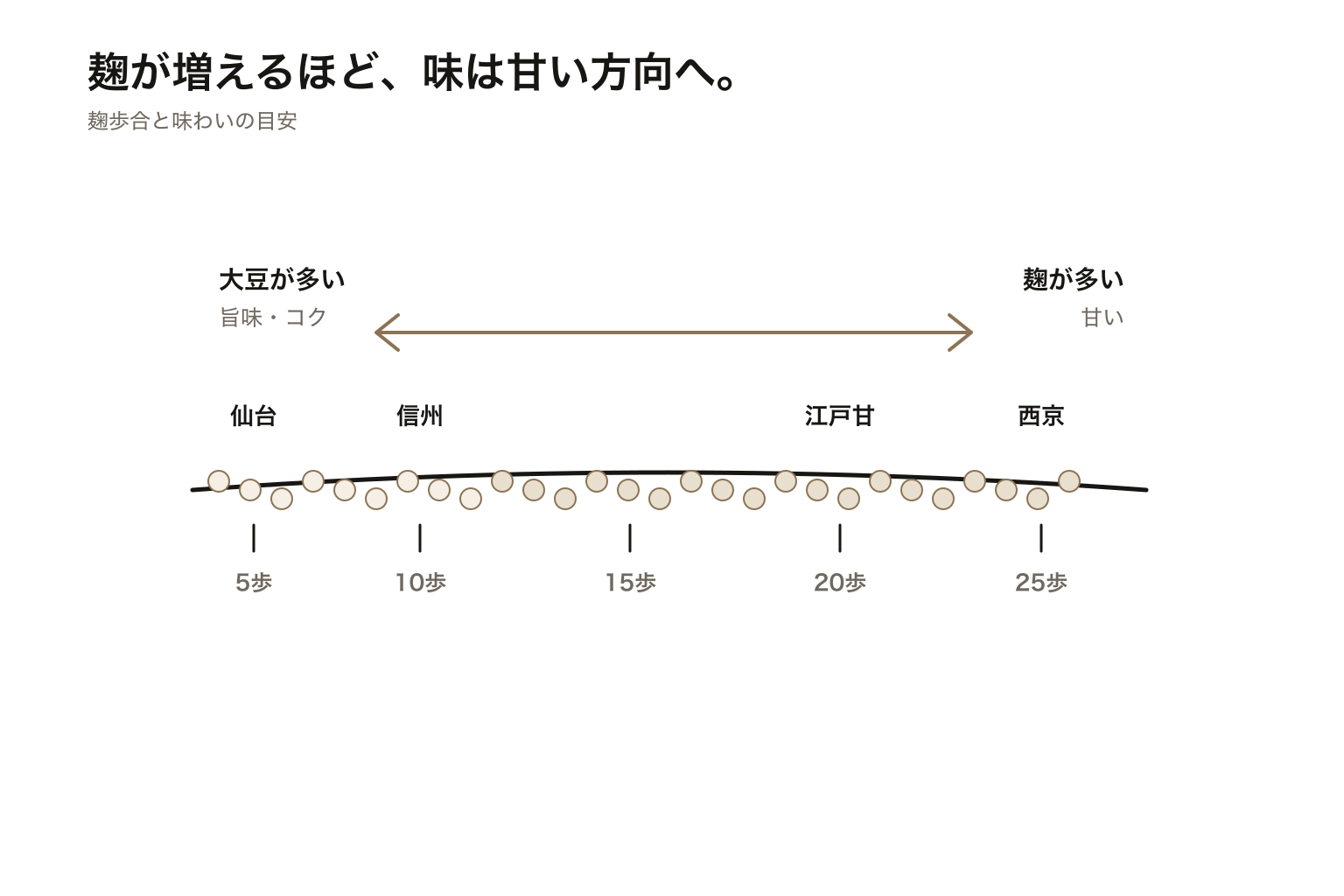
The labels in this illustration are in Japanese.
What happens when you raise the koji-buai? More rice means more starch brought in, and the amylase of the koji turns it into sugar. Measurements put the directly reducing sugars of a salty rice miso at about 13%, against 21-27% for Edo sweet miso. A sweet miso is sweet not because sugar has been added but because rice starch is being turned into sugar. And sugar masks saltiness.
Lower the koji-buai and the soybeans increase in relative terms. More protein is brought in, more amino acids and peptides are cut out, and the flavor leans toward umami and body. Sweet miso is broadly 15-30 bu and salty miso 5-10 bu. That spread is the design of the flavor itself.
Salt content ranges from 5% to 13%
The figure "miso is about 12% salt" has taken on a life of its own. That is the figure for salty rice miso. Taking miso as a whole, the range is much wider.
The salt equivalents in the Standard Tables of Food Composition in Japan (eighth revision, 2023 supplement), per 100 g edible portion, are 6.1 g for sweet rice miso, 12.4 g for pale salty miso, 13.0 g for red salty miso, 10.7 g for barley miso and 10.9 g for bean miso. The classification table shared within the industry gives 5-7% for sweet miso, 7-12% for mildly salty miso and 11-13% for salty miso. All of these are percentages by weight of the finished miso.
Calculate white miso as 12% and you will be out by nearly a factor of two. Whenever you use a salt figure, it is worth first checking which miso it refers to.
Let us check one common claim here: "Hatcho miso is the saltiest of all". In fact the composition tables give bean miso 10.9 g/100 g, lower than red salty rice miso at 13.0 g and pale salty miso at 12.4 g. On salt alone, bean miso is more restrained than a salty rice miso.
So what is that intensity? One part is the amount of protein. Bean miso has 17.2 g/100 g, clearly more than the 12.5-13.1 g of a salty rice miso. Since the only ingredient is soybeans, that follows naturally enough. The other part is the long maturation, which builds up astringency, bitterness and acidity together with a deep color. Measurements put Hatcho miso at the lowest lightness among commercial misos and toward the high end for acidity.
The low salt of sweet miso comes at a price: with less salt, it does not keep. One report found that white miso darkened in about ten days at 30°C, whereas at 10°C there was no great change even after 180 days. That is why you do not leave a white miso you have bought on a shelf at room temperature.
Let us line the representative brands up as numbers
To the three things so far — the material of the koji, the koji-buai and the salt content — we add the maturation period. Line the representative brands up by these four and the differences in flavor can largely be explained without invoking any regional story.
| Brand | Material of the koji | Koji-buai | Salt (% by weight of the finished miso) | Maturation |
|---|---|---|---|---|
| Shinshu miso | Rice | 5-10 bu | 11-13% | A few months to a year (pale, salty) |
| Sendai miso | Rice | 5-10 bu | 11-13% | One to one and a half years (red, salty) |
| Saikyo miso | Rice | 15-30 bu | 5-7% | 8-10 hours at around 50°C plus 7-14 days at room temperature (white, sweet) |
| Edo sweet miso | Rice | 12-20 bu | 5-7% | About ten days (red, sweet) |
| Barley miso of Kyushu | Barley | 15-25 bu | 9-11% | Short (pale to pale red, mildly sweet) |
| Hatcho miso | Soybean (bean koji) | — (the koji is entirely soybean) | 10-12% | Two years or more, at least two summers and two winters (red, salty) |
Representative values from the industry classification table and the Standard Tables of Food Composition in Japan. Even within one brand there is a range from brewery to brewery. The maturation period for Hatcho miso is the standard in the specification of the Hatcho Miso Cooperative under GI registration No. 49.
What surprises people in the table is probably the maturation period of Saikyo miso and Edo sweet miso. White sweet miso is often assumed to be "a luxury that takes time and therefore matures for long", but in fact the opposite is true. After 8-10 hours of high-temperature digestion at around 50°C, it is held one or two weeks at room temperature. Edo sweet miso is finished in about ten days.
Hatcho miso, by contrast, takes at least two summers and two winters, which is more than two years. Called by the same word, miso, the time it takes to make differs by nearly a hundredfold.
Breakdown type and fermentation type — there are two ways of thinking
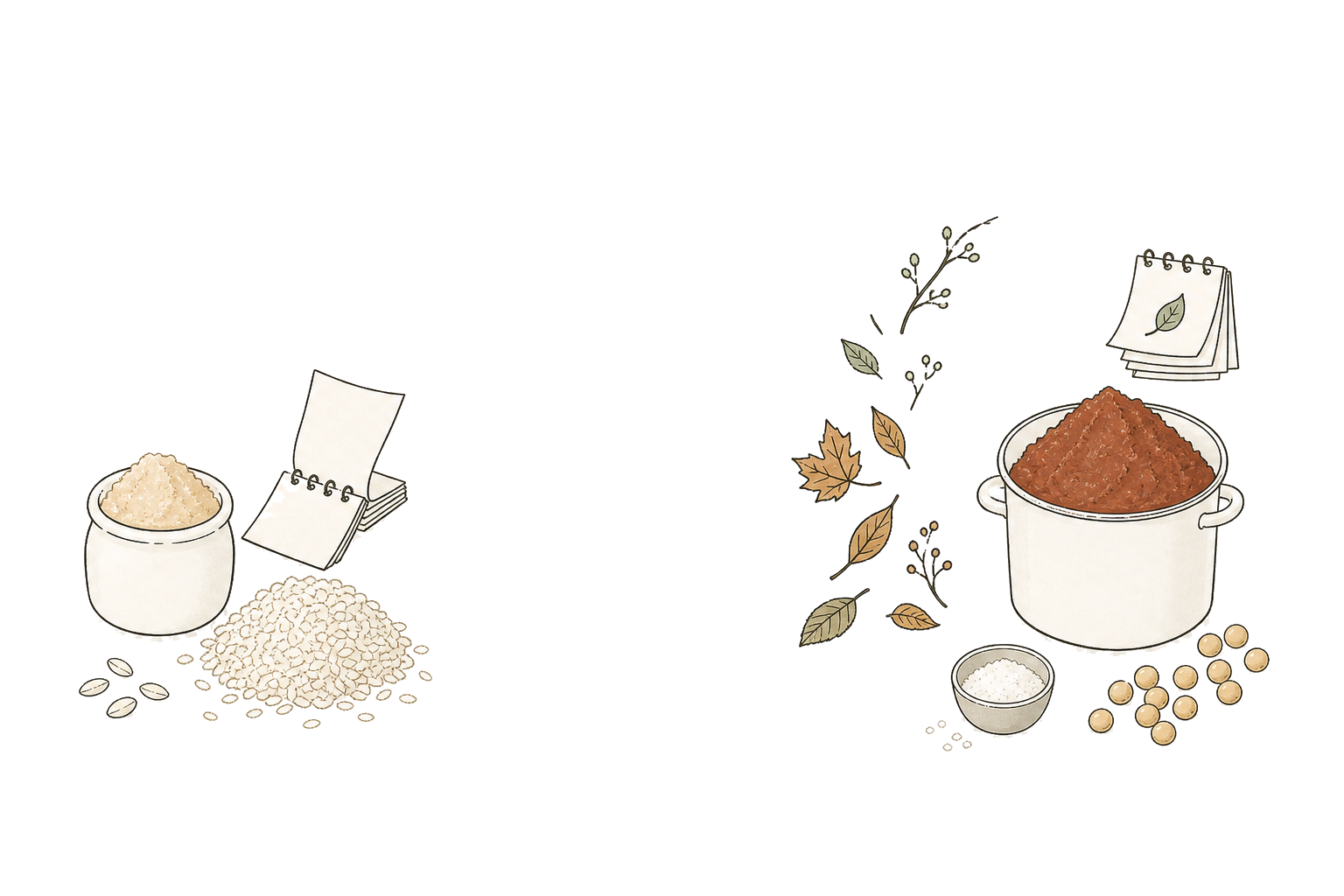
Read the table vertically and you notice that the higher the koji-buai, the lower the salt and the shorter the maturation. This is no coincidence. Miso in fact has two clearly distinct ways of thinking about how it is made (two design philosophies).
The labels in this illustration are in Japanese.
One is the breakdown type. The koji-buai is raised to 15-30 bu, the salt lowered to 5-7%, and it is held at around 50°C for a few days. At that temperature neither halotolerant lactic acid bacteria nor yeasts can do much, so all that proceeds is breakdown by the enzymes of the koji. Sugars and amino acids appear all at once and the sweetness stands out. The aroma, on the other hand, stays simple. White miso and Edo sweet miso belong here.
The other is the fermentation-and-maturation type. The koji-buai is lowered to 5-10 bu, the salt set at 11-13%, and it is held at 20-30°C for months or years. Alongside breakdown by the enzymes of the koji, halotolerant lactic acid bacteria produce organic acids and halotolerant yeasts produce alcohol and aroma compounds. A layer the breakdown type does not have is added here.
And through that long stretch of time the Maillard reaction proceeds — the reaction in which sugars and amino acids join and turn into brown pigments and toasted-smelling compounds. It goes faster the higher the temperature and the longer the time. Measurements put the coloration of rice miso after three months at about 1.4 times at 4°C, about 2.2 times at 20°C and about 17 times at 37°C. The 150-180°C that comes up when talking about browning in cooking is the same reaction on a different timescale.
Deepening color is not free. The Maillard reaction uses sugars and amino acids as its materials, so some of the amino acids produced are diverted into pigment. But through maturation the enzymes of the koji are also at work cutting up soybean protein in parallel. So the amino acids that become umami do not usually decrease during maturation; they increase.
Where umami really does erode is when a matured miso is kept somewhere warm. In a rice miso held for three months, formol nitrogen, which serves as a guide to the amount of amino acids, actually rose below 20°C but fell 13.5% at 37°C. What a long rest adds is body and toastiness from melanoidin. It is more accurate to think of another layer being added than of umami being swapped out wholesale.
Everything so far assumes soybeans as the ingredient. Replace soybeans with chickpeas or nuts and the amount and composition of protein, the amount of starch and the amount of fat all move together. Which is to say that how the four numbers work changes as well. The measuring stick that explained regional differences so neatly has to be re-marked the moment you change the ingredient.
What happened over the name Hatcho miso
So far we have talked about numbers that people decide. But the name of a miso is not settled by numbers alone; part of it is settled by institutions. Let us lay out in order what happened to Hatcho miso under the Geographical Indication (GI) protection system.
- 01
June 2015 — two applications
The Hatcho Miso Cooperative, to which two firms in Okazaki belong, applied for GI registration. Three weeks later the Aichi Prefecture Miso, Tamari and Soy Sauce Industrial Cooperative applied as well.
- 02
December 2017 — the prefectural cooperative is registered
The Ministry of Agriculture, Forestry and Fisheries asked whether the production area could be widened from Hatcho-cho in Okazaki to the whole of Aichi Prefecture, and the Hatcho cooperative withdrew its application. Examination moved to the later application from the prefectural cooperative, which became registration No. 49.
- 03
September 2019 — a formal opinion
On the Hatcho cooperative's request for review, the Administrative Complaint Review Board gave the opinion that "the judgment of the reviewing agency that it should be dismissed cannot, at the present time, be called appropriate".
- 04
March 2021 — a third-party committee
It concluded that no clear difference (no significant difference) could be found on compositional analysis between the Hatcho miso of the two cooperatives. It also pointed out that the way the maturation period is written in the prefectural cooperative's specification is misleading.
- 05
January 2025 — a two-body arrangement
The Hatcho Miso Cooperative was added as a producer body under registration No. 49. Two bodies and two specifications now coexist.
The two specifications set different standards under the same name. The prefectural cooperative's specification gives the production area as Aichi Prefecture, with preparation in tanks for a year or more (at least ten months at 25°C or above if temperature is controlled). The Hatcho cooperative's specification gives the production area as Hatcho-cho in Okazaki, with about six tonnes in wooden vats under roughly three tonnes of natural stones piled in a cone, unheated, for at least two summers and two winters. The water content is finished at around 40%, lower than the 44.9% of a typical bean miso.
GI is not a system that grants one party a monopoly on a name. The third-party committee report itself states that even after registration, a new producer body may be formed and submit its own specification in order to use the geographical indication. Hatcho miso followed exactly that route and became two bodies.
So what a "Hatcho miso" on the shelf refers to is not settled by the design of its flavor alone. Even so, the design is shared: made with bean koji, 10-12% salt, matured for around two years until the color falls deep. The name is a product of institutions; the flavor is a product of numbers.
And a region is the result of these four numbers settling over a long time, not the cause. The barley miso of Kyushu is mildly sweet and pale in color because the climate is warm and the maturation could be short. Shinshu miso is pale and salty for the opposite reason. So through which of the numbers, and how strongly, does a local climate affect the flavor? Breaking that down into something measurable comes up again later on.