
Down the Fermentation Rabbit Hole — 04
The second half is carried by the few residents that got past the salt
Microbial succession, and what it means to have no oxygen
About 10 min read

Basics said that the koji mold leaves the stage the moment the batch is prepared. Salt comes in and the oxygen goes. For an aerobic mold like Aspergillus oryzae there is nowhere left to multiply. Indeed, a study following soy sauce moromi with a microscope and flow cytometry found that the hyphae of the koji mold underwent autolysis after the batch was made, with both number and length clearly reduced by day seven.
So for the six months that follow, is there nobody in the container? Is it an unstaffed site where enzymes work away in silence? No. There are residents who came through the gateway of salt.
There are not many of them, though. The inside of miso is not a place where all sorts of microbes mill about; it is a place holding only the very few that passed the selection. From here we look at the names of that minority, and at who decides the order in which they line up.
A minority that chose a home at ten-odd percent salt
Chapter 6 of Basics called them only "lactic acid bacteria" and "yeasts". What is actually at work is a tiny part of the vast company those words cover. There are three leading players: the salt-tolerant lactic acid bacterium Tetragenococcus halophilus, the yeast that carries the main fermentation, Zygosaccharomyces rouxii, and the late-maturation yeasts of the genus Candida that arrive last (now separated into Wickerhamiella and Starmerella).
Two words are worth keeping apart here. "Halotolerant" means able to live even with salt present. "Halophilic" means growing better with a certain amount of salt than without any. T. halophilus and the late-maturation yeasts are halophilic: they are not avoiding salt but have deliberately chosen a salty place to live. Z. rouxii is halotolerant, and grows without salt as well. Lumping both together as "strong against salt" makes that distinction disappear.
| Resident | Salt it prefers / tolerates | pH range for growth | Speed of increase |
|---|---|---|---|
| Halotolerant lactic acid bacterium T. halophilus | Optimum 5-10%. Can grow even at 22-24% | Cannot grow at pH 5.0 or below | Short generation time; the first to rise |
| Main fermentation yeast Z. rouxii | Can grow up to 18-22% | pH 3-7 without salt. Narrows to about 4-5 at 18% salt (large variation between strains) | Colonies visible in 2-3 days at 30°C |
| Late-maturation yeasts, genus Candida | Optimum 5-10%. Can grow even at 23-25% | Broad, pH 3-7 even above 17% salt | 5-7 days at 30°C. The slowest |
The salt figures in this table are percentages by weight of the culture medium used in the experiments. They are separate numbers from the salt content of finished miso (broadly 5-13% by weight of the miso), so please do not compare them directly.
Look at the right-hand column. The speed of increase is entirely different across the three. That difference is, in fact, exactly the order in which they appear. Nobody is conducting.
What passes the baton is not the microbes but the rewriting of the environment
The order runs like this. First the enzymes of the koji cut starch and sugar increases. T. halophilus eats that sugar and produces lactic acid. The pH, 5.7-6.0 when the batch was prepared, falls to around 5.0. And this lactic acid bacterium cannot grow at pH 5.0 or below. The acid it produced itself is what stops it multiplying.
In its place, conditions come right for the yeast. Many strains of Z. rouxii can grow only around pH 4-5 in an environment at 18% salt. The pH the lactic acid bacteria brought down falls neatly into that band. The environment the previous resident rewrote for its own reasons becomes the entry condition for the next. That is what succession really is.
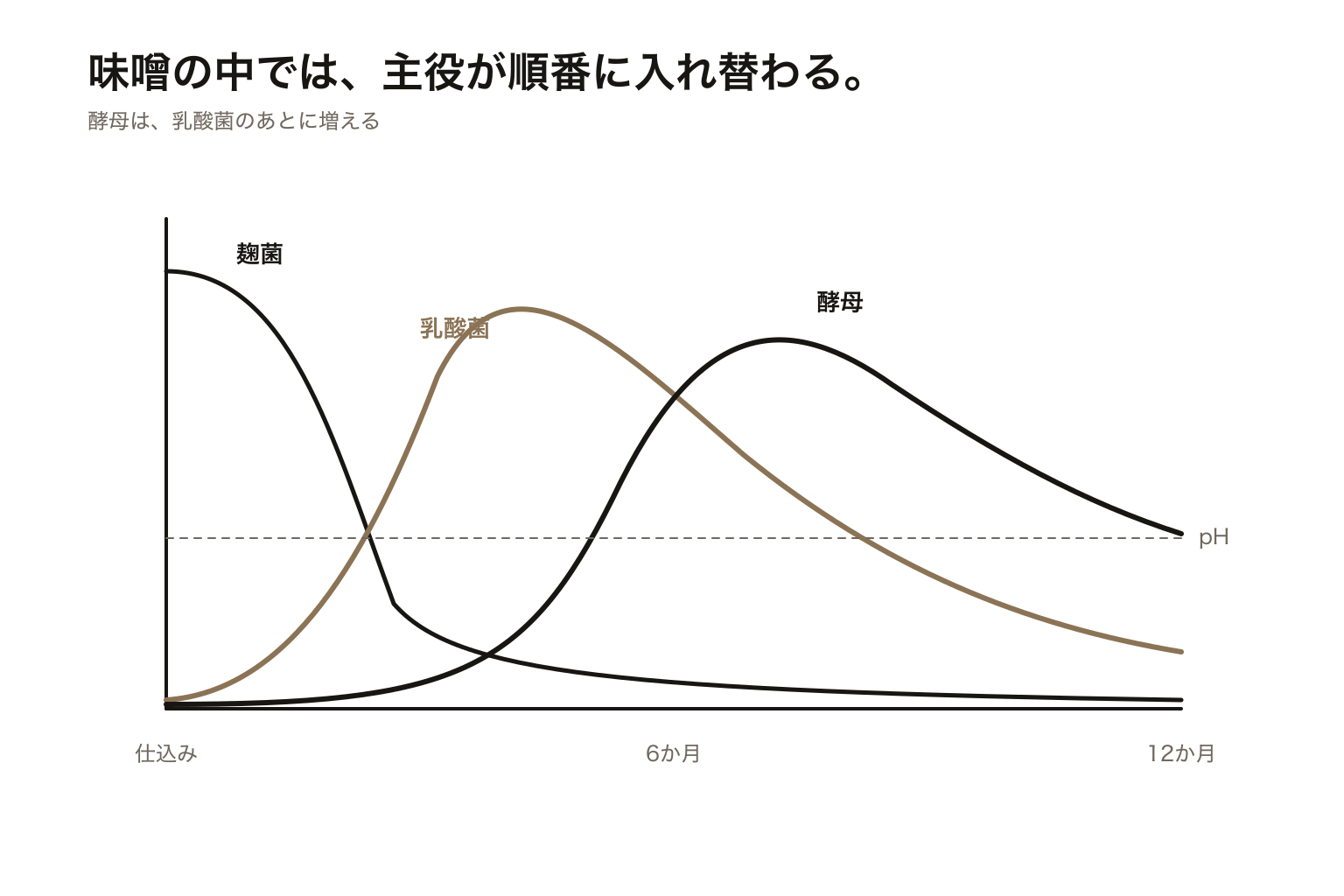
The labels in this illustration are in Japanese.
But if you file it away as "the pH falls, so yeasts come after lactic acid bacteria", it will break down later. There are at least three reasons why the lactic acid bacteria rise first.
- The pH of 5.7-6.0 just after preparing the batch is already close to the band T. halophilus likes. It starts from an advantageous position.
- Lactic acid bacteria have a shorter generation time. Set off at the same starting gun and they are simply faster.
- Breweries often add ten times as much cultured lactic acid bacteria as yeast. A design that gives them the first move is built in on the human side too.
The effect of pH also depends on who is involved. For the late-maturation Candida yeasts, practice says to add them "once the moromi pH has fallen to about 5.3", and the mechanism bites hard. For the main fermentation yeast Z. rouxii, on the other hand, there really are groups of strains that grow vigorously at pH 3.5-6.5 even under high salt. In mixed culture at 18% salt and an initial pH of 6.0, one report found that lactic fermentation had no effect on yeast growth — and that the yeasts rather suppressed the fermentation of the lactic acid bacteria. So "lactic acid bacteria first" is robust, while "yeasts cannot work until the pH falls" is close to essential for the late-maturation yeasts and advantageous but not absolute for the main fermentation yeast. That, we think, is the reading faithful to the primary sources.
Why do the yeasts not break the sugar down all the way?
Here we should open up the fact that the word "fermentation", used throughout this book, actually has two definitions. One is the food-science definition: food changed by the action of microbes into something beneficial to people, with no question of oxygen. The other is the biochemical definition: metabolism without oxygen, drawing out energy without borrowing an external acceptor for electrons. The two do not overlap cleanly.
Seen from the biochemical side, things become clear. With oxygen, a microbe can break sugar all the way down to carbon dioxide and water, taking about 30 ATP (the energy currency of the cell) from one molecule of glucose. Without oxygen it cannot get that far. It has to stop the breakdown partway and throw the surplus electrons out along with them, in the form of alcohol or lactic acid. The net yield is about 2 ATP.
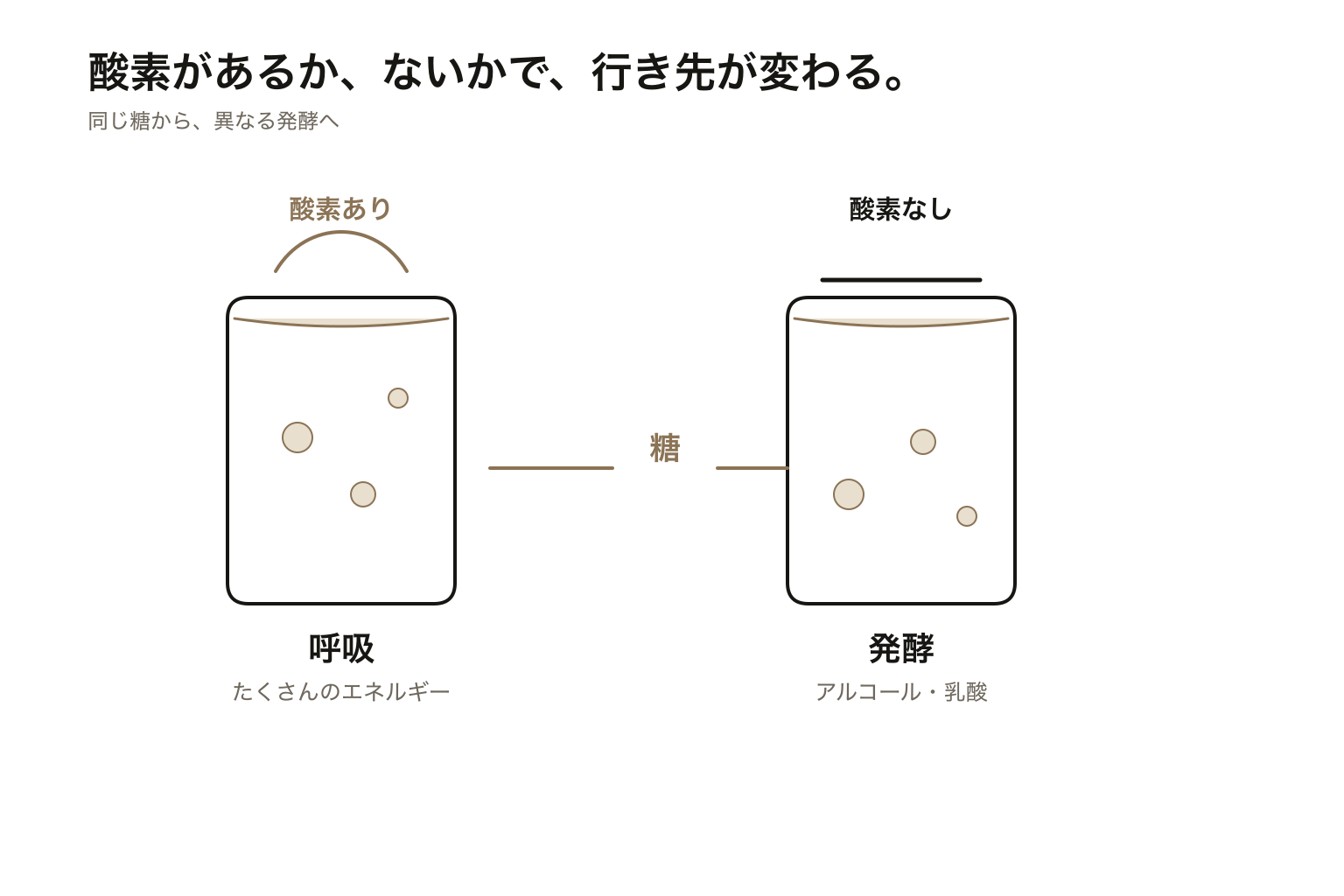
The labels in this illustration are in Japanese.
So the alcohol behind the aroma of miso was not made for us by the yeasts. It is waste they had no choice but to discard in order to survive where there is no oxygen. Not using sugar to the last is not a matter of ability but a constraint of the pathway.
That said, calling the inside of miso completely oxygen-free is also an approximation. The purposes of the mixing that breweries carry out formally include "supplying oxygen to encourage the growth of yeasts", alongside evening out the batch and releasing heat. Z. rouxii requires oxygen to multiply (some sources write that it grows only under aerobic conditions), while alcoholic fermentation itself proceeds without oxygen. The late-maturation Candida yeasts can multiply at lower oxygen than that. This is the interesting part: the reality is not "anaerobic" but microaerophilic, or more precisely a system short of oxygen.
Increase has a fixed shape
The way microbes increase has a fixed shape: the lag phase before growth begins, the log phase of explosive doubling, the stationary phase where numbers neither rise nor fall, and the death phase. In a long system like miso, these curves for many species overlap with a time lag, so the whole looks like a gentle handover.
Some measured figures. In a salty rice miso matured at 28-32°C for 85 days, lactic fermentation proceeded relatively early and finished on days 30-40. Yeasts reached their peak numbers on days 20-30 or days 40-50 depending on the group of strains, and alcohol took 15 to 25 days to reach 1%. In a test following a miso at a lower 20°C for 18 months, no culturable microbes at all could be detected by day 270, and breakdown after that was attributed to residual enzymes from the koji.
What is easy to miss here is that what shapes the flavor is not the high cell counts of the log phase. The thin, continuing metabolism of the stationary phase makes flavor over time, more than the period when the microbes are multiplying most vigorously. That is why the flavor goes on changing even in the later months when almost no microbes can be detected.
One more thing. Cell counts have to be read on a logarithmic scale or the shape itself is invisible. Ten to the fourth and ten to the sixth per gram are not "two apart" but a hundredfold. Drawn on an ordinary scale, the run-up just before the rise is flattened out, and it looks as if numbers exploded one day out of nowhere. Note also that all the figures given here come from batches to which lactic acid bacteria and yeasts were added by people. In a home-made miso with nothing added, neither the counts nor the timeline will follow this pattern.
When it goes wrong, the same words explain it
When this succession goes wrong, the same vocabulary explains that too. If the temperature is too high, the lactic acid bacteria run away with it. In soy sauce this is the abnormal fermentation known as hayawaki: a sudden drop in pH weakens the neutral protease and glutaminase of the koji mold, and the utilization of nitrogen falls. Glutamic acid also turns into pyroglutamic acid, so umami itself declines. It is not a straight line where the lower the pH the safer and tastier. There is a band you want to hit.
That is why preparing a batch in the cold season makes sense. Prepared at low temperature, the initial surge of lactic acid bacteria is itself held back. With the pH not falling all at once, the neutral protease of the koji mold has longer to work. The "cooled preparation" used in soy sauce to prevent hayawaki also holds the initial temperature of the moromi low, aiming at the same thing. Seeing temperature not as a dial for "speeding up or slowing down fermentation" but as a dial for "changing how fast the pH falls and how the time available to the enzymes is allocated" lets you read traditional practice as design.
So what happens if you raise the temperature without applying salt? That is not a failure but a different design. Held at around 40°C without salt, soybeans go down a line known as the Bacillus type. Natto is held in that temperature range for roughly 16-24 hours, and Korean cheonggukjang for 2-3 days. The walls of miso deliberately close that road.
And spoilage organisms fail to establish themselves not because they are being killed. It is because the nutrients and the space have already been taken by the earlier residents, and they lose on speed of increase. This is called competitive exclusion, or antagonism. It happens inside miso as well. In a test adding ethyl alcohol, growth of lactic acid bacteria became sluggish at 0.5% and almost stopped above 1%. Breweries turn this to their advantage with a technique called heavy yeast addition, adding ten times as much yeast as lactic acid bacteria in order to suppress lactic fermentation.
The handover is not automatic upstream either. Some strains of koji mold have been reported to produce a substance (hepteridic acid) that interferes with the growth of halotolerant lactic acid bacteria, and this is regarded as one possible cause of the practical complaint that lactic acid does not appear even though lactic acid bacteria were added. Fermentation is a technique for increasing the microbes you want, and equally a technique for not letting the others run.
How do we know the cast — the methods that do not culture
We have been listing names and numbers of microbes, but how were they counted? The classical method is to spread a sample on a medium and count the colonies. It is a reliable method with a decisive weakness: any microbe that will not grow on that medium is not counted, however many there are. Microbes in a viable but non-culturable state (VBNC) are missed as well.
What is used now are methods that read without growing. Analyses that identify species by reading the sequence of 16S rRNA, a gene common to bacteria, and metagenomics, which reads the DNA contained in a sample all together. Discovering that culturable microbes are only a small fraction of the whole was a decisive turning point for microbial ecology.
With that view, the numbers in the previous section read differently too. "Not detected on day 270" means, precisely, "not detectable by culture". Much of the Japanese primary literature comes from plate culture in the 1970s and 1980s; the information is dense, but it may carry this blind spot.
And there are still not many studies that have applied time-series metagenomics to miso itself. For the microbial communities of home-made miso, there are only fragmentary reports. It is not that this is unknown but that it has not yet been sufficiently measured — and it is this means of measuring that turned the question of the next chapter, whether the house microbes really do decide the flavor, into something that can be checked.