
Down the Fermentation Rabbit Hole — 05
There is no such molecule as "the smell of miso"
Aroma compounds and browning — putting the names of substances to what you smelled
About 9 min read
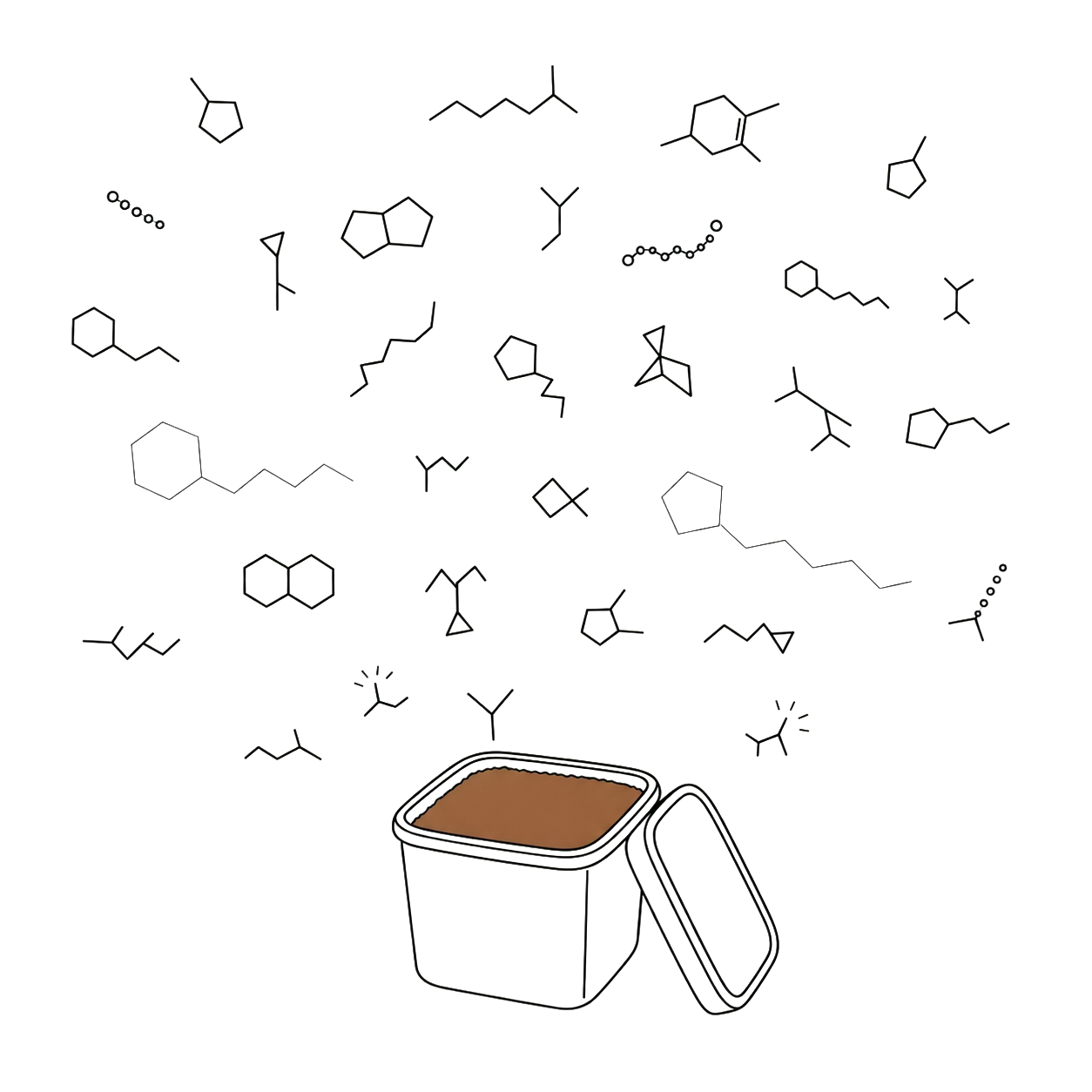
That smell when you lift the lid. Something sweet, something toasted, something a little like sake. What substance is it? The honest answer is: it is not one substance.
Chapter 3 of Basics dealt with this in two lines: aroma is made by yeasts, and color deepens through the Maillard reaction. Here we open those two lines out to the names of molecules and to the concentrations a person can actually perceive. And at the end we check how far the phrase "the longer you leave it, the better it gets" is true.
No molecule smells of miso when you sniff it on its own
Two hundred and eight aroma compounds have been reported from rice miso, of which 193 have been confirmed against reference standards and the like. Soy sauce goes past 300. More interesting than the count, though, is the breakdown. Nobuo Homma, who compiled the list, concluded that almost all the aroma compounds found in miso are also found in other foods, and that none is recognized as unique to miso.
So you cannot pull out a single "molecule of the smell of miso". That smell arises as the sum of several hundred volatile compounds arriving at the nose all at once.
There are compounds that strongly shape the character of miso, though. The leading example is HEMF (4-hydroxy-2(or 5)-ethyl-5(or 2)-methyl-3(2H)-furanone). It has a sweet, scorched, caramel-like aroma. It was originally known as a characteristic aroma of soy sauce, and Etsuko Sugawara first isolated it from a red salty rice miso in 1991. In quantity there is actually about ten times more of it in soy sauce, so it is not a compound exclusive to miso either.
This is the interesting part: the way this molecule is made is rather unusual. In test batches prepared without adding the halotolerant yeast Zygosaccharomyces rouxii, HEMF was not detected at any point during maturation. So does the yeast make it? Not that either. Tracing the carbon with stable isotopes shows that the five-membered ring side comes from a five-carbon precursor formed by the Maillard reaction between sugar and amino acids, while the ethyl branch comes from acetaldehyde released from sugar by the yeast. Joining the two parts is where the enzyme of the yeast is needed.
The enzymes of the koji prepare the sugar and the amino acids, time lets them react, and the yeast plays the final move. Take any one away and this aroma does not appear. That is why HEMF is not detected in sweet rice miso or bean miso, where yeasts barely work. When the aroma is born is decided by the changing of residents we saw in Chapter 4 of this series.
The most abundant compound is not necessarily the leading one
To talk about aroma you need a second measure alongside quantity: the lowest concentration at which a person can perceive the smell (the threshold). That value differs between compounds by orders of magnitude.
In measurements of one miso suspension, isoamyl alcohol came in at 14.6 ppm and HEMF at 24.1 ppm — the same order of magnitude. Yet the threshold of HEMF in aqueous solution has been reported at 20 micrograms per liter (20 ppb) or below. More extreme still is 2-furanmethanethiol, which smells of coffee (a threshold of 0.4 nanograms per liter has been reported). Sulfur-containing compounds are deeply involved in aroma while being invisible in terms of quantity.
So the methods of investigation come in two stages as well. First, gas chromatography-mass spectrometry separates the compounds and establishes what is present and how much. Then a person sniffs the separated compounds one by one. The aroma concentrate is diluted step by step, and the compounds still detectable at the greatest dilution count as having the strongest effect (that is, the largest contribution). By this method, only two things gave the highest values in an unheated miso suspension: HEMF, and a peak where HDMF overlapped with gamma-nonalactone.
There is also the case of methionol, long held to be a characteristic aroma of miso, which came in lowest in this sample system. The compounds an instrument can pick up and the compounds a person perceives do not line up neatly. The final judgment is still delivered by the human nose.
Color and aroma are two exits from the same reaction
We now turn to color, though in truth the subject has not changed. The Maillard reaction is not the name of one reaction. It begins where the carbonyl group of a sugar joins the amino group of an amino acid, passes through a rearrangement called the Amadori rearrangement, and branches from there. What goes down the road of Strecker degradation becomes aldehydes with a smell. Methional, prominent in heated miso soup and reminiscent of boiled potato, is thought to be the product of a sulfur-containing amino acid taking that road. What goes on joining together (that is, polymerizing) becomes the brown pigment melanoidin.
So the deepening of color (browning) and the making of aroma are not two separate phenomena. They are two branches off the same trunk. What Chapter 3 of Basics explained separately as "taste is taste, aroma is aroma, color is color" joins into one here.
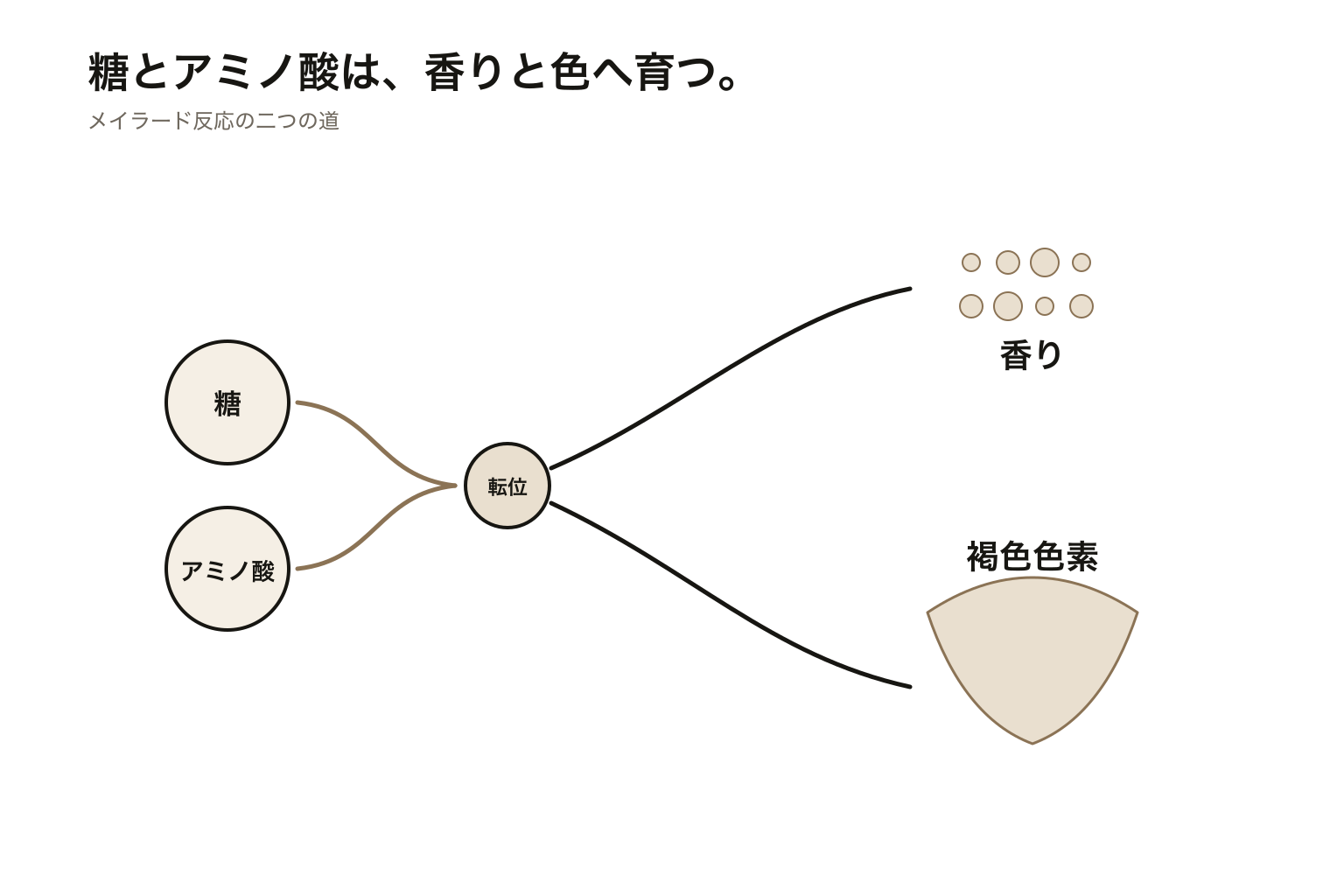
The labels in this illustration are in Japanese.
This reaction uses no enzymes, so it does not stop
The Maillard reaction is also called non-enzymatic browning. As the name says, it borrows no help from enzymes. So it goes on advancing after the koji mold is gone and after the enzymes have lost their activity. Refrigeration works not by stopping it but by slowing it down.
| Storage temperature | Degree of coloration after three months |
|---|---|
| 4°C | 0.035 |
| 20°C | 0.055 |
| 37°C | 0.430 |
Values measured on a commercial rice miso (11.6% salt). Coloration is absorbance at 415 nm; the initial value was 0.025. Yamabe (1991).
Over the same three months, that is about 1.4 times at 4°C, 2.2 times at 20°C and roughly 17 times at 37°C. And comparing the increments shows that the effect between 20°C and 37°C is far greater than between 4°C and 20°C. The higher the temperature, the more the acceleration itself increases.
So even for the same "half a year", a batch prepared in winter and kept somewhere cool arrives at a different place from one that spent a summer in a warm room. Chapter 5 of Basics said that where you put it decides the color and the speed; this reaction is the main reason. Half a year is not a count of days but an accumulation of temperature.
Browning uses amino acids, so if it goes too far the umami thins
Here is where this chapter turns over. The raw materials of the Maillard reaction are the very free amino acids that the enzymes of the koji cut out. Color deepening also means the raw material of umami decreasing.
A report measuring free glutamic acid in commercial miso found 746.1 mg/100 g in the pale, salty Shinshu miso, against 213.6 in a red miso and 182.1 mg/100 g in Sendai miso. That is a third to a quarter. As early as 1968 it was reported that the amino acids particularly scarce in red miso are lysine, arginine and glutamic acid. The amino group on the side chain of lysine is the part most reactive in this reaction, so the order makes chemical sense too.
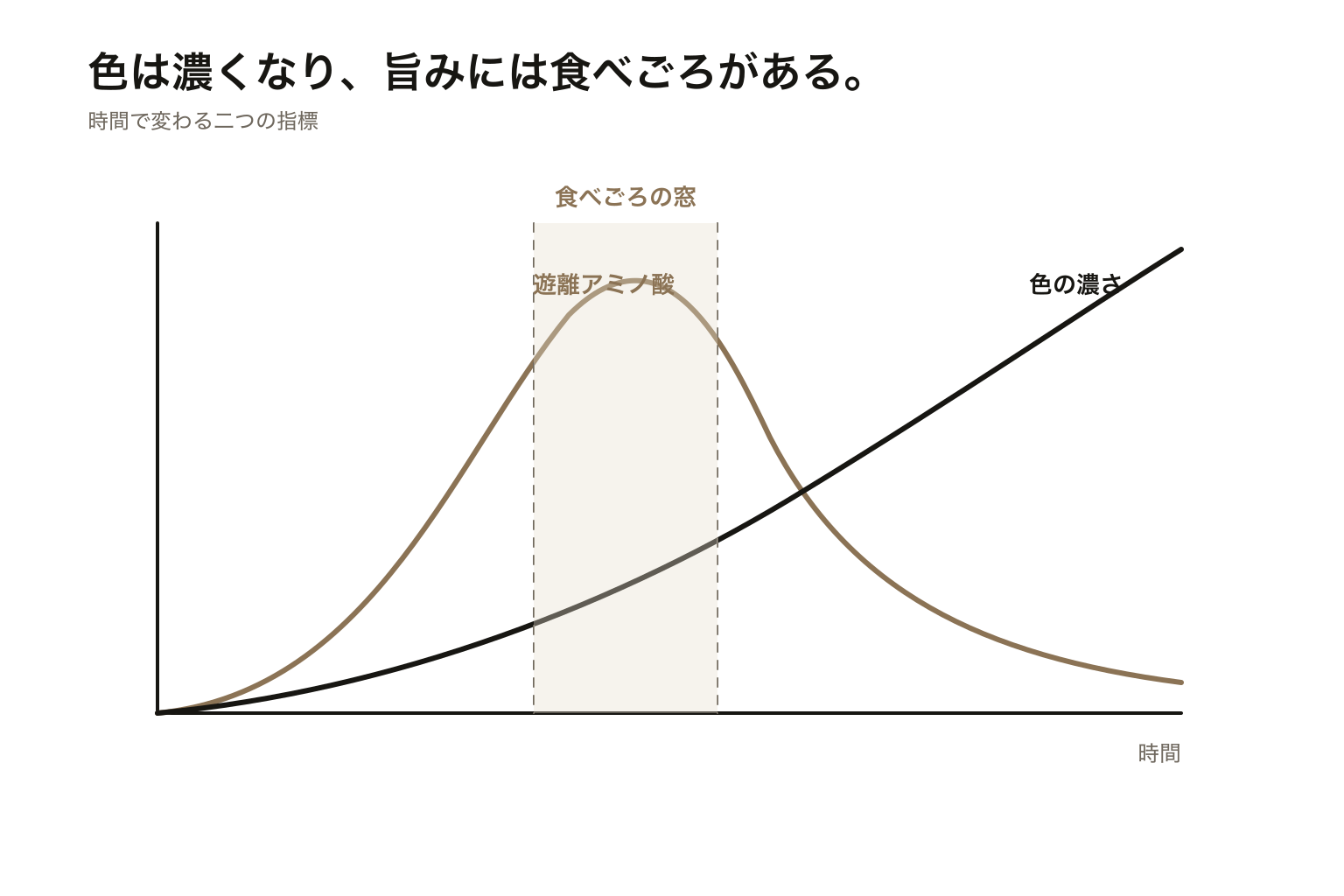
The labels in this illustration are in Japanese.
Umami is not the only thing that declines. HEMF itself is not very robust either. In trial brews it reached a maximum at 45-60 days of maturation and then broke down and fell. In storage tests with the yeast contribution stopped, about 80% of the original amount remained after 180 days at 5°C, whereas at 30°C it fell to about 30% in 60 days and was undetectable after 180 days.
The peak of umami, the peak of aroma, and your preference in color. These three do not arrive on the same day. So there is no "correct day"; rather, the window for eating moves depending on what you care about.
That said, a long maturation is not all loss. Melanoidin brings body and a toasted quality along with the color.
And not all the protein in miso is cut down as far as amino acids. In the rice miso Yamabe measured, the portion counted as free amino groups (formol nitrogen) was 24.5% of total nitrogen, and the water-soluble portion was 62.5%. The difference, just under 40% of total nitrogen, is peptides that stopped short of amino acids. The remainder is protein that neither dissolved in water nor was fully cut. The thickness of a red miso is carried by that peptide side.
Something kept too long at high temperature is another matter, though. In a test storing rice miso at 37°C for three months, coloration increased seventeenfold while acidity roughly doubled, the pH fell from around 5.4 to around 4.5, and an off-odor close to rancid oil appeared. That is one example of what "gone too far" looks like when you actually measure it.
And the aroma is lost in the pot
Finally we come back to the kitchen. Many of the compounds we have looked at fly off easily (they are volatile) and are also weak to heat.
In an experiment heating a suspension of red salty rice miso at 98°C for 30 minutes, the number of distinguishable aromas fell from 57 to 45. What matters, though, is the breakdown of that. Twenty-four disappeared and twelve were newly born. Those that disappeared were largely "sweet", "fresh" and "fermented"; those that appeared were largely "cloying", "burnt" and "sour".
So an over-boiled miso soup has not merely lost its aroma. The outcome is the balance between what flew off and what newly appeared. The main culprit behind "it tastes worse" is, if anything, the addition. Measured out, isoamyl alcohol fell from 14.6 ppm to 0.1 ppm and HEMF from 24.1 to 9.2, while methional increased. The Strecker degradation of the third section is running inside the pot as well.
Incidentally, the account that this smell arises "because methionol is oxidized by heat into methional" circulated for a long time, but experiments did not confirm it. Adding methionol and heating it produced almost no methional. This is an example of a sentence written as conjecture being quoted secondhand as settled fact.
Looked at by temperature, heating for 15 minutes kept the aroma close to unheated up to 70°C, and sweet aromas even increased. Above 80°C it is lost rapidly, and at 98°C almost nothing can be perceived. The kitchen rule that "miso goes in just before you turn off the heat" has proper backing at the level of the compounds.
Even when the aroma weakens, the umami remains. And here there is a reliable ally: dashi. Miso has glutamic acid but almost no nucleotide umami compounds. Bring the two together and the perceived strength jumps beyond simple addition.
There is a measurement from soy sauce. Taste compounds were added to soy sauce, which was poured over tofu, and people were asked whether they could tell it from the original. Monosodium glutamate had to be added at 3.9% relative to the soy sauce before a difference could be told. With a nucleotide, 0.03% was enough — a hundred and thirtieth of that. The paper reads this as the synergy showing up strongly precisely because soy sauce contains no nucleotides to begin with.
Miso is on the same side in containing almost no nucleotides. When you want to strengthen the umami, pairing it with dashi works by an order of magnitude more than adding more miso.
Miso goes on quietly advancing after it is opened, too. HEMF is oxidized and broken down when exposed to air. Refrigeration does not stop the reaction, only slow it. Dividing miso into small portions to reduce the surface in contact with air is a measure for protecting the aroma.
So far this has been about what happens inside miso. What remains is where it happens — the story of the place it is kept.