
Down the Fermentation Rabbit Hole — 03
Salt is not killing the microbes. It is taking the water first
Water activity, hurdle technology, and the number we choose not to show
About 9 min read
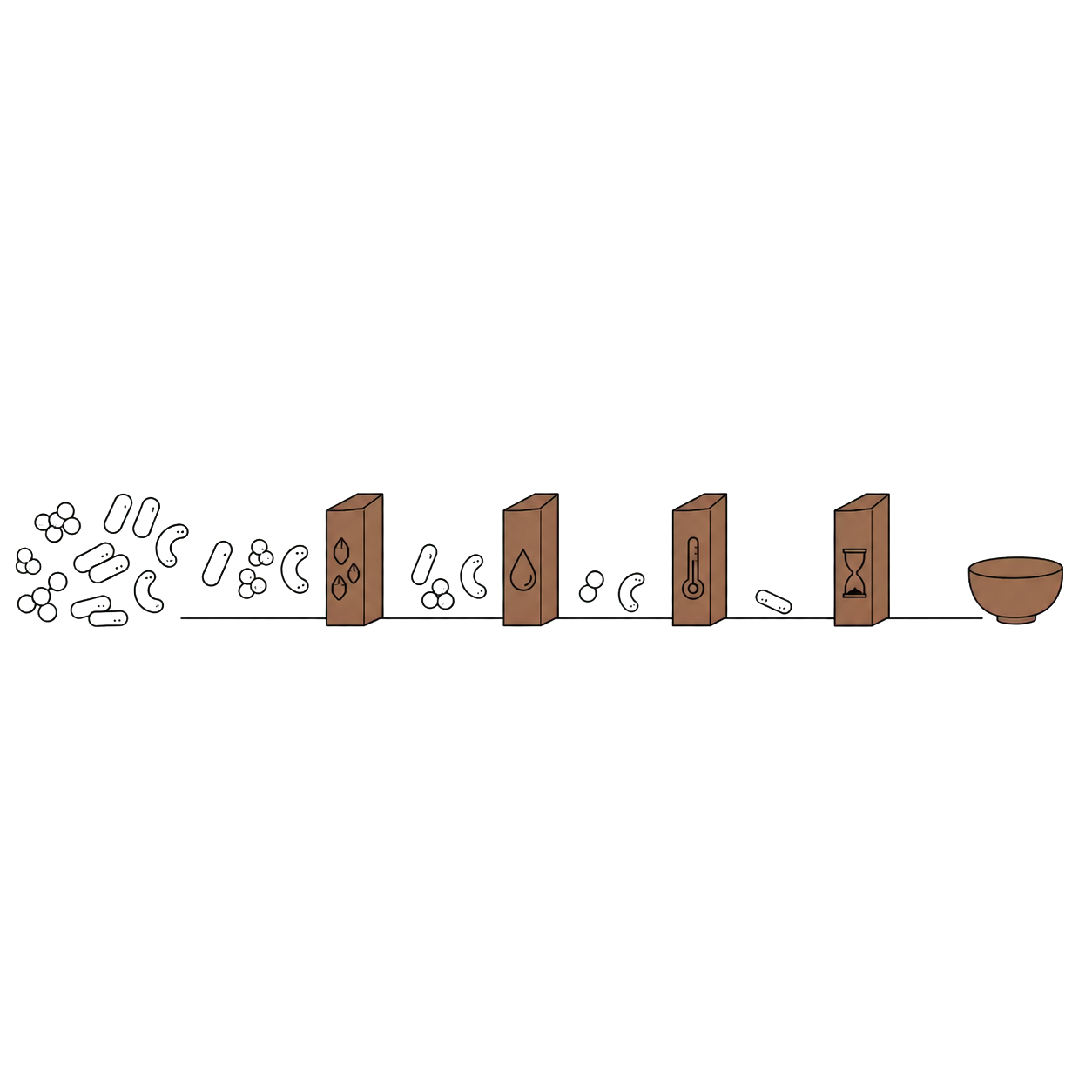
"Salt has an antibacterial action" is a widely accepted way of putting it. It is usually the explanation given for why miso does not spoil when left at room temperature for half a year.
But what salt is doing inside miso is not killing microbes. It is getting hold of the water before they do. Chapter 4 of Basics put this as "salt takes away the water the microbes could use, first".
From here we look at that "usable water" as a quantity. Once it becomes a quantity, the very way of asking "how much salt is safe" shifts a little.
What is doing the work is not the total amount of water but the amount that can be used
Put a cell into concentrated brine and the water inside the cell moves out. Across a membrane, water moves toward whichever side has more dissolved in it. This is osmotic pressure. From the microbe's point of view, the water is drawn out of its body and its metabolism cannot turn over. Salt is not acting as a poison; it is simply taking away the microbe's workplace first.
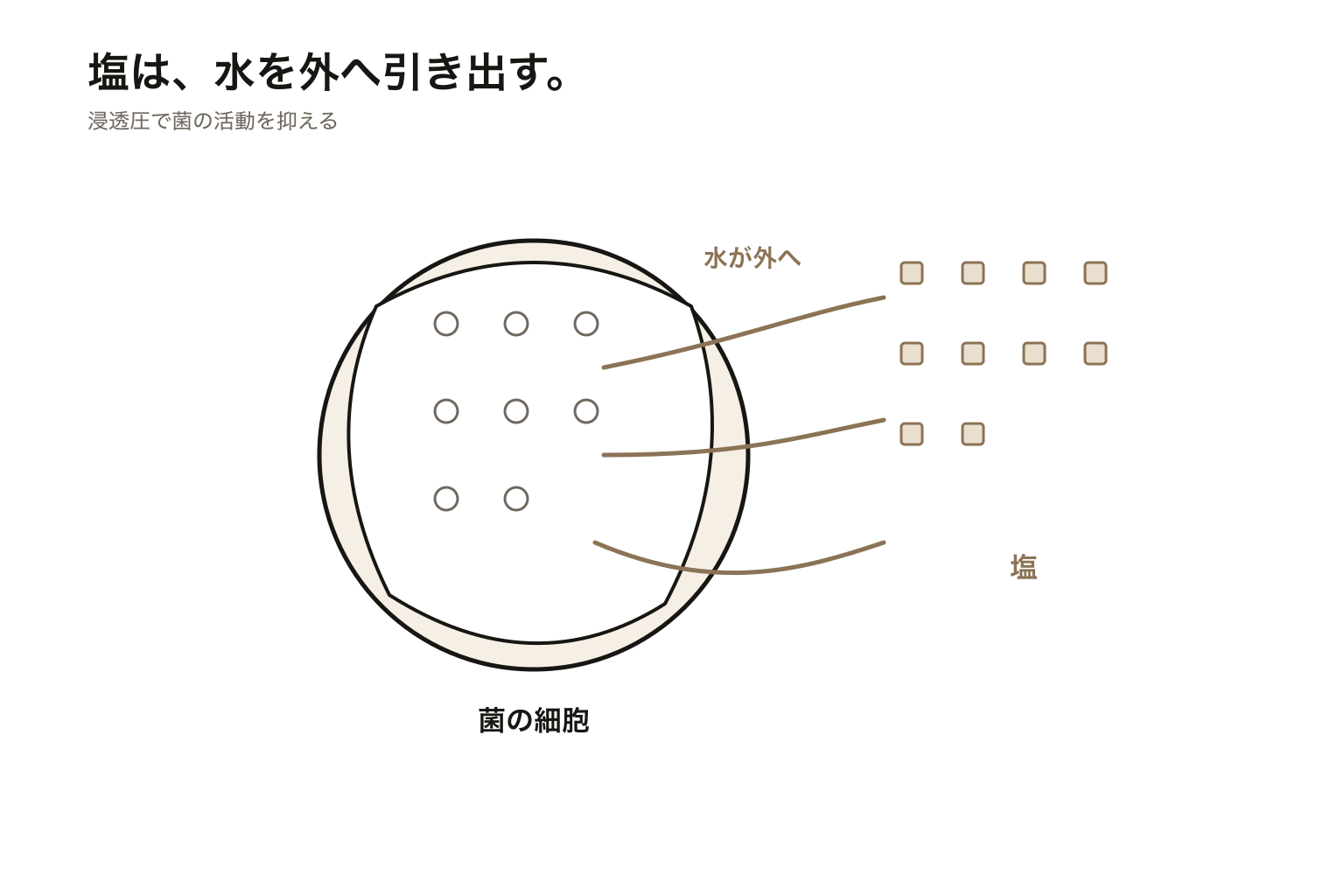
The labels in this illustration are in Japanese.
So how do you measure how much water is available to a microbe? This is where water activity comes in (the proportion of water in a food that can move freely; the symbol is aw). Pure water at the same temperature is taken as 1.00, and the value expresses how far below that you are. The interesting part is that dissolving salt or sugar does not change the total amount of water at all, and yet aw falls. Water molecules are tethered around what is dissolved, and the share the microbes can take away shrinks.
Roughly 40-53% of the weight of miso is water. Analyses of entries to the national judging fairs put the average for pale salty miso at 45.3% and for red salty miso at 46.7%. Nearly half is water, and it feels moist to the touch. Even so, measured aw values reported across various studies fall broadly between 0.68 and 0.83, and most of them sit in the 0.7s.
The lower limit for life varies from microbe to microbe
How far do you have to lower aw to be safe? There is no single answer, because the lower limit for survival differs by type of organism.
In the classification table of the Japan Food Research Laboratories, the limit is around 0.90 for many bacteria, 0.88 for many yeasts and about 0.80 for many molds. Halophilic bacteria go down to 0.75, and xerotolerant molds and osmotolerant yeasts can be active lower still. In that table, miso and soy sauce appear in the 0.80-0.75 row, the same place as jam, marmalade and honey.
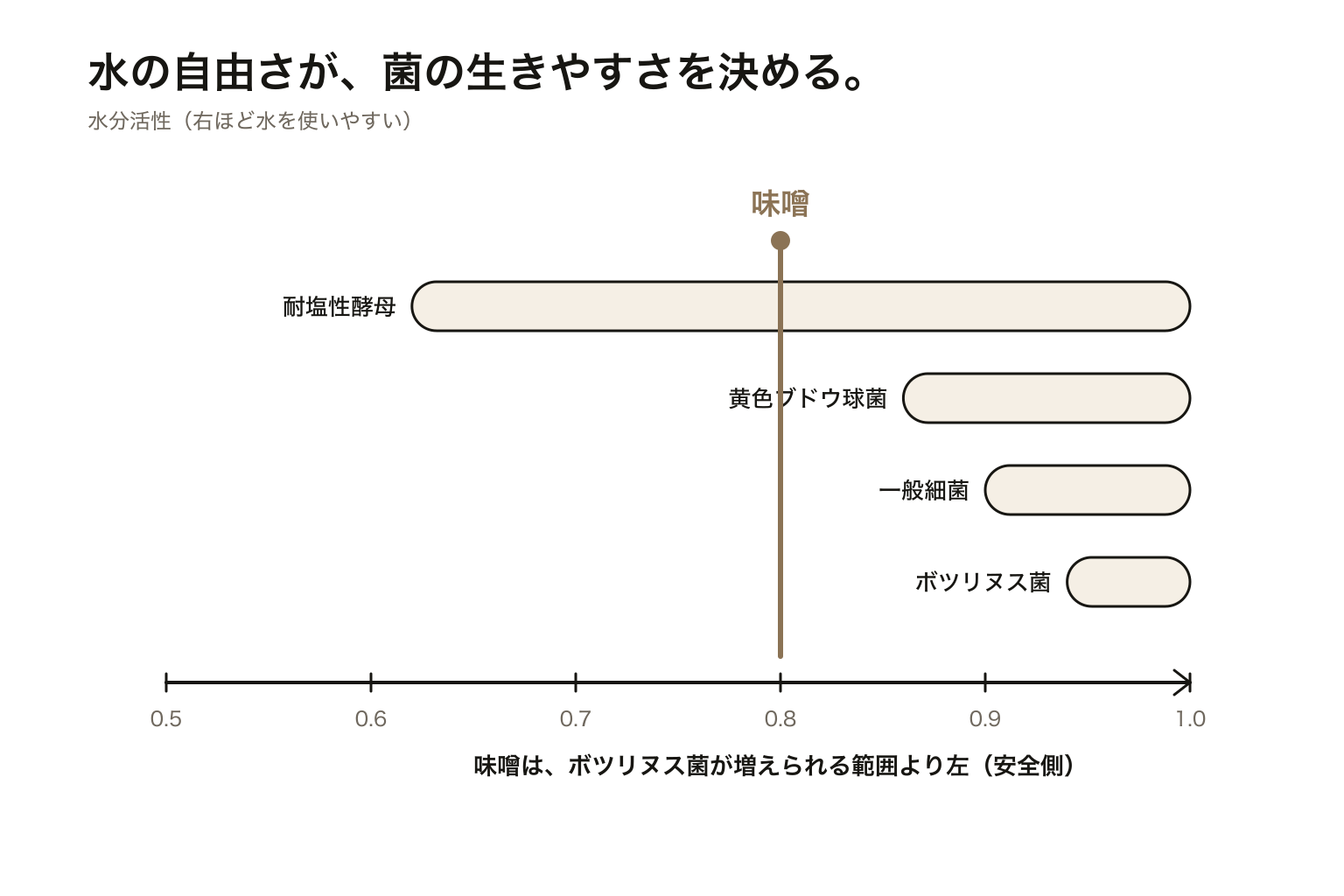
The labels in this illustration are in Japanese.
This is what lay behind the line in Chapter 4 of Basics, "salt is a filter that selects". Apply salt to lower aw and the least tolerant microbes drop out first, and the cast that remains changes. It is not that the inside of miso is clean; it is that only a few can live there.
Clostridium botulinum may be the worry. It grows where there is no oxygen (it is anaerobic), so the low-oxygen interior of miso looks as if it might suit. But the literature survey by the Food Safety Commission of Japan gives a minimum water activity for growth of 0.94 for group I, and the table from the US FDA gives 0.935, while measured values for miso are more than 0.1 below that. Worth noting alongside this is that pH is not the leading actor. The pH of miso is broadly 4.55-5.30, and plenty of samples do not go below 4.6, which is given as the lower limit for growth. "Fermented foods are safe because they are sour" is often said, but it does not hold for miso.
Several low walls, stacked
This way of counting the walls one at a time has a name: hurdle technology. Water activity, pH, temperature, oxygen, time, and the way microbes that took the ground first shut out those arriving later (competitive exclusion). Each is a low wall that could be cleared on its own, but stacked together they add up to practical keeping quality.
What matters is that the effects multiply rather than add. The conditions the FDA table lists for Clostridium botulinum are aw at or above 0.935, pH at or above 4.6, 10°C or higher, and an environment without oxygen. It can grow only when all of these hold at once. The table itself notes that these are reported extreme values, not design values with a margin built in.
The walls also rise as fermentation itself proceeds. According to measurements by Hisao Yoshii, salt is not the only thing pushing down the aw of miso. Sugars account for 0.013-0.017 and nitrogenous components such as amino acids for 0.030-0.035, together lowering it by about 0.04-0.05 quite apart from the salt. As enzymes cut the soybeans and the resulting molecules dissolve, free water declines. The reaction that makes flavor and the reaction that shores up the defenses are, in fact, one and the same.
So a change that thins one wall alters how all the rest work at the same time. The reduced-salt trials at the Miyagi Prefectural Industrial Technology Center are a case in point. In batches with the salt lowered to 9%, a water content of 46% was optimal; raising the water to 48% dropped the pH to 4.68 by the third month of maturation, and souring appeared. Cutting the salt, adding water, letting air in partway: each looks like a small adjustment to a single item, and each is in fact a redesign of the whole.
Why this site does not show the salt measure that specialists use
In brewing, alongside the salt percentage by finished weight, a measure is used that expresses the relationship between salt and water. The trouble is that two ways of taking the denominator are in circulation: one follows the original literature, and the other grew out of how the words sound.
The awkward part is that the mistaken one always returns a larger value. For the same miso, that is a gap of 1-2 points for a sweet miso and more than 5 points for a salty one. And a larger value looks like "plenty of margin". In other words, this mix-up always falls on the dangerous side. Since it still works as an arithmetic formula, checking your working will not reveal the contradiction.
That mix-up actually happened on this site. The calculation had been written with the wrong definition, and the display was making things look safer than they were. We fixed it, and then decided not to display the measure at all.
So the only salt figure this site gives is the percentage by weight of the finished miso. Not comparing numbers with different definitions is itself, we think, a safety technique in fermentation practice. This is not withholding information; it is declining to place side by side numbers that cannot be compared.
Presets with fixed proportions are not a missing feature but a chosen design
Traditional miso recipes, when you actually measure them, sit in a comfortable place. Even the sweetest, lowest-salt miso has an aw of 0.75-0.80, averaging around 0.78. That is more than 0.13 away from the 0.935-0.94 lower limit for Clostridium botulinum. What produces that margin is not the amount of salt alone but the whole composition, sugars and amino acids included.
There is peer-reviewed support as well. Tanaka and colleagues inoculated three kinds of miso with extremely little salt, 2.36-5.79%, with types A and B of Clostridium botulinum and held them at 25°C for 18 weeks. No toxin was produced. But the aw of those three was 0.835-0.875 — higher than ordinary miso, yet still below the lower limit for the organism. It is a result with a condition attached: the composition was one that lowered aw even at low salt. You can equally read the paper as saying that safety cannot be discussed from the salt percentage alone.
It is worth knowing the case that runs the other way, too. The literature survey by the Food Safety Commission of Japan names home-made fermented soybean foods as the most common cause of food poisoning in China. What protects you is neither "fermentation" nor "soybeans" but the conditions. That Japanese miso has not caused incidents is, we think, most naturally explained by the fact that the proportions were historically fixed.
So this site offers only presets with fixed proportions, and lets you choose the amount alone. It is not that we lack a mechanism for judging safety; we chose a design in which situations calling for such a judgment do not arise. If you find yourself wanting to build a free recipe, that is something to do on a system that can watch several walls at once — the app, not here. That is where the line of responsibility is drawn.
Salting, sugaring and drying are the same thing done in different ways
Everything so far carries straight out beyond miso. Dried fish removes the water itself, jam tethers water with sugar, and shiokara and miso do the same with salt. The means differ, but they arrive at one place: reducing free water. That miso and soy sauce sit in the same band as jam and honey in the classification table is no coincidence.
Not every preserved food can be explained by that one point, though. What protects sauerkraut is mainly acid, and what protects wine and spirits is alcohol. The leading wall differs from food to food, and carrying the common sense of one type straight into another causes accidents. If, faced with a preserved food in your kitchen, you can ask "what is protecting this one?", then this chapter has already done its work.
And the walls of miso are not all standing the moment you prepare the batch. The second wall, acid, is produced by the few that made it past the salt. Who those few are, we have not yet named.