
Down the Fermentation Rabbit Hole — 06
When the same recipe tastes different, it is usually the temperature of where you kept it
Breaking terroir down into things you can measure
About 8 min read
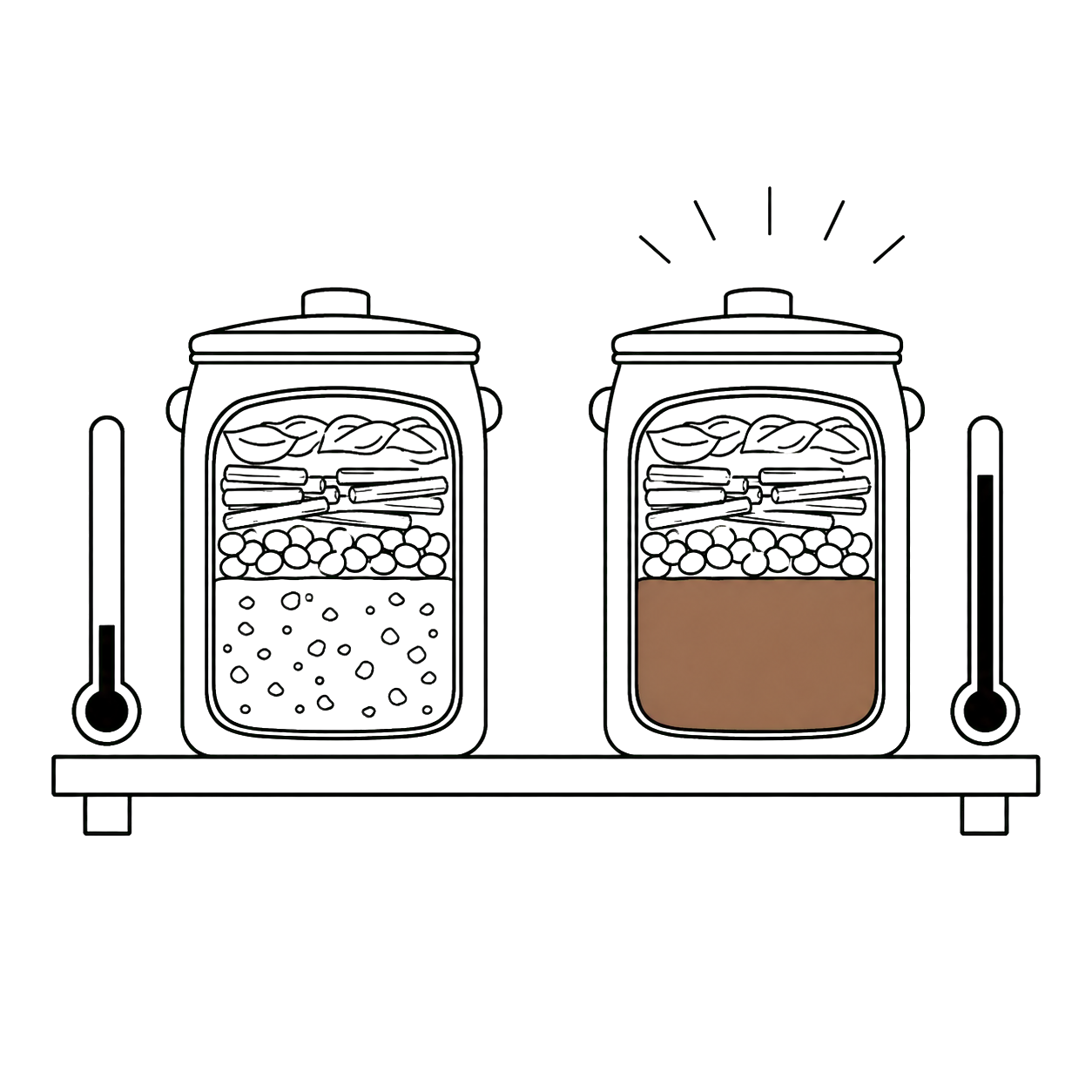
The same recipe, ingredients from the same shop, the same movements as last year. And yet when you open it, it is different from last year. Almost everyone who has made miso at home for a few years runs into this.
The explanation you hear most often is "the microbes of this place", "the microbes of our house". It is not a bad explanation. That a place has microbes of its own really has been confirmed by measurement. How much they are doing, though, is another matter.
Chapter 5 of Basics said that "the temperature history of where you keep it decides the color and the speed six months later", and went no further into the contents. This chapter deals with those contents. We reorder the differences in flavor from the largest effect down, and draw a line between the part that can be measured and the part that remains after measuring.
The microbes of a place really do exist. But the order of their effect is a little different from the story that has been told
Let us start by granting the part that has been confirmed. Swab the floor, the wooden shelves, the cloth and the surfaces of the fermentation tanks of a sake brewery and read the DNA, and the cast of microbes on the raw materials (koji and water) is clearly distinct from the cast belonging to the building. Buildings have residents of their own. That much is certain.
A study following a sake yeast starter for about a month was also able to trace those environmental microbes actually entering the batch. The prominent sources were the surfaces of the fermentation tank and the cloth, along with the floors of the koji room and the cold room. But this study limited sampling to ten points across floors, tools and raw materials, and left walls and ceilings out from the start. It is not a result that can say anything about walls.
As for the famous story that "the flavor changed after the brewery walls were repainted", no underlying source can be found in the peer-reviewed literature or in public institutional material. When a building is renovated, the people, the air conditioning and the tanks all change with it. Isolating the microbes on the walls is, in fact, quite hard.
And there is one result that matters most for the word terroir. When house bacteria were classified by production region, no regional grouping appeared. The interpretation is that the microbes were not so much supplied by the land as happening to get into that particular brewery and settle there.
The size of the effect has been measured too. In wine there is an experiment with a single variable: yeasts collected from six regions were used to ferment sterilized juice from the same lot from the same region. The variation in chemical composition explained by the region of the yeast was 10%, and 12.7% when weighted by aroma activity. Another study of the microbial communities on grape skins found that region explained 13.7% of the variance for fungi and 6.6% for bacteria, less than cultivar (23.9% for fungi, 12.9% for bacteria).
For miso, verification at that level does not exist yet. Technical literature in the industry goes no further than saying that the involvement of microorganisms other than those deliberately added "is presumed". So "the microbes of the brewery decide the flavor of miso" is not a refuted hypothesis but an unverified one.
So what is actually doing the most? The order is most naturally seen as: temperature history; the lot of raw material (soybean variety and harvest, and the enzyme titer of the koji); the physical conditions of the batch (particle size, water content, how tightly it is packed); and then microbes from the environment. The tradition was not wrong. What the tradition contained has become measurable.
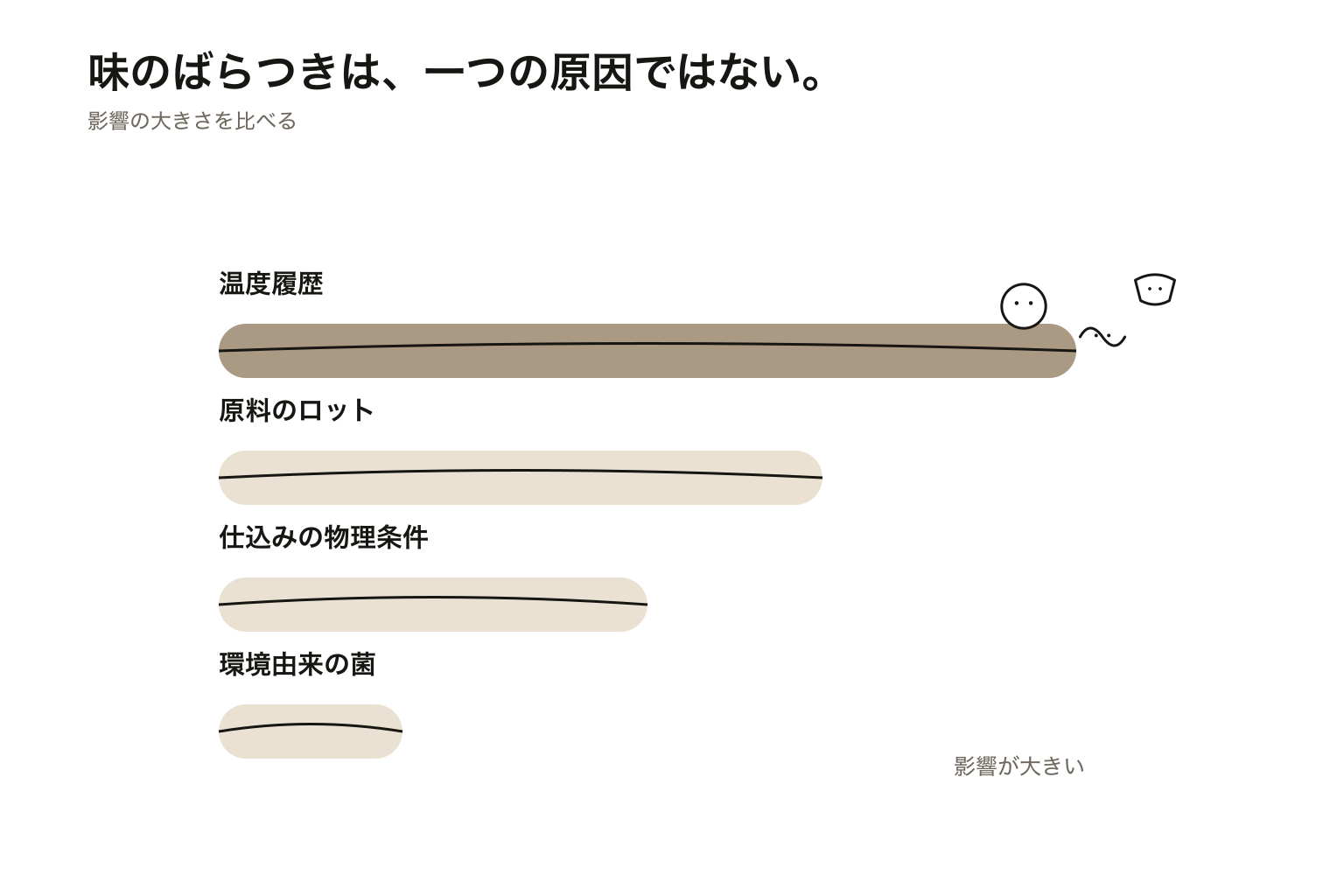
The labels in this illustration are in Japanese.
Home-made miso differs every time because the temperature where you kept it differed
Let us shift the subject from place to conditions. Your kitchen is indeed a microbial environment. But miso works at home not because special microbes live there. Salt comes in, oxygen falls, the pH drops. Once those conditions hold, only the microbes suited to that environment are selected.
The inside of miso is a fairly extreme environment: roughly 10-13% salt by weight of the finished product, and a pH around 5. Only a very limited cast can multiply there — the halotolerant lactic acid bacterium Tetragenococcus halophilus and the halotolerant yeast Zygosaccharomyces rouxii and their like. So the story that "mixing with bare hands puts your own resident microbes in and gives the miso your household flavor" is hard to sustain as a mechanism. No grounds have so far been found for the idea that skin microbes could win through that selection pressure.
The strength of that selection pressure does vary a good deal by type of miso, though. A sweet miso at roughly 5-7% salt cannot be said to have the same defenses as a salty one. Think of it as a different design, one that assumes more water and a short finishing period.
Put the other way round, only once you know the order can you decide what to reach for. If you want to reduce year-to-year variation, there are four things to fix: where you keep it, when you prepare it, the size of the container, and where you buy your ingredients. Those four broadly cover the things that matter most.
Half a year is not a count of days but an accumulation of temperature
What decides how far things have gone is not the number of days but speed multiplied by time. Days are only an approximation of that. The idea is called accumulated temperature.
In numbers, the effect of temperature is almost violent. In tests keeping miso at different temperatures, a miso held at 20°C for four months fell in lightness from 15.0 to 7.4 — less than half. Over the same four months at 15°C it was 11.9, a fall of about 20%. At 5°C it was 14.1, with almost no change in composition or color. Another report measuring coloration itself found it about 1.4 times greater after three months at 4°C, about 2.2 times at 20°C and about 17 times at 37°C.
So "three months at 20°C" and "six months at 10°C" can arrive at a similar place even though the number of days differs twofold. Up to here, the idea of accumulated temperature gives a good approximation.
Simple addition is not enough, though. This is the interesting part: reactions differ in how sensitive they are to temperature. Browning, which makes the color, roughly doubles per 10 degrees in the lower range but rises far more steeply at high temperatures (a rough estimate from the measurements above puts it above fourfold). Breakdown by enzymes, on the other hand, stops if you raise the temperature too far, because the enzymes themselves are destroyed. Even for the same area under the curve, a hot-and-short path and a cool-and-long path arrive at different compositions. That is why a quickly made miso and a slowly made one are different things.
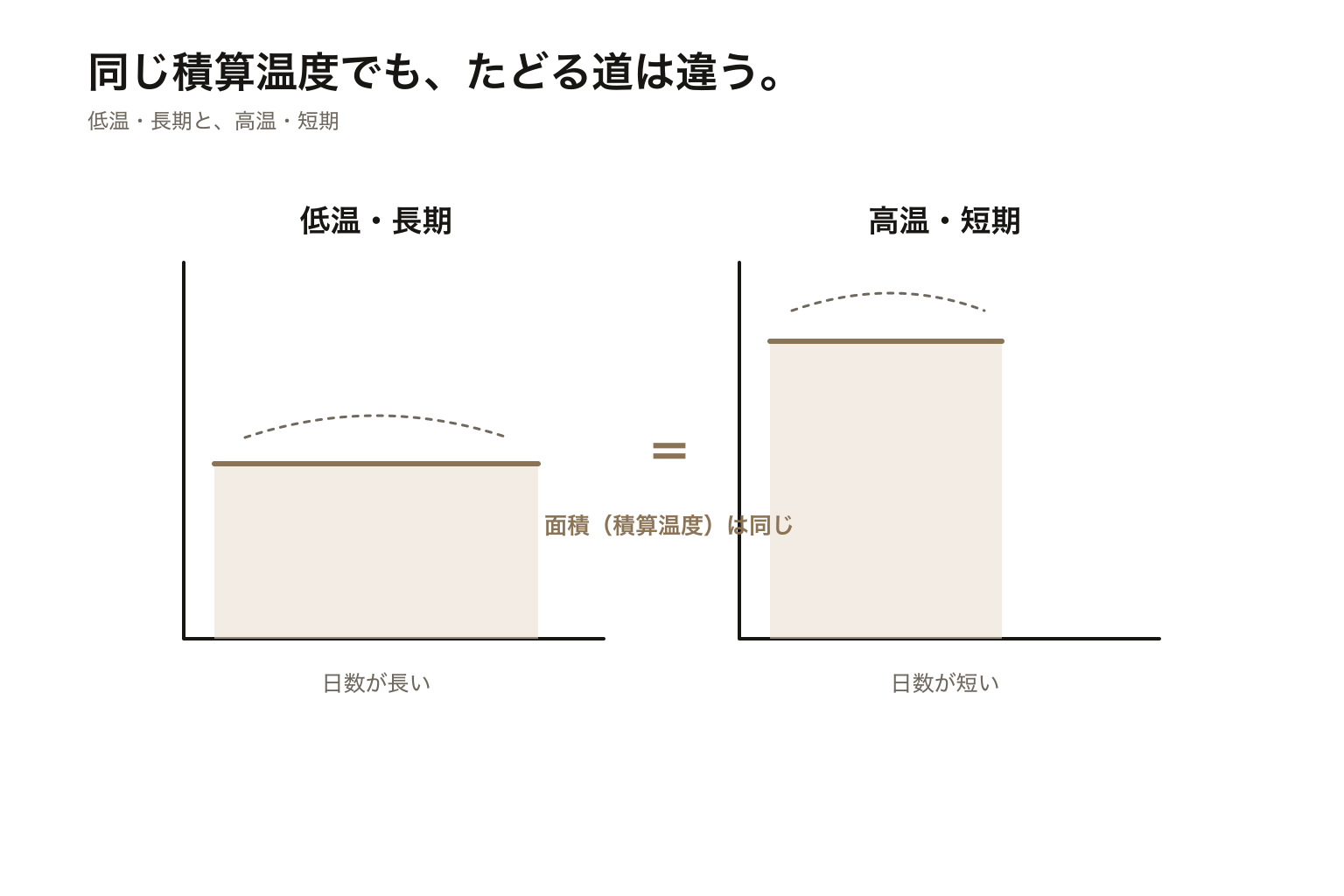
The labels in this illustration are in Japanese.
We could not find a published calculation model that converts household temperature swings (10°C in winter, 35°C in summer) into a state of maturation. We can explain the reasoning behind why such a prediction would work — because progress is an accumulation of temperature. But actually turning the temperature of your own storage place into a line and estimating when it will be ready is not a job for a browser.
Change the ingredient and every wall shifts in height
Does it have to be soybeans? The accurate answer is: "You can use something else. But it is not only the flavor that changes." Let us take apart what changing the substrate actually changes.
First, flavor. Change the amount and composition of protein and the composition of the amino acids cut out changes, which moves the character of the umami itself. Bean miso, made with soybean koji alone, has 17.2 g of protein per 100 g, clearly more than the 12.5-13.1 g of a salty rice miso. Change the proportions of starch and fat and the weight of the saccharification and aroma pathways changes as well. Chickpeas are high in starch, and nuts are high in fat, so fat-derived aromas come to the front.
Incidentally, the division into rice miso, barley miso and bean miso is not a division by main ingredient. It is a division by "what kind of koji is combined with the soybeans". Barley miso contains soybeans too. When talking about changing the ingredient, it saves confusion to separate first whether you are changing the soybean side or the koji side.
Then there is safety. In the light of the hurdle technology of Chapter 3 of this series, changing the ingredient is not moving one wall. Water content, the amount of sugar and the way the pH falls all change at once, so every wall shifts in height.
Not being able to reproduce is different from not being able to control
Even if you match every variable, perfect reproduction is impossible. Fermentation is a system in which small initial differences grow over time. Even industry technical literature says honestly that miso is uneven in composition and temperature from the beginning of maturation, so that preparing it the same way rarely gives an identical result.
This is where many accounts slide toward "so fermentation is beyond understanding" and "that is where the richness lies". But not being able to reproduce and not being able to control are, in fact, not the same thing.
Even without an exact match, the width of the spread can be moved. Fix where you keep it and the variation in temperature history narrows; fix where you buy your koji and the variation in the amount of enzyme going in narrows. Take just the swelling ratio of the cooked soybeans: 2.2 times or 2.6 times changes the finished quantity by 10%, and moves the salt content by weight of the finished miso by about one point. A variable you are not measuring is not standing still; it is simply out of sight.
On top of that, choose one variable to move deliberately. Then you can attribute the difference from last time to that one thing. Move two or more at once and you will never know what did it. This is the discipline of an experiment, and at the same time the fastest road to getting better.
You are no longer merely following a tradition
In the twelve chapters up to here, miso has never once appeared as "something mysterious". The speed of enzymes, the quantity of tools stockpiled in koji, the amount of water available to microbes, the changing of residents, the molecules of aroma, and the accumulation of temperature. Every one of them could be written as a quantity.
So having read this far, you are no longer on the side that keeps to a recipe but on the side that decides the conditions. Next time you prepare a batch, the way you choose where to keep it will have changed. Because you already know that where you put it is an operation that decides the flavor.
Let us set out the division of labor once. Understanding the principles is this page. Koji and soybeans are the shop. And recording conditions, turning six months of temperature into a single line and estimating when it is ready is the job of the app. A measurement means nothing at one point; it becomes information only as a line. So that belongs to a different tool.
What to do next is nothing grand. Decide one condition, and write it down. That alone makes next year's miso a continuation of this year's.