
Fermentation Basics — 04
It does not go bad because the microbes you do not want cannot live there
Salt, acid, low oxygen and time — four walls
About 9 min read

The defense is not one wall but four, stacked
Miso sits in a room-temperature kitchen for six months. It does not go in the fridge, and the lid is closed just once. Do the same with most other foods and they rarely last even a few days.
That miso does not go bad all the same is not good luck. Inside miso, four conditions under which the microbes you do not want cannot live are stacked on top of each other: how salty it is, the acidity produced by lactic acid bacteria, how little air there is, and time. A wall that could be crossed on its own cannot be crossed when four are stacked.
Let us be clear about what salt does. Salt is not a poison that kills microbes. Salt holds water to itself, taking the water the microbes could use before they get to it. The amount of water does not change, and yet from the microbes' side the usable water has fallen. Drying something out and salting it are, as it happens, different ways of arriving at the same aim.
As usable water falls, microbes stop being able to act, starting with the least tolerant. They do not all stop at once; there is an order in which they drop out. So salt is a filter that sifts microbes, not a dial for adjusting flavor.
These walls increase over time
But the four are not all standing from the start. What stands immediately after you prepare the batch is only the wall of salt.
The wall of acid builds itself later. When the enzymes in the koji cut sugars out of the ingredients, salt-tolerant lactic acid bacteria eat them and put out organic acids. The pH of miso is 5.7-6.0 when prepared and falls to around 5.0 when finished. Acid production is concentrated in the first half of maturation and levels off in roughly one to three months, depending on conditions.
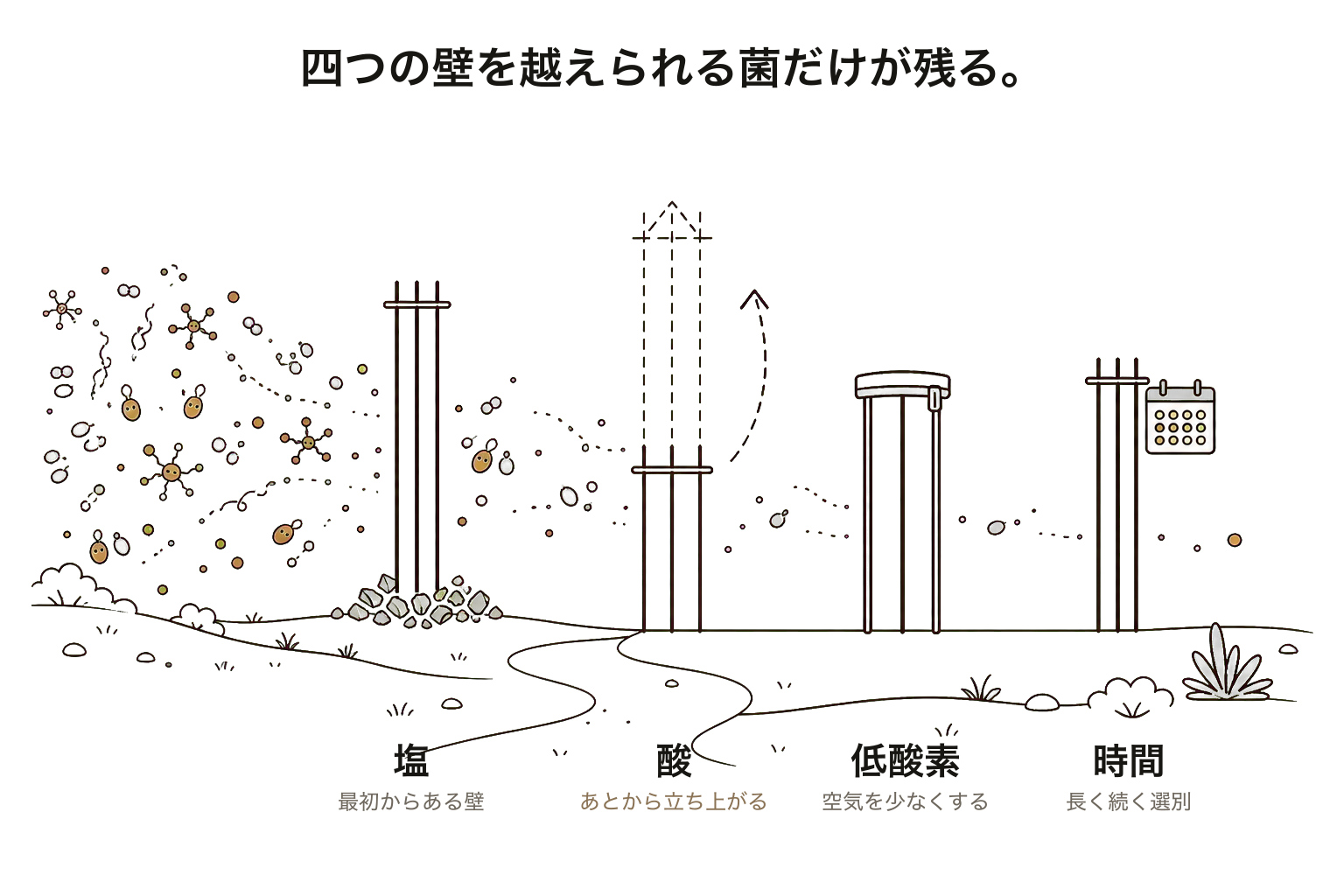
The labels in this illustration are in Japanese.
Which means that, structurally, the weeks right after preparing are the most defenseless period.
When people say it is good to prepare miso in winter, this is not about tradition or the charm of the seasons. At low temperature the activity of microbes generally is slow, and during that time the salt spreads through and the lactic acid bacteria begin producing acid. It has also been noted that in cold-season preparation the salt dissolves more slowly and the lactic acid bacteria move before the yeasts, giving a good balance of flavor and aroma. The period when the walls are thinnest is passed through while it is cold.
This does not mean you must not prepare miso in summer. But the order changes. It helps to decide on a cool place out of direct sunlight before you buy the ingredients.
The only salt figure this site gives is a weight percentage of the finished weight
Numbers like "12% salt" come up often in discussions of miso, but the same words give different numbers depending on what was taken as the denominator. Is it against the total of the ingredients as prepared, or against the weight of the finished miso? In brewing practice there are also indicators using yet another denominator. With a different denominator, the same miso becomes a different number.
Getting them mixed up shifts things by one or two points, and more than that under some conditions. The awkward part is that the direction in which people go wrong is the one that makes it look safer than it is. So the only salt figure this site gives is the weight of salt as a percentage of the weight of the finished miso. We do not display the other indicators that specialists use.
Reducing salt is not the same as making it less salty to taste
The most common change people make on their own when working at home is to cut the salt a little. Because they do not like salty food, or for their health. That feeling is easy to understand.
But what happens when you reduce salt is not that the flavor becomes milder. It is that fewer kinds of microbe can be shut out. And what appears first is usually not a pathogen but the failure of turning too sour — acid spoilage. With nothing to hold back the lactic acid bacteria, acid alone goes on advancing.
The Miyagi Prefecture Miso Craftsmen's Association ran preparation trials taking 12% salt as the baseline and stepping down through 10, 9, 8, 7 and 6%. In a sensory evaluation by 22 members, the level judged equivalent to conventional Sendai miso went down to 9% salt as prepared. Salt measured after maturation came out at almost the same values.
Following on from that result, the Miyagi Prefectural Industrial Technology Institute ran small-batch trials holding salt at 9% and varying only the water content. The conclusion was that 46% water at preparation is best. And here is the important part: at the same 9% salt, raising water to 48% brought the pH down to 4.68 by three months of maturation, with acid spoilage observed. Salt and water are not things you can move independently.
The reasoning that "it is fermented soybeans, so it is safe" does not hold either, unfortunately. A Food Safety Commission of Japan review of Clostridium botulinum gives an example from China: home-made fermented soybean foods (chou doufu) are known as the most common cause of botulism food poisoning there. What protects miso is not the phenomenon of fermentation itself but the conditions created by salt and water.
This is why this site offers only presets with fixed ratios. The only thing you choose is the amount. As long as the ratios do not move, a dangerous formulation cannot be produced in principle. The idea is to keep the situations that would need judging from arising at all. If you want to compose your own free formulation, it is safer to do it on a system that can watch several walls at once, and that is the app's department.
Tell the white things apart by shape, not color
You open the lid after three months and there is something white on the surface. A great many people throw it out at this point, but much of it does not, in fact, have to be thrown out.
Film-forming yeast spreads out flat, as a film. It covers the surface and wrinkles. The official positions of the miso makers agree: it is not harmful to the body, but it does spoil the flavor, so you may remove it.
Mold is different. It spreads in a circle from a single point and rises up in three dimensions, like down. There are white molds and there are white film-forming yeasts, so color cannot separate them. There is one axis to look at: is a film lying flat, or is fuzz standing up? Incidentally, the white grains that appear on the sides of the container are crystals of the amino acid tyrosine, and these too are harmless.
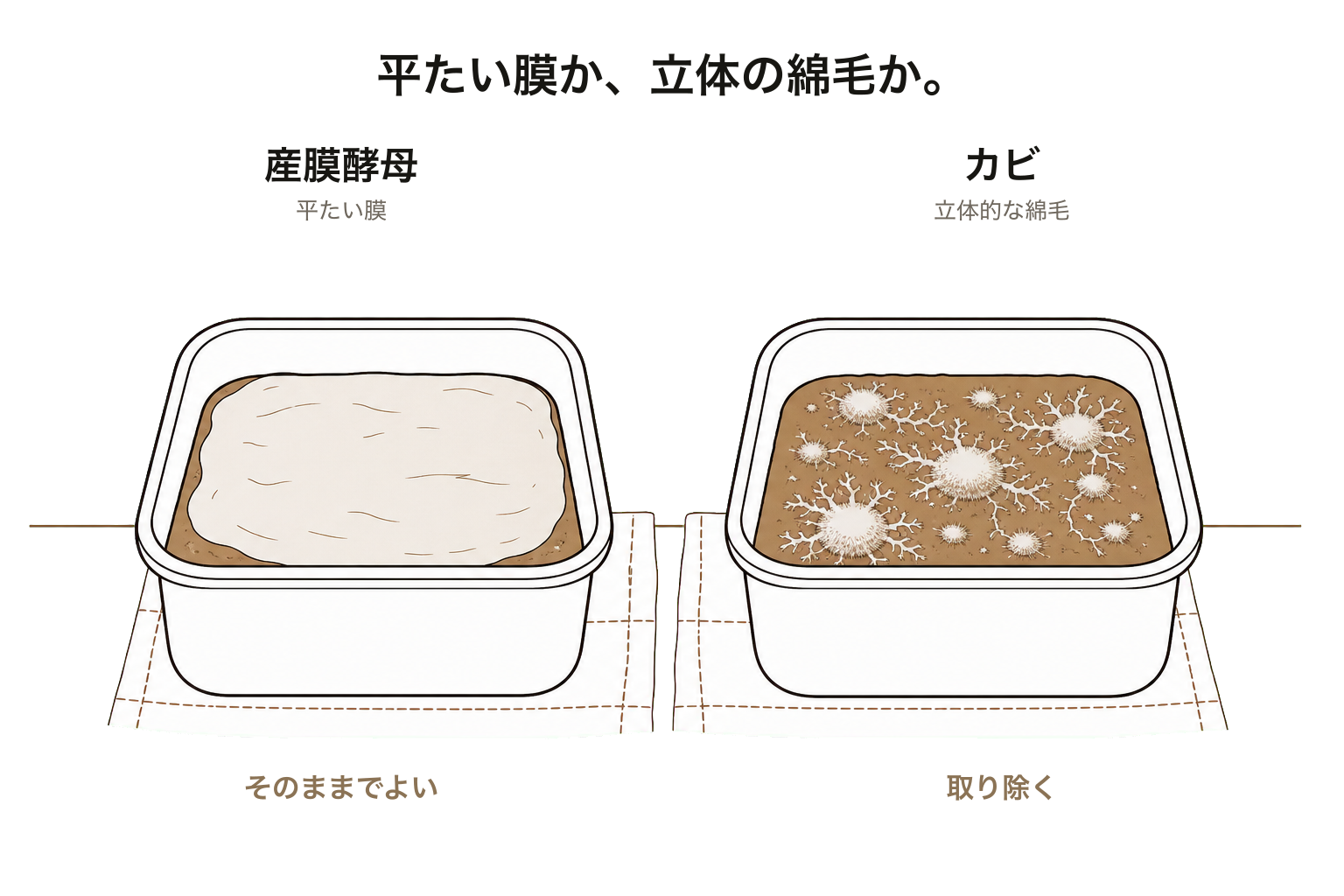
The labels in this illustration are in Japanese.
Mold cannot grow without oxygen. The inside of miso has had the air pressed out of it, and the salt is working as well. So when something white appears, it is almost always at the surface. If it is a film of film-forming yeast, dealing with it is simple: mix it in, or skim it thinly off.
The fuzzy kind cannot be treated the same way. The Ministry of Agriculture, Forestry and Fisheries advises not eating foods on which mold has grown. Even if you remove the mold you can see, "there is every possibility that mold you cannot see still remains inside or on the surface". Appearing at the surface does not mean it ends at the surface.
Let us be honest here. In home practice it is common to remove the fuzz together with a generous margin around it and repack, and the "about 5 mm" that breweries advise belongs to that same custom. But this is a rule of thumb from experience, not a verified figure. It also conflicts with the official advice. When it appears over a wide area, or when it keeps coming back after being removed, not using it is the surer course.
The signs to stop eating are few
To cut down the number of times you have to agonise, let us draw a line. If any of these five appear, do not use that miso.
- a strong smell of rot
- sliminess on the surface or inside
- pink or red spreading through it
- the container bulging
- an obviously wrong taste when put in the mouth
Conversely: a smell close to alcohol, a cheese-like smell, the color deepening, a brown liquid rising to the surface. These are all within the range of normal fermentation, so there is no need to worry.
On top of that, there is only one principle: when in doubt, do not eat it. Not eating something you cannot make up your mind about is not a failure; it is part of the craft.
That is the whole of why miso does not go bad. As you can see on rereading it, the work of raising all four walls is finished before the lid goes on.