
Fermentation Basics — 03
It tastes good because big molecules have no taste
Where do umami, sweetness, aroma and color come from?
About 9 min read
Pick up a single boiled soybean and it does not taste of miso. There is only a faint bean sweetness. Bite into rice koji and it is nothing more than slightly sweet rice.
And yet mix these two with salt and leave them for six months, and you get something so concentrated that one spoonful can season a whole bowl of soup. Nothing was added from outside. The only addition was salt. So what is it that increased?
The answer is not that anything increased, but that things got smaller.
Fermentation does not add flavor. It cuts things down to a size the tongue can receive
The taste receptors on your tongue are something like small hollows for catching molecules. Only molecules that fit into these hollows can be felt as taste. Soybean protein is an enormous molecule of several hundred amino acids joined together. It is far too large to enter the hollow, so it has no taste.
Starch is the same. It is a chain of hundreds of glucose units, and in itself it is not sweet. Rice becomes sweet if you keep chewing it, but that is because the amylase in your saliva, the enzyme that cuts starch, is breaking the chain into sugars. Only once it is cut does it become sweet.
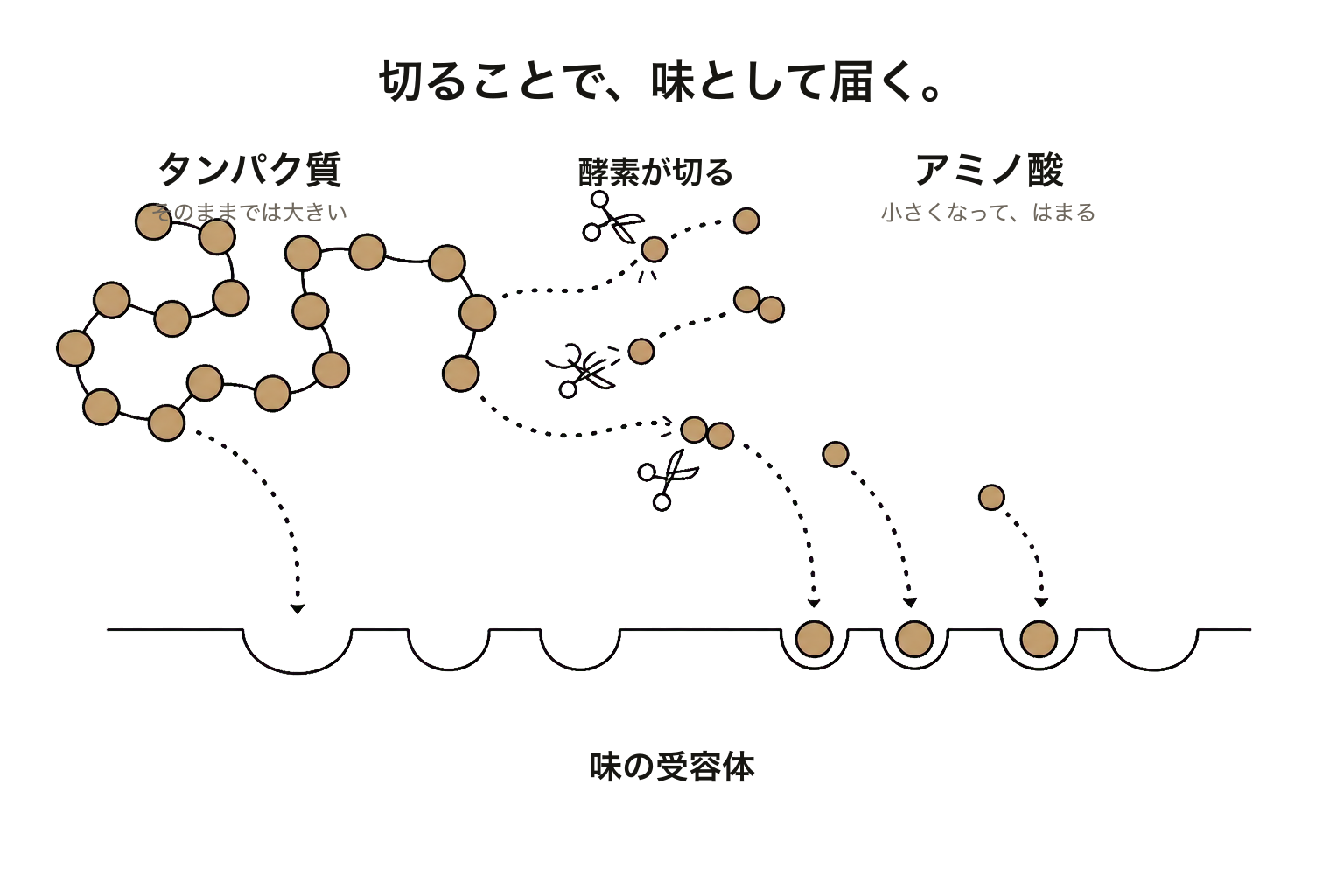
The labels in this illustration are in Japanese.
The same thing is happening inside miso. The enzymes left behind by the koji mold cut protein and starch wherever they can. Neither the umami nor the sweetness came from outside. What was already inside the soybeans and the rice has simply reached a size the tongue can receive.
Not everything is cut, though. In one measurement of a commercial rice miso, only about a quarter of the protein, by nitrogen content, had made it as far as free amino acids and short peptides. Another 40% or so stops at water-soluble peptides of medium length. The remaining not quite 40% is still large protein that does not even dissolve in water. These half-cut fragments matter later.
Umami, sweetness and bitterness all come out of the same single reaction together
So is it only umami that gets cut out? As it turns out, no.
The protease that cuts soybean protein does not pick out only the glutamic acid that carries umami. Out of the same chain come alanine and glycine, which are sweet, and leucine and valine, which are bitter, all together. Scissors choose what they cut, but they cannot choose what comes out once it is cut.
Measured for real, free amino acids in commercial miso total roughly 1,000-3,400 mg per 100 g. In many misos glutamic acid is the most abundant, but not always. In one study of eight commercial misos, Hatcho miso had more proline, while Kyoto white miso and Sendai miso had more arginine. The amount of glutamic acid itself differs nearly sevenfold between brands: 746 mg in a light-colored salty Shinshu miso, 107 mg in Kyoto white miso. The taste of miso is not decided by any one component; it rises out of a blend of dozens of amino acids.
One thing to be careful of here is not to swallow whole those tables that say "this amino acid tastes like this". Those tables describe the taste of that amino acid alone, dissolved in water at high concentration; they do not show how much it counts inside miso. Leucine is classified as bitter, but the amount in miso is about the same as the threshold at which bitterness can be detected, so it is not bitter on its own.
The sharp edge of a young miso is not down to salt alone. It is also the half-cut short fragments left behind as bitterness.
Amazake is this same reaction compressed into a few hours
The one in charge of starch is amylase. It cuts the starch in rice into sugars. This reaction is called saccharification.
That alone explains why amazake, with no sugar added at all, is sweet. Add two to three times its volume of hot water to rice koji and hold it at 55-60°C, and in about half a day sugars accumulate and it turns clearly sweet. The same thing happens inside miso, only much more slowly.
Sweet miso is sweet for the same reason. There is no sugar in it. The proportion of koji is raised so that a large amount of rice starch is brought in, and that is turned into sugar. Measured, reducing sugars in a salty rice miso are around 13%, while in Edo sweet miso they reach 21-27%.
Koji is not an ingredient reserved for miso. Shio-koji uses the protein-cutting tools as a seasoning in themselves; amazake takes out only the starch-cutting tools. Buy a bag of rice koji, mix it with hot water, and you can see today a part of what takes six months in miso.
Aroma is molecules that flew; color is molecules that absorb light
So far we have talked about taste. Aroma and color are entirely separate phenomena.
Taste is molecules dissolved in saliva that reach the tongue. Aroma is molecules that became gas and flew as far as the nose. Color is molecules absorbing particular wavelengths of light. The three arise by separate routes and are received by separate organs. So "strong flavor", "good aroma" and "deep color" do not necessarily move together.
Aroma is mainly the work of yeasts. They eat sugar and make alcohol, which joins with acids to become esters, a family of molecules with fruit-like smells. Over 200 aroma molecules have been reported from rice miso, and what we call the smell of miso is the particular mix of them.
Color, on the other hand, is what happens when the pieces that were cut out then react with each other. Amino acids and sugars join to become brown pigments. It is the same reaction as the browning of bread or a steak, called the Maillard reaction. What differs is temperature and time: browning happens in minutes in a pan above 150°C, while in miso the same thing proceeds over months at room temperature.
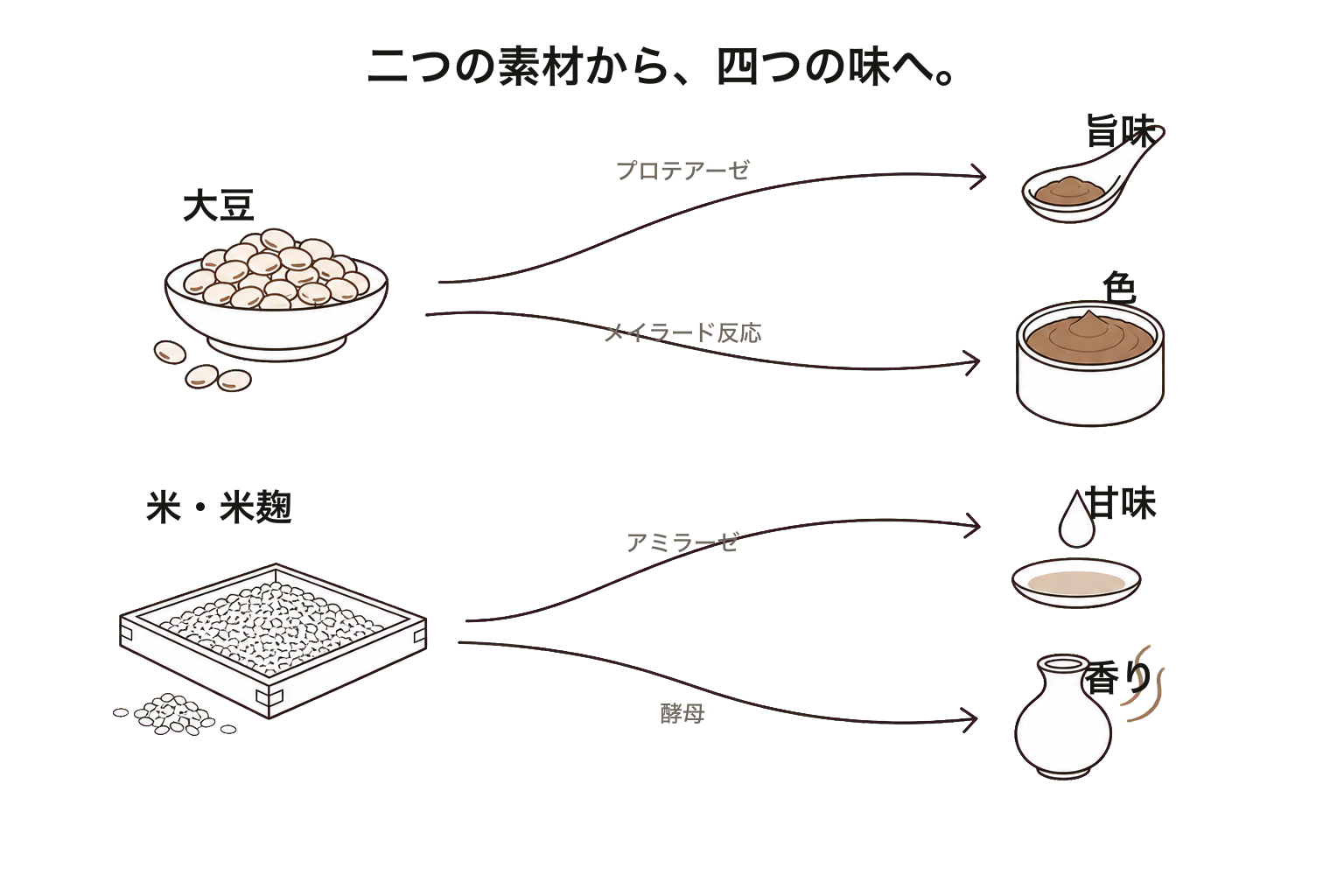
The labels in this illustration are in Japanese.
So the color of miso is a record of maturation time
The further the reaction goes, the deeper the color. So color can be read as a record of time.
But white miso is not white only because it was matured briefly. The maker removes the soybean skins, throws away the cooking water three or four times to reduce what causes color, keeps salt low at 5-7% of the finished weight, uses plenty of koji, and finishes it in a matter of days at around 50°C. The materials for browning are reduced in advance in order to keep the color light. Stopping a salty miso after one month will not give you white miso.
Within a single container you prepared yourself, though, the depth of color does honestly reflect how far things have gone. And how far things go is not decided by time alone. Here is the interesting part: what tells is temperature.
| Storage temperature | Depth of color after 3 months (start = 1) |
|---|---|
| 4°C | about 1.4x |
| 20°C | about 2.2x |
| 37°C | about 17x |
Measurements by Yamabe (1991). Values for an already matured commercial rice miso (11.6% salt) stored for three months at each temperature. Depth of color is measured as absorbance at 415 nm.
Over the same three months, color advances by an order of magnitude differently depending on where it is kept. There is in truth not much you can do after preparing the batch. But where to put it is yours to decide. That is what tells.
A deep color does not mean it turned out well. Color is a scale of how far things have gone, not a scale of quality. Some things are lost in the course of getting darker — but that is a story for the deep-dive chapters.
Open the lid, look at the color: with that alone you can now read one level deeper into what is going on inside. Although the first thing you notice on opening it is usually not the color but the white something floating on the surface. What is that? And how can you keep something like this in the kitchen for six months?