
Down the Fermentation Rabbit Hole — 01
The optimum temperature is not the best temperature
On the speed of enzymes — why does it take half a year?
About 9 min read
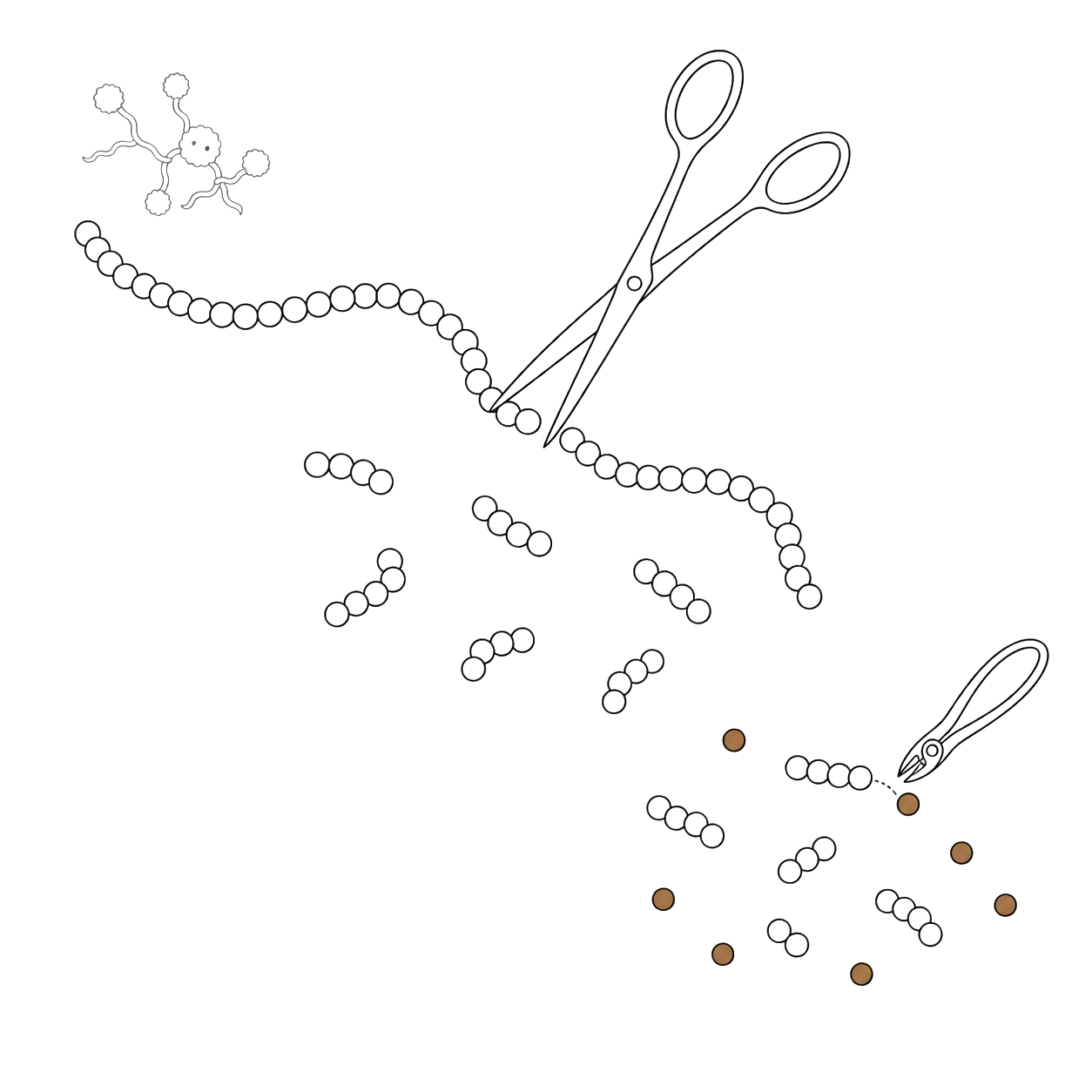
The first thing that puzzles anyone who has prepared a batch of miso is probably the time it takes. The enzymes in the koji cut soybean protein like scissors. That much is clear. So why does it take half a year?
With amazake, the same enzymes from the same koji sweeten rice overnight, at 55-60°C. Miso is left at ordinary room temperature for six months to a year. The ingredients and the enzymes are much the same, and yet the time differs by two orders of magnitude.
"It is slow because the temperature is low" does not explain that gap on its own. Speed, resistance to being destroyed, salt, and the division of labor between ways of cutting: how these four mesh together is what fixes the half year. Chapter 2 of Basics stopped at "enzymes are proteins, so if they get too hot they break and do not come back". Here we put numbers to that sentence. At what temperature, and over how long, do they break? And how much work can they do in the meantime?
The speed of an enzyme is set not by how much there is, but by two characteristics
How well an enzyme works is usually expressed with two numbers. One is Vmax: the ceiling on how much it can process when there is an endless supply of the partner it cuts (the substrate). The other is Km: the concentration of that partner at which the speed is half the maximum. The smaller Km is, the more thinly spread a partner the enzyme can still catch.
Roughly speaking, Vmax is "the number of pairs of scissors" and Km is "how easily they reach". Raising the koji-buai — using more koji relative to the soybeans — moves the Vmax side. It increases the number of scissors per unit of soybean. A sweet miso is sweet not because sugar has been added but because more koji brings in more rice starch, which is then turned into sugar.
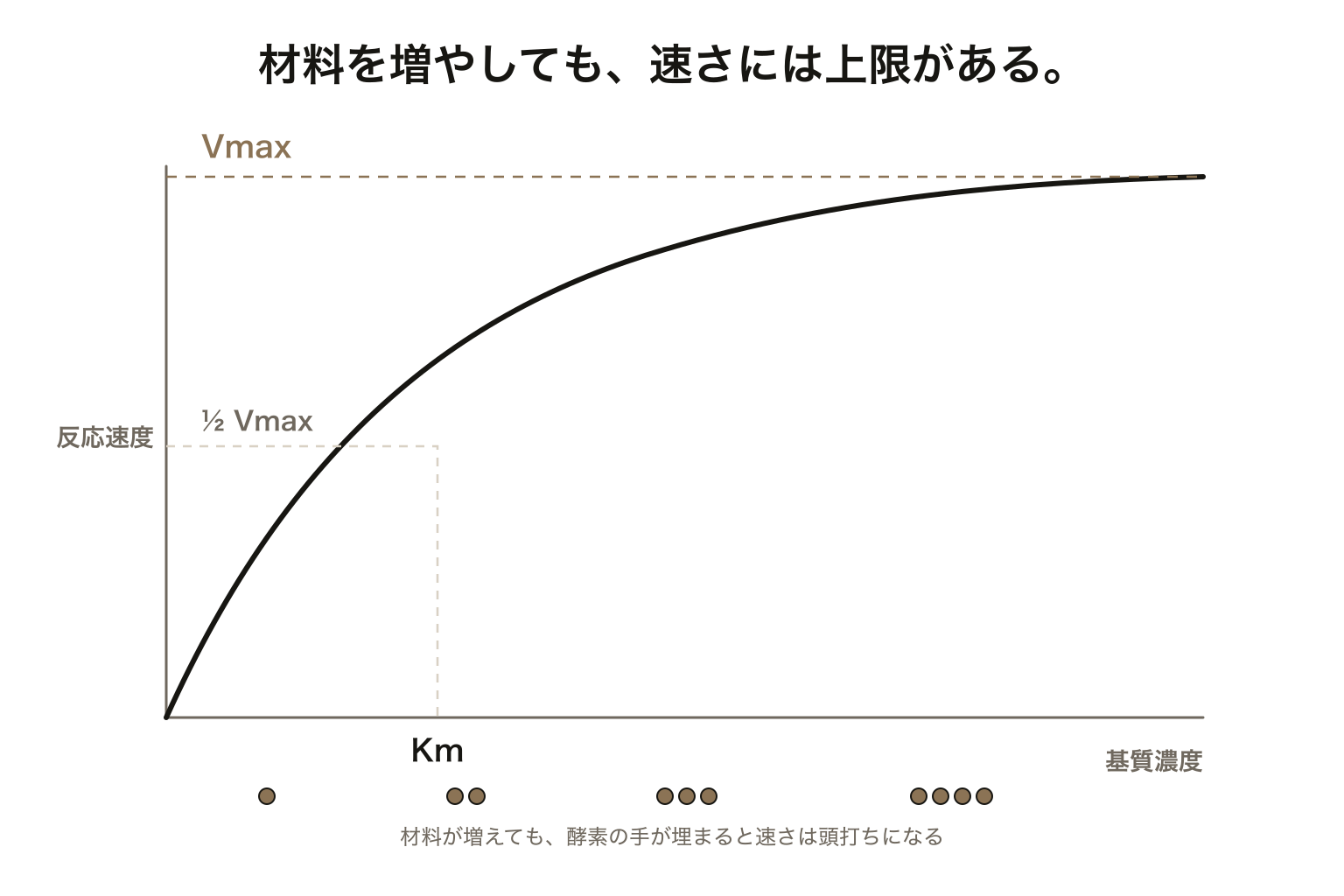
The labels in this illustration are in Japanese.
Miso just after it has been prepared is packed with soybean protein that has not been cut yet, and with rice starch. From the point of view of the enzymes, partners are in surplus, and the reaction runs near the right-hand end of the curve, close to Vmax. As the cutting proceeds, the easiest partners are used up first. The reaction slides back down the curve to the left.
So when the flavor stops changing so quickly in the later months, it is not because the enzymes are tired. In a test batch held at 13% salt (by weight of the finished miso) and 30°C for 60 days, about 95% of the proteases remained, 97% of the glucoamylase, and even the weakest, alpha-amylase, kept 84%. The enzymes are almost untouched. They have simply slowed down.
The optimum temperature is the temperature of greatest speed, not the best temperature
Raise the temperature and the reaction goes faster. As a rule of thumb, a rise of 10 degrees roughly doubles the speed. This sensitivity to temperature is called Q10, and behind it lies the Arrhenius equation. The same thing shows up inside miso. Held for three months, the color of a rice miso deepened by about 1.4 times at 4°C, about 2.2 times at 20°C, and about 17 times at 37°C.
But enzymes carry a second clock as well: the clock of coming apart. The alpha-amylase of Aspergillus oryzae is said to have an optimum reaction temperature of 55-60°C, yet in fact it begins to unfold little by little well before that.
One way of measuring that unfolding is the D value — the time taken for activity to fall to a tenth. For alpha-amylase embedded in a food, that is 4-5 hours at 55°C, about 1 hour at 60°C, around 10 minutes at 65°C and just under 5 minutes at 70°C. Rather than "it is inactivated at 60°C", it is closer to the truth to think that "a minute at 60°C" and "an hour at 60°C" are completely different things.
There is an asymmetry here. The speed of the reaction goes back and forth with temperature. Cool it and it slows; warm it again and it speeds up. Inactivation, however, does not come back. An enzyme that has unfolded will not refold itself when you cool it. The asymmetry in the instructions — "cooling too much only costs you a wait, but overheating cannot be taken back" — comes from this difference.
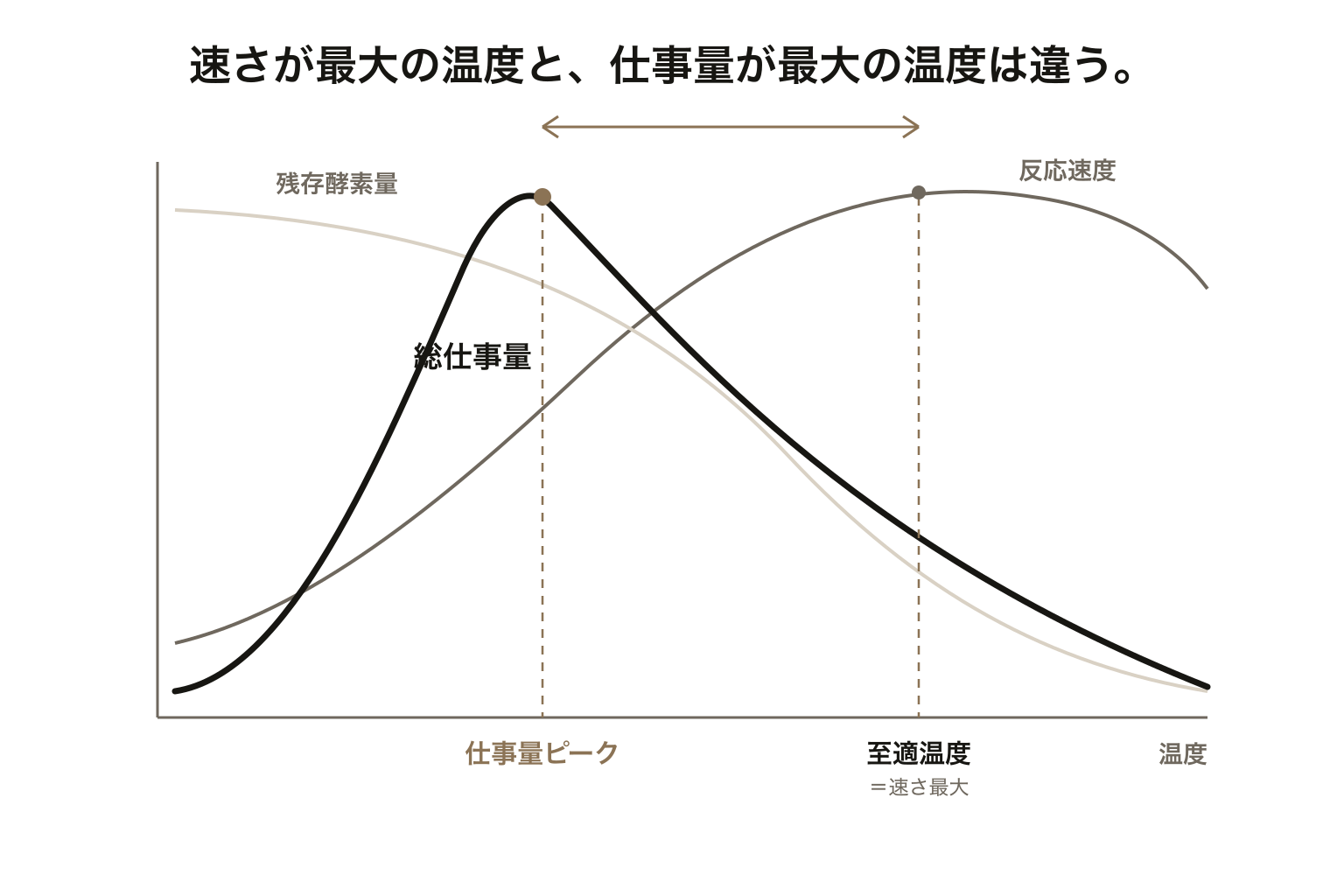
The labels in this illustration are in Japanese.
If you are going to hold something at a given temperature for a fixed length of time, the total work you can get is set by "speed multiplied by the amount of enzyme not yet destroyed". The peak of that product sits on the cooler side of the optimum temperature. There are measurements to match. In a test digesting shio-koji at 13% salt for 96 hours, alpha-amylase activity was almost fully retained at 45°C, roughly halved at 50°C, and had barely any left at 55°C. This is the interesting part: 55°C, which is close to the optimum reaction temperature, gets less work done when you look at four days.
That is where amazake and miso part company. Amazake is a sprint in which amylase alone runs flat out for a dozen or so hours and then it is over, so you can go for the optimum reaction temperature. Miso is a long-distance run in which every enzyme must keep going for months, so resistance to being destroyed matters more than instantaneous speed. Leaving it at room temperature is not a passive choice. It is a design that goes after the total.
Salt puts a brake on the enzymes too
Chapter 4 of Basics explained salt as a wall that shuts out the microbes you do not want. But salt also acts on the enzymes on your own side. And it acts differently on each one — in opposite directions, even.
In a test holding a crude enzyme extract for 40 days, raising the salt from 0% to 20% pushed the surviving proportion of protease measured at pH 3.0 from 57.7% up to 84.4%, and of the one measured at pH 6.0 from 50.6% up to 90.9%. Salt is protecting the acidic proteases. Meanwhile the neutral protease fell from 77.6% to 49.3%, and alpha-amylase from 96.7% to 78.9%.
But "hard to destroy" and "works quickly" are two different things. Glutamic acid, the source of umami, is produced when an enzyme called glutaminase converts glutamine that has already been released. As it happens, that glutaminase is weak against salt: the long-known enzyme from Aspergillus oryzae drops to a tenth or less of its activity at the salt concentrations found in miso and soy sauce. Salt-tolerant versions that keep 54% of their salt-free activity even at 2.9 mol/L of salt are being searched for precisely because of this. In an environment full of ions, the attraction between an enzyme and its partner weakens. Salt buys resistance to destruction and sells speed.
So the slowness of miso is paid as the cost of selection by salt. Cut the salt and the enzymes may work faster, but the road also opens for the microbes that were being shut out. "Erring on the side of safety" and "taking time" are two faces of the same operation, and you cannot have both at once. Waiting half a year is what it looks like when that dial is turned toward safety.
There are two ways of cutting, and bitterness comes from the gap between them
We say "protease" as if it were one thing, but what is inside is a mixture. Aspergillus oryzae has seven proteinases — three acidic, two neutral, one alkaline and one semi-alkaline — plus more than a dozen peptidases that trim the ends. Broadly, they work in two ways: endo-type, which cut inside the chain, and exo-type, which take units off the end.
The endo-type cut somewhere along a long chain. Each cut makes two fragments, so a great many peptides appear in a short time. The exo-type remove amino acids one at a time from the end. These are the ones that make the free amino acids that become umami, but each pass moves things along by only one unit.
In sequence, the endo-type act first and the exo-type follow later. And inside miso there are circumstances that work against the exo-type. The pH of miso falls slowly through maturation, from 5.7-6.0 at the time of preparing the batch. In small-batch tests of Sendai miso it went from 5.74 to 5.30 over 60 days; measurements of products on the market fall in the range 4.5-5.2.
Leucine aminopeptidase, the representative exo-type enzyme, has an optimum pH of 8.0. From the moment the batch is prepared, miso is already far outside that environment. Indeed, in the 60-day test just mentioned, where most enzymes retained around 90%, the only ones clearly reduced were the three leucine aminopeptidases (33-57%).
The bitterness that rises in mid-maturation and fades later is explained as arising from this gap in timing. Short peptides containing amino acids that do not sit well with water (hydrophobic ones) taste bitter; the endo-type mass-produce them while the exo-type that would round off the edges arrive late. In miso, about 60% of the nitrogen in soybean protein ends up in a water-soluble form, and about 20% is broken down as far as amino acids. Both were reported to level off around 35 days after the batch was prepared. The rest stays as peptides, carrying both body and bitterness.
To be honest, though, we could not find, within the sources we consulted, measurements that identify the bitter peptides of miso themselves and quantify their amounts and thresholds. What we can offer is an account of the mechanism, and no further.
Nor does the "enzyme activity titer" printed when you choose a koji tell you about this division of labor. "So many units of acid protease" is the strength of protein breakdown measured at pH 3.0; it does not mean that an enzyme whose optimum pH is 3 is present in that amount. What is more, the pH used for measurement varies with what you want to follow. The standard method of miso analysis measures protease at three points — acidic 3.0, neutral 6.0 and alkaline 7.5 — while research following peptidases uses 5.5, 7.0 and 8.0. Numbers measured under different conditions are best not lined up side by side.
Cutting and eating are going on at the same time
One more thing shapes the passage of time. Inside miso, the reaction that cuts and the reaction that eats run simultaneously.
While the enzymes of the koji turn rice starch into sugar, salt-tolerant yeasts eat that sugar and turn it into alcohol and aroma. Fermentation does not begin once saccharification has finished; both proceed in parallel. This arrangement is called multiple parallel fermentation. What sets it apart from a system that runs in sequence is that intermediates do not pile up. Sugar is consumed as fast as it is made.
There are products that do pile up, though. The amino acids and peptides released by cutting get in the way of the enzymes trying to cut next. This is feedback inhibition. Substrate falls, product rises, and pH drops. All three pull in the same direction, so the reaction does not proceed at a constant rate but grows duller toward the end. Even when breakdown appears to stop during a long maturation, it is not because the enzymes have been destroyed.
And what happens in the second half is different in kind from the first. In the first half, cutting was the leading role. In the second, the reaction in which the released amino acids and sugars combine — the Maillard reaction — comes to the front. That reaction uses amino acids and sugar to make color and a toasted quality.
How much umami is lost on balance, though, is hard to pin down with numbers. A survey measuring free glutamic acid in eight commercial misos found 746 mg per 100 g in the pale Shinshu miso, 214 mg in a red miso and 182 mg in Sendai miso. Read on its own, that makes the darker ones look poorer. Yet in the same survey the darkest of all, Hatcho miso, came in at 249 mg — more than the red miso — while the palest, Saikyo white miso, was lowest of the eight at 107 mg. Since these are products with different koji-buai, different ingredients and different maturation periods laid side by side, depth of color does not appear to settle the matter by itself.
Another report says the opposite: that the longer the maturation and the darker the color of a salty miso, the more free amino acids it holds. Inside the same container, the reaction that makes amino acids and the reaction that consumes them run at the same time. Saying that umami changes its form into toastiness and color may point in the right direction, but there is not yet enough evidence to speak of the balance of gains and losses.
Half a year is not a uniform half year. A few months of rapid cutting, and a few months in which what has been cut mingles together. Inside the same container, the reactions that are running have themselves changed places.