
Down the Fermentation Rabbit Hole — 02
Making koji means stockpiling enzymes
Seikiku — the step that matters most, and that Basics walked straight past
About 9 min read
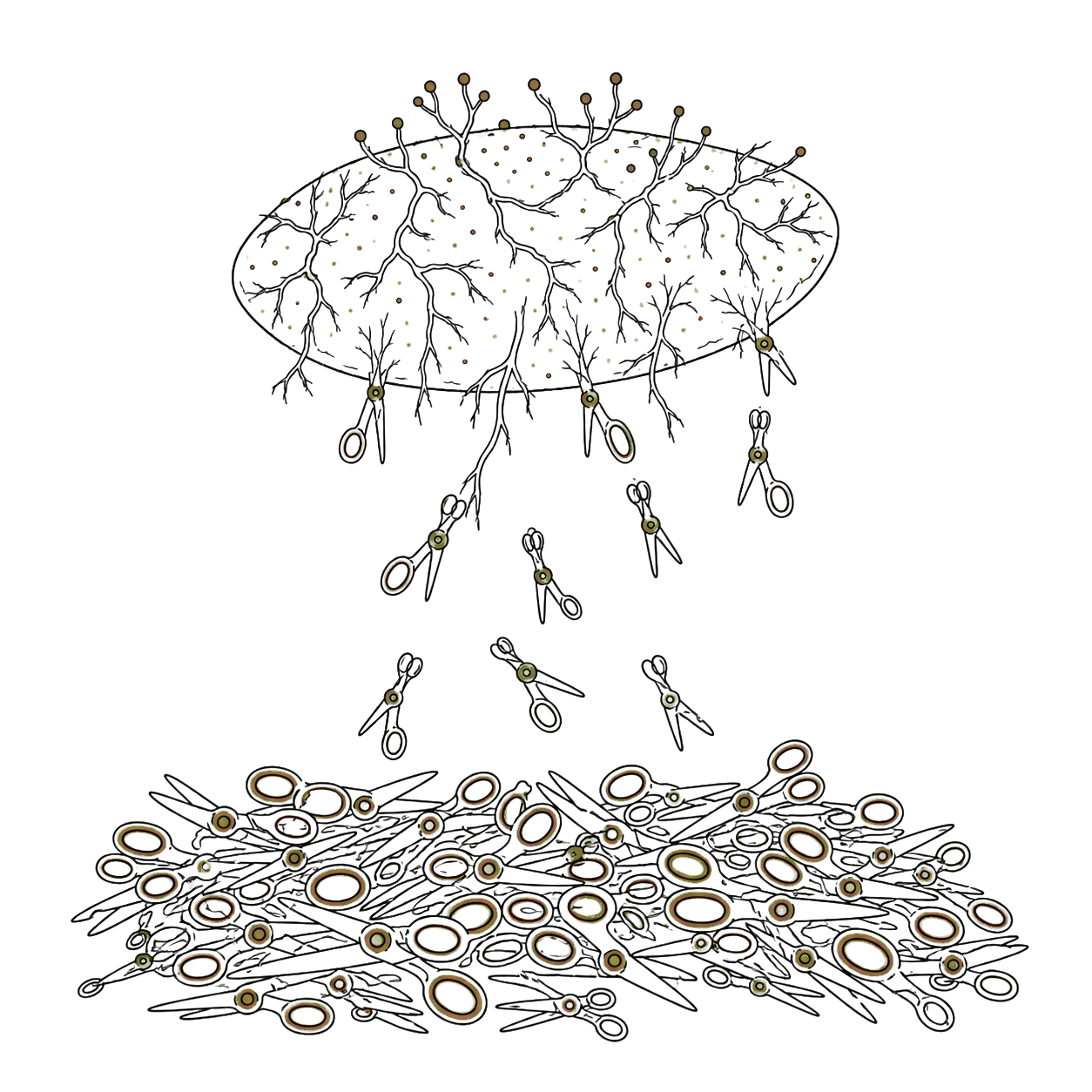
A bag of rice koji usually carries nothing but the ingredients and a best-before date. "Rice, koji mold." A 500 g bag at four hundred yen and one at twelve hundred yen sit on the same shelf, and nowhere does it say where the difference lies.
Chapter 2 of Basics called koji "an ingredient loaded with enzymes". But there, koji was treated as something you buy. Not a line was spent on how it had been made.
Which also means that the step with the greatest effect was walked straight past. The amount and the proportions of the enzymes that go into the batch on the day you prepare it are, in fact, already fixed by the time the koji is finished.
Tane-koji is the oldest commercial microbe in the world
Spores of the koji mold really are in the air. That does not mean, however, that leaving out some steamed rice will give you koji.
A research group at Nagaoka College left petri dishes open outdoors for about 20 hours and isolated 13 strains of koji mold (Aspergillus oryzae) from what fell in. But the medium used to grow them was carefully chosen: gelatinized rice mixed with wood ash, with a potassium phosphate solution (pH 8.5) spread over the whole surface as well. On a medium of wood ash alone this did not work. The paper puts that down to the ash not reaching every part of the rice, so that molds other than Aspergillus grew faster on the grains it had missed. Being in the air and appearing if you leave things alone are two different matters.
So where do those spores come from? From tane-koji makers, known as moyashi-ya. In the earliest days of koji making, people waited for microbes to settle on grain of their own accord. Next came tomodane, in which part of a batch that had turned out well was carried over as the seed for the next. In the Muromachi period a technique appeared for preserving the seed using wood ash, and the manufacture of tane-koji began. The ash is not a lucky charm; it is a selective medium, pushing the pH to the alkaline side to hold back unwanted microbes. Over six hundred years, the movement has been toward reducing chance.
Today's tane-koji can be described in numbers. Steamed grain is inoculated with koji mold and cultured for about six days until it bears 0.4-2 billion conidia per gram, then dried below 40°C to a water content under 10%. The number of tane-koji makers in Japan has now consolidated to about six firms.
People have gone on selecting a lineage that cannot make the toxin
Chapter 2 of Basics handed you only the conclusion: that the koji mold is extremely close to a toxin-producing relative and yet cannot produce that toxin. Here we open up the evidence.
The relative is called Aspergillus flavus, a mold producing the powerful mold toxin aflatoxin, and matching the koji mold at about 99.5% in its coding regions. As close as wolves and dogs, if that helps. Taxonomically the koji mold sits on a branch inside A. flavus, and whether they should be kept apart as separate species is not yet settled.
In A. flavus, more than 25 genes for the enzymes that make aflatoxin are lined up together within a stretch of about 70 kilobase pairs. Think of it as a single production line. The National Research Institute of Brewing examined what has become of that line in 196 preserved strains of Japanese yellow koji mold.
The result split neatly in two. In 89 strains, 45.4% of the total, most of the line has been lost. What is more, it was lost through a break in the chromosome, and the broken end carries telomere repeat sequences. Telomeres mark the end of a chromosome, so the lost region is never coming back.
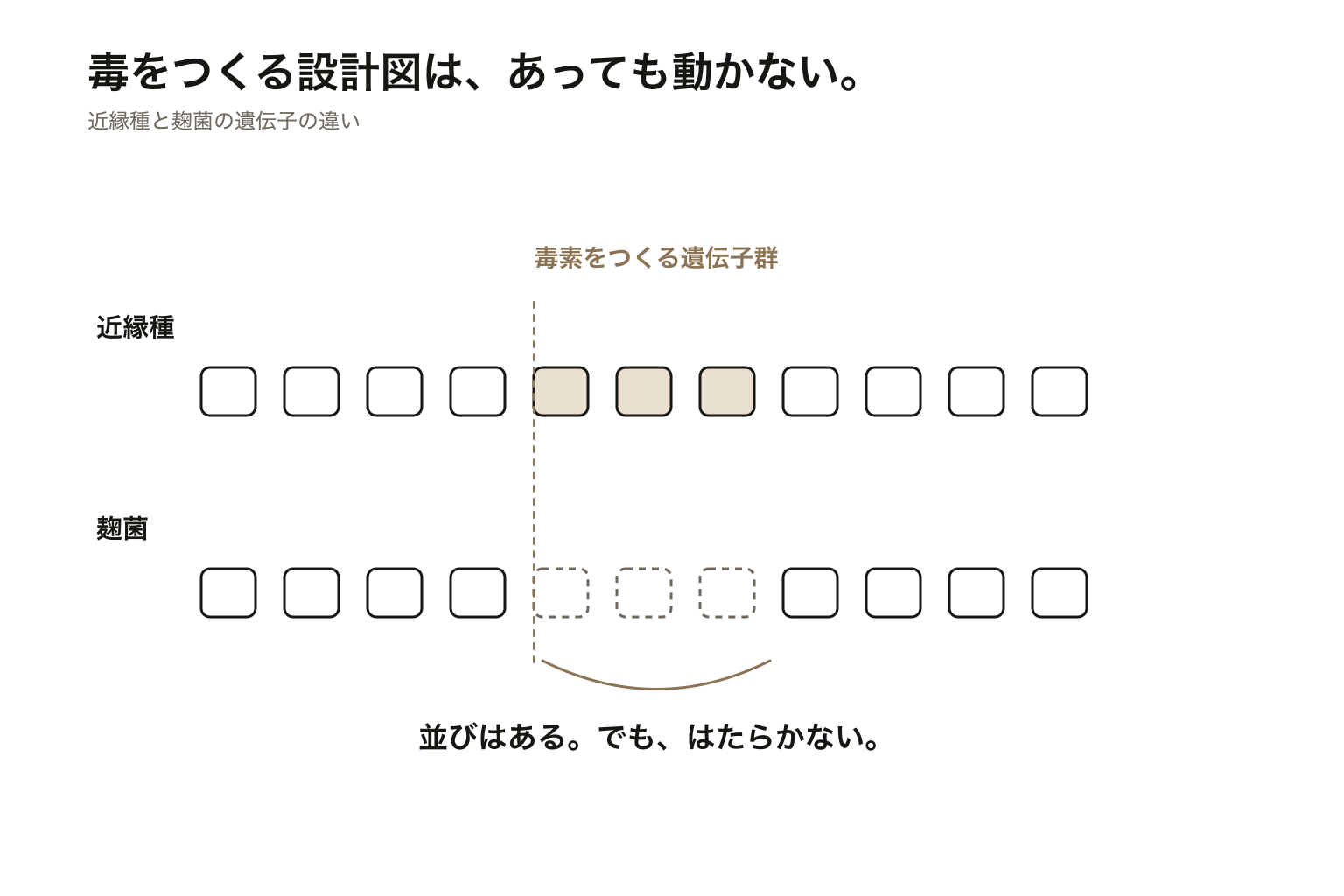
The labels in this illustration are in Japanese.
There is also a group of 105 strains (53.4%) that still hold all seven genes. They do not produce aflatoxin either. The reason is that aflR, the controller of the production line, barely functions, and even if it did, the protein AFLJ that should work alongside it has lost its function.
So the basis of safety is not "the toxin genes are absent" but "the toxin production line is broken in several places, independently". And the way it is broken varies from strain to strain. This is the interesting part: that very unevenness is what tells us nature did not design it this way.
Saying flatly that "koji mold produces no mold toxin whatsoever" does go a little too far, though. In a report on 19 Aspergillus strains isolated from Korean foods, seven identified as A. oryzae produced a mold toxin called cyclopiazonic acid. Safety rests not on the name of the species but on the strain and the process. That is exactly where the tane-koji makers earn their place.
Haze is what it looks like when the hyphae have gone in deep
Chapter 2 of Basics described the white fuzz covering a rice grain only as "a gathering of hyphae". In fact, the way that whiteness appears is a reflection of what is happening inside the grain. In brewing this is called haze.
There are two broad types. Tsuki-haze is where the hyphae on the surface are modest but have burrowed deep inside. Sou-haze is where hyphae have spread throughout, on the surface and within. Grains that look equally white will show different cross-sections if you break them open.
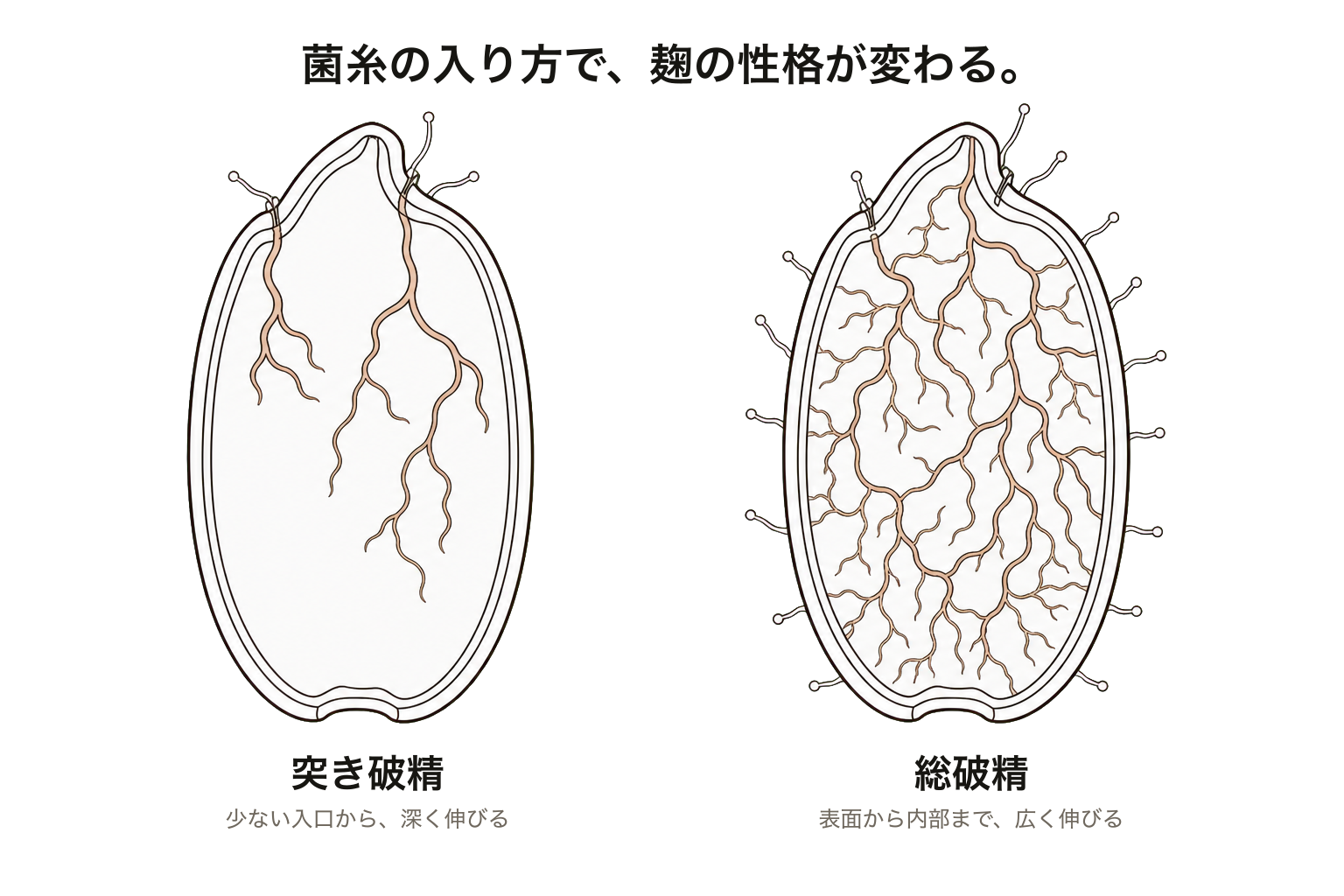
The labels in this illustration are in Japanese.
Which is better depends on the use. Sake often calls for the tsuki-haze type, while miso and soy sauce are said to want something closer to sou-haze. Miso aims to break its ingredients down without waste, so hyphae reaching into every corner suit it.
The manner of burrowing matters in itself. glaB, the gene for the saccharifying enzyme glucoamylase in the koji mold, is expressed only in solid-state culture on steamed rice; in liquid culture, production is only about a twentieth. Swimming the mold in a tank does not give you the same koji.
Enzyme titer and koji-buai — the same weight, a different quantity of tools inside
The number that measures how many pairs of scissors a koji carries is its enzyme activity titer. The unit is U (units) per gram of koji.
One thing is worth watching here. "Acid protease" is not the name of an enzyme; it is the name of a measurement. The standard method of miso analysis measures the power to break down protein at three points, pH 3.0, 6.0 and 7.5, and calls them acid, neutral and alkaline protease. It does not mean that a separate enzyme whose optimum pH is 3 is present.
How large is the spread? The Miyagi Prefectural Industrial Technology Center measured the finished koji of two companies in the prefecture that make the same Sendai miso. Company A came in at acid 95.6, neutral 64.7 and alkaline 5.5 (U/g of koji); company B at 65.6, 46.3 and 2.7. Between two companies in the same region making the same miso, there was a gap of 1.4-1.5 times in the acid and neutral figures and twofold in the alkaline one.
The main thing that creates the gap is the temperature of the koji during seikiku. Held cooler, the protein-breaking side comes out stronger; held warmer, the starch-breaking side does. There is a ceiling set by the body of the mold, though: above 40°C, production of protein-breaking enzymes stops increasing. Growth is best at 32-36°C, and above 44°C it cannot grow at all.
| Miso being made | Where the koji temperature is held | Aim |
|---|---|---|
| Rice miso (standard) | Controlled around a standard of 35°C | Adjust the later stage of culture, where enzymes appear, to the activity required |
| For sweet miso | 2-5°C above standard | Increase amylase production |
| For barley miso | 2-5°C below standard | Lowered to account for the different raw material |
A table from Kashiwagi (2020). Take it not as a procedure for making koji at home but as a way of reading how a koji is designed.
There is one more thing people can decide (that is, another variable): the koji-buai. It is defined as "weight of rice (for koji) divided by weight of dry soybeans, times 10". The unit is not the percent but the bu: at 10 bu the soybeans and rice weigh the same, at 20 bu the rice is twice the soybeans. A salty rice miso is generally 5-10 bu, commonly around 6. Sweet miso goes past 15 bu, with around 20 being usual. The koji-buai of a sweet miso is high because it makes the saccharifying side relatively stronger.
So even with the same "500 g of rice koji", the number and the balance of tools going in differ every time. That is why the same recipe can give a different result. Nothing has gone wrong; there was simply one variable you were not holding.
What separates fresh koji from dried koji is not whether the mold is alive
The question most often asked in the shop can be answered with what we have gathered so far.
First, whether the koji mold is alive inside the miso after the batch is prepared has almost no bearing on the result. By the time the koji is finished, its water activity has fallen to 0.90, and then around 12% salt is added. In that environment the koji mold can no longer multiply. What works for you over the six months are the enzymes released during seikiku.
Enzymes are not living things but molecular tools made of protein. Dry them, and as long as the shape is preserved they work perfectly well. Tane-koji is dried at the fairly low temperature of 40°C or less in order not to harm the living spores. Enzymes are a slightly different matter, but they share the same weakness to heat: raise the temperature too far and the shape collapses, and they no longer work as scissors.
In practice, what makes the most difference when preparing a batch is the water content. Dried koji holds little water, so use a little more seed water; fresh koji holds more, so use a little less. Swap only the koji in the same recipe and the firmness changes — and so does the denominator by which the salt is divided.
To be honest, within the sources we consulted we could not find published data comparing, under the same conditions, how much enzyme remains in fresh and dried koji. Neither "fresh has more enzymes" nor "there is no difference" can be stated in numbers at present.
A bag of koji almost never states its enzyme titer. What you can read is the intended use, the date of manufacture, and whether it is fresh or dried. Even so, knowing what those three mean changes how you choose.
Yellow, white, black — choosing a strain is designing a flavor
Finally, a word on the fact that "koji mold" is not one single organism.
On 12 October 2006, the Brewing Society of Japan certified the koji mold as the "national fungus". This was a declaration by a learned society rather than a state institution, and it covers three groups: the yellow koji mold Aspergillus oryzae; A. sojae, used for soy sauce, together with white mutant strains of the yellow koji mold; and the black koji mold A. luchuensis with the white koji mold A. luchuensis mut. kawachii.
The black and white koji molds produce citric acid. That tips the mash to the acidic side, making it harder for unwanted microbes to get in even in warm regions. That the two are used for shochu and awamori can be explained by this property combined with the climate.
Even within the yellow koji mold, strains differ inside. Strains for miso show average amylase activity about 8% higher and protease activity about 20% higher than those for sake. A. sojae, used for soy sauce, is on the low side for producing amylase. A report comparing a white mutant derived from A. sojae with a commercial tane-koji for miso found alpha-amylase activity about a twentieth as high. That, however, is a comparison between particular strains, so the ratio cannot be applied to the species as a property of its own.
Designing a flavor, then, does not begin when you decide the proportions. Basics said that "the work a person does is finished before the lid goes on"; in fact it reaches back one stage further, to which koji you choose.
The enzymes that koji has stockpiled will now work inside salt. Of salt we have so far said only that it takes away the water the microbes could use, first. What does taking away mean, and how much has to be taken for it to be enough? From here on, the story turns that "taking away" into a quantity.